


- Free Article: No
- Contents Category: Film
- Custom Article Title: November
- Review Article: Yes
- Article Title: November
- Article Subtitle: Remembering the 2015 Paris attacks
- Online Only: No
- Custom Highlight Text: There have been nuanced treatments of the November 2015 Paris attacks, including the docuseries November 3: Attack on Paris (2018), the excellent En thérapie (2021), which deals with post-traumatic stress in a counterterrorist agent who is also a Muslim, and Mikhaël Hers’ sublime human drama Amanda (2018) which looks at the aftermath of terrorism in an understated fashion.
- Article Hero Image (920px wide):
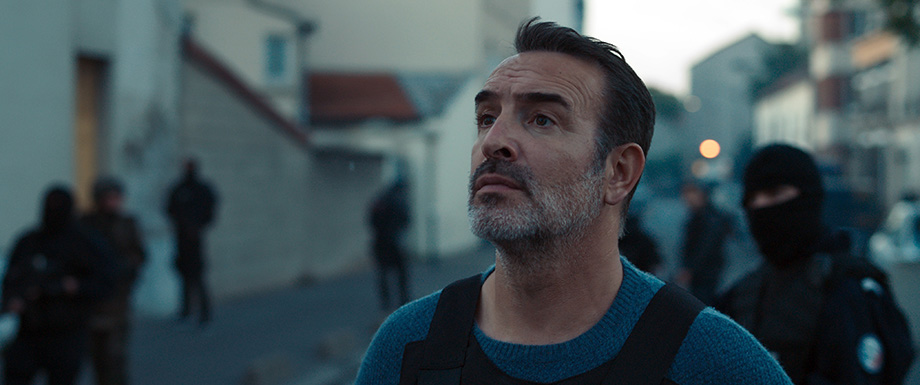
- Article Hero Image Caption: Jean Dujardin as Fred in November (courtesy of Palace Films).
- Alt Tag (Article Hero Image): Jean Dujardin as Fred in November (courtesy of Palace Films).
- Production Company: Palace Films
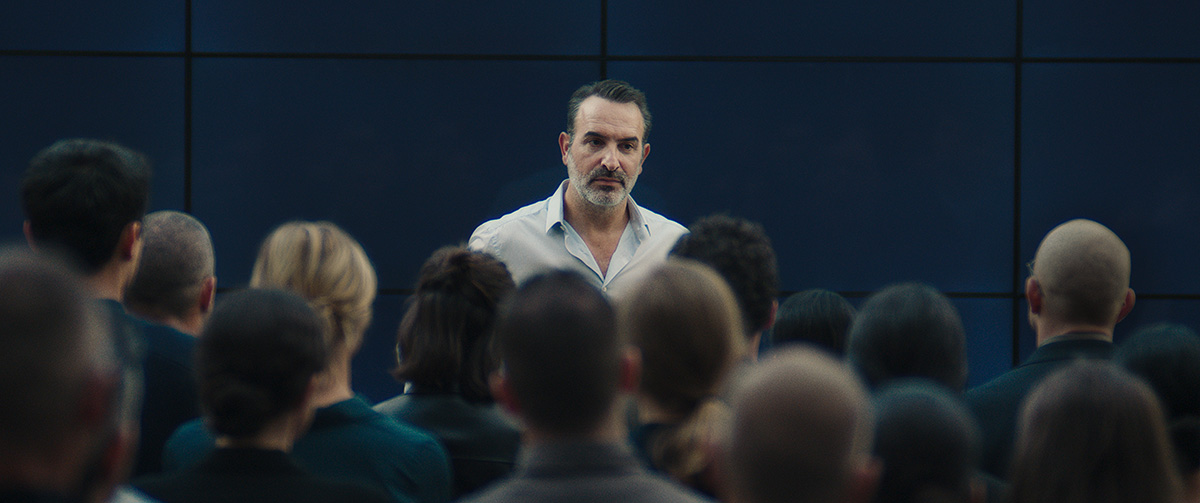 Jean Dujardin as Fred in November (courtesy of Palace Films).
November is ostensibly a thriller, and it is thrilling, grabbing you by the throat from the very outset, relaxing its grip only occasionally to indulge in pockets of melodrama. It is not, however, a thriller generically speaking; it belongs to the genre of policier or police procedural film, of which there is a rich history in French cinema. False leads and dead ends heighten the suspense, and the raid scenes, in which rows of black-clad tactical response units creep silently along walls and break down doors, are tautly shot. These sequences are reminiscent of the French police raids from Gillo Pontecorvo’s landmark film Battle of Algiers (1966). Where Pontecorvo famously described his film as an instruction manual for how terrorism can be used to achieve political ends, November often resembles a training video for anti-terror squad recruits, treading a fine line between objectivity and propaganda. Jimenez avoids any direct representation of the attacks, and there is no inclusion of actual footage. Instead, the film uses more subtle means: the scene of telephones in the empty command centre ringing one by one conveys the magnitude of the situation on the night of the attacks effectively. The use of footage shot on mobile phones and police drones as well as CCTV shows not only the extent of police surveillance capabilities but also adds to the overall docudrama effect.
November tries not to muddy the waters of police procedure with politics, but there is nonetheless a not-so-subtle validation of French republicanism, which borders on patriotism. There is little nuancing of the French situation, which might have hinted at something greater than a goodies-versus-baddies scenario. The film is at pains to point out that France is an inclusive and harmonious country and it does this primarily by showing a multi-ethnic and multi-faith team (both men and women) working together to defeat the evil Islamic State. There is no reference to the fact that the attacks were in part a response to the French involvement in air strikes against Syria, and there is only a passing nod to France’s colonialist past in a brief sequence shot in Morocco. The film ultimately descends into a parody of itself, with an ending that recalls Hollywood films like Independence Day, a shallow celebration of state power and military muscle with a central hero giving a platitudinous speech to the glory of the French nation.
A rather undemanding script solicits solid if one-dimensional performances. Dujardin’s Fred has a job to do and gets it done, after a fashion, in a kind of ends-justifies-the-means approach which does not sit well with his young protégée Inès, more sympathetically portrayed by Anaïs Demoustier. Lyna Khoudri is excellent as Sabia, a young Muslim woman caught between her religion and her duty to her country. Her relationship with Inès forms the emotional centre of the film, which otherwise proceeds in a rather tactical fashion. Indeed, the most interesting thing the film does is to tentatively, almost in spite of itself, present these two women as the answer to the ‘violence begets violence’ that is the clash of two patriarchal systems. Their bond transcends cultural and religious differences to reach a kind of humanity which is lacking in the systems each represents. The wonderful Sandrine Kiberlain is somewhat underutilised, reduced to facial expressions showing the tragedy and horror of the events and the occasional operational suggestion shouted down by her male colleagues. Dardenne brothers regular Jérémie Renier is Marco, the head of the command centre who conveys with a tight-jawed grimace the unpleasantness of the whole business.
As both a thriller and a procedural film, November works, though it does raise questions about the extent to which it is appropriate to subject such a socially complex traumatic event to the thriller format. Perhaps there was a missed opportunity here, for critique, for reflection. But this is not Jimenez’s style, as his previous films show, with their preference for police procedure, male virility, grand stylistic effects, choreographed action sequences, and pomp and pageantry. Perhaps November works best in a complementary sense, when watched in conjunction with the film and television mentioned above. It has its place among these more reflective works, which can provide the film with the broader social context and emotional core it lacks.
November (Palace Films) is on national release from 11 May.