


- Free Article: No
- Contents Category: Theatre
- Custom Article Title: Happy Days
- Review Article: Yes
- Article Title: Happy Days
- Article Subtitle: Judith Lucy tackles Beckett’s Winnie
- Online Only: No
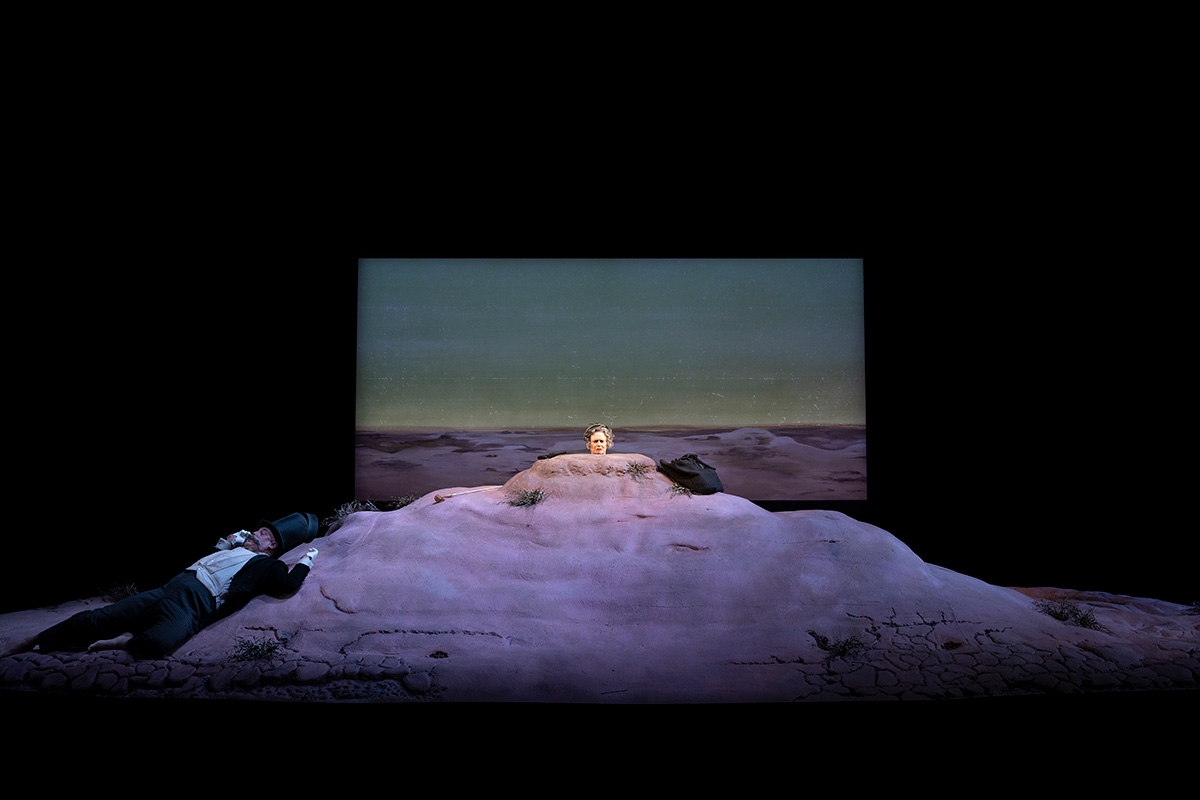
- Custom Highlight Text: A middle-aged woman, Winnie, is buried to her waist in the middle of a mound, amidst a dry, monotonous expanse while the scorching sun beats down. It is one of Beckett’s indelible theatrical images. She finds solace in her handbag, where she uncovers a domestic detritus that affords her the rituals and distractions that help her endure: comb, toothbrush, mirror, hat, music box.
- Article Hero Image (920px wide):
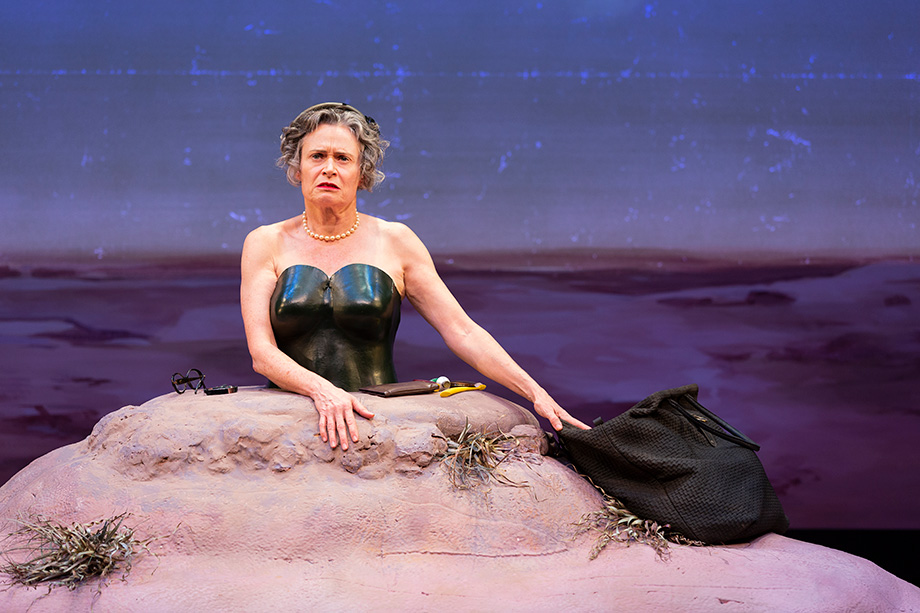
- Article Hero Image Caption: Judith Lucy in Happy Days (photograph by Pia Johnson).
- Alt Tag (Article Hero Image): Judith Lucy in Happy Days (photograph by Pia Johnson).
- Production Company: Melbourne Theatre Company
Beckett worked on the play in 1961, in Folkestone, Kent, where he and his long-term partner, Suzanne Déchevaux-Dumesnil, had travelled from Paris to be secretly married for testamentary reasons, which may account for its marital theme, yet one suspects the setting is also inspired by the couple’s regular holidays in Tunisia and Morocco. The image of the woman buried to her waist in sand may have been influenced by the closing shot of Louis Buñuel’s short surrealist film, Un Chien Andalou (1929), though, as ever in Beckett, the vaudeville entertainment and popular culture feel as present as the European avant-garde. If En Attendant Godot (1953) deploys the comic male double act to make a play about futility, habit, and decay, Happy Days uses another music hall pairing – the chattering woman and the taciturn, often put-upon husband. Willie sits behind the mound, seldom speaking, but reading job advertisements from his newspaper, like a bourgeois husband on a Sunday afternoon trip to the beach. Winnie chatters incessantly, insistently, and with a determined pathophobia – ‘This will have been a happy day!’.
 Judith Lucy in Happy Days (photograph by Pia Johnson).
Time seems to be running out in this sun-baked, death-drenched world. Winnie speaks nostalgically about the ‘old style’ and seeks to reassemble half-remembered quotations from the ‘classics’. We can spot flotsam from Shakespeare, Milton, Keats, and Yeats in her allusions. She is determined to render this a ‘happy day’, marshalling husband (who only occasionally converses), handbag, and memories in the struggle to get through it, to keep her mind away from the devastation of her condition. Death is both an encroaching inevitability, made manifest in the second act, when the mound now reaches her neck, and a possible release, manifest in the gun, ‘Brownie’, which she kisses as she takes it out of her handbag early in the action. Here is a play which, with a wink to the audience, breaks the old Chekhhovian principle – the gun which appears in the first act is never fired in the second. There is surprisingly little actual death in Beckett’s world, and this play is no exception. ‘World without end’, her morning recitation of her prayer concludes, and her world, it seems, is endless.
Often Beckett’s plays are not well served by famous actors, who carry an individual aura or performative baggage that can distract. Beckett himself often got frustrated with ‘stars’ when they took an interest in his plays, refusing their demands for explanations of character motivation or the play’s deeper meanings. He preferred to work with favoured performers, who understood the exactitude and fastidiousness of his stagecraft and submitted themselves to his scrupulous choreography. ‘Too much colour!’, he would often say to his predominant, female interpreter, Billy Whitelaw, whom he directed on several occasions, including in a 1979 production of Happy Days at the Royal Court in London.
So what of so large a personality as Judith Lucy, a figure well known in Australia for her candid and colourful stand-up comedy? It’s true that famous international comics have taken on Beckett in the past. Steve Martin and Robin Williams did an acclaimed Waiting for Godot in 1988. Beckett himself sought out the legendary Buster Keaton to make his Film (1965). But does Lucy have the subtlety and the technical mastery to deliver on this role, this ‘summit part’ for female performers, on a par with Hamlet, as Peggy Ashcroft claimed?
The answer resoundingly is yes. Lucy’s performance is compelling. Her supple, expressive, seductive, haggard face captures the grotesque comedy of Winnie’s situation, but she also moves adeptly through the other registers of fear, anger, vulnerability, and bewilderment. There is a histrionic element to Winnie, since she is of course acting to herself, performing her own happiness. Beckett wrote to Alan Schneider, director of the first production in 1961, that the play should have ‘a pathetic unsuccessful realism, the kind of tawdriness you get in 3rd rate musical or pantomime’. Lucy is well suited to acting the actor, producing a performance which bears witness to its own fragility. But the façade breaks down as the play moves to its climax, and Lucy’s performance holds true here too. Shorn of object and routines, Winnie is forced, desperately, to recall stories and memories, as we approach the quick of her utter vulnerability and tragic desperation.
The fine performance is supported by some judicious decisions of director and designer. Mercifully, there were no didactic attempts to make the play relevant to contemporary themes, such as the pandemic or global warming. Those resonances are too obvious to need emphasis, and nothing kills Beckett quicker than preachiness of any sort. Earlier productions have tended to focus on its themes of social class, with Winnie as a something of a Hampstead hostess fallen on hard times. This production under-emphasises that aspect, which arguably resonates less in contemporary Australia than in 1960s London. Sequins, sparkles, and evening wear are more subdued or given a slicker contemporaneity, with a slight techno-dystopian feel. Willie, when he finally comes out from behind his mound, looks like a cartoon with his Cat-in-the-Hat topper and his handle-bar moustache, not a ladies man ‘dressed to kill’. Winnie speaks in easy Australian tones, putting on a mocking Ocker accent when imitating the passers-by who, like the audience, wonder who she is and what her situation means. ‘What’s she doing? he says – What’s the idea? he says – stuck up to her diddies in the bleeding ground – coarse fellow – What does it mean? he says – What’s it meant to mean? – and so on – lot more stuff like that – usual drivel’.
Coarse is the word when we spectators or critics demand what a Beckett play ‘means’ in any cut-and-dried sense. His plays are not philosophical messages but artistic expressions. This careful, subtle Australian production allows Happy Days to shimmer in the sun, with beguiling eeriness and emotional impact.
Happy Days (Melbourne Theatre Company) continues at the Southbank Theatre until 10 June 2023. Performance attended: 5 May.