


- Free Article: No
- Contents Category: Music
- Custom Article Title: Mahler’s Seventh
- Review Article: Yes
- Article Title: Mahler’s Seventh
- Article Subtitle: Transcendent Mahler from Simon Rattle and the LSO
- Online Only: No
- Custom Highlight Text: Throughout his long, prolific, and fulfilling musical life, Simon Rattle has never misused time; rather, he has relished it, always with the same energetic sense of purpose and clarity of execution that has made him such an extraordinary musician.
- Article Hero Image (920px wide):
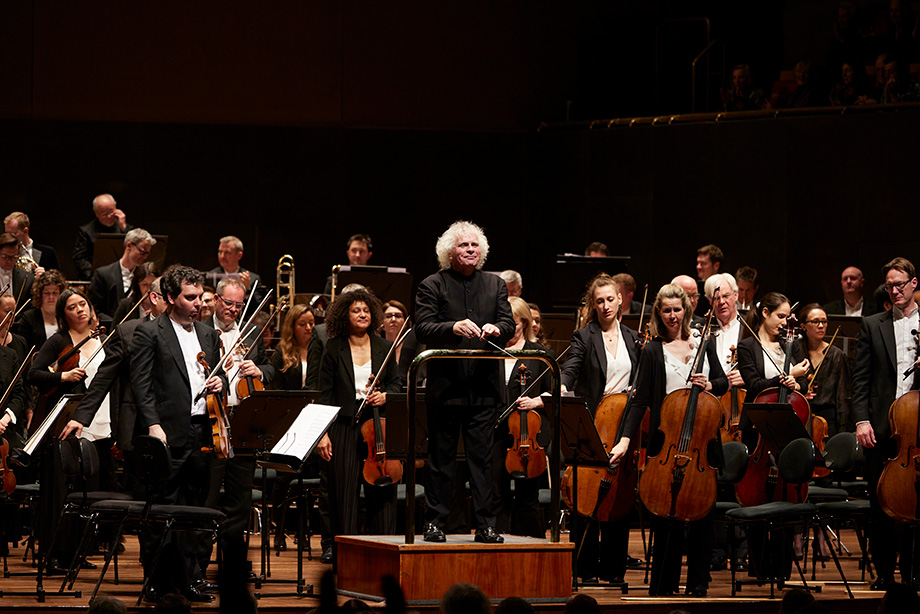
- Article Hero Image Caption: Simon Rattle with the London Symphony Orchestra (photograph by Laura Manariti).
- Alt Tag (Article Hero Image): Simon Rattle with the London Symphony Orchestra (photograph by Laura Manariti).
- Production Company: London Symphony Orchestra
Only five years before that interview, Rattle was a new student at the Royal Academy of Music, studying piano and percussion. Within a year, at eighteen and realising his real passion – as he put it, ‘I wanted to carve’ – he was conducting. In March 1973, he directed an orchestra of RAC students. As Rattle told the Guardian, this was part of his ‘lifelong predilection for forming orchestras, groups, getting people to play, preferably by blackmail’. On the program was Mahler’s Symphony No. 4. A couple of years later, Rattle also conducted Mahler’s Symphony No. 1.
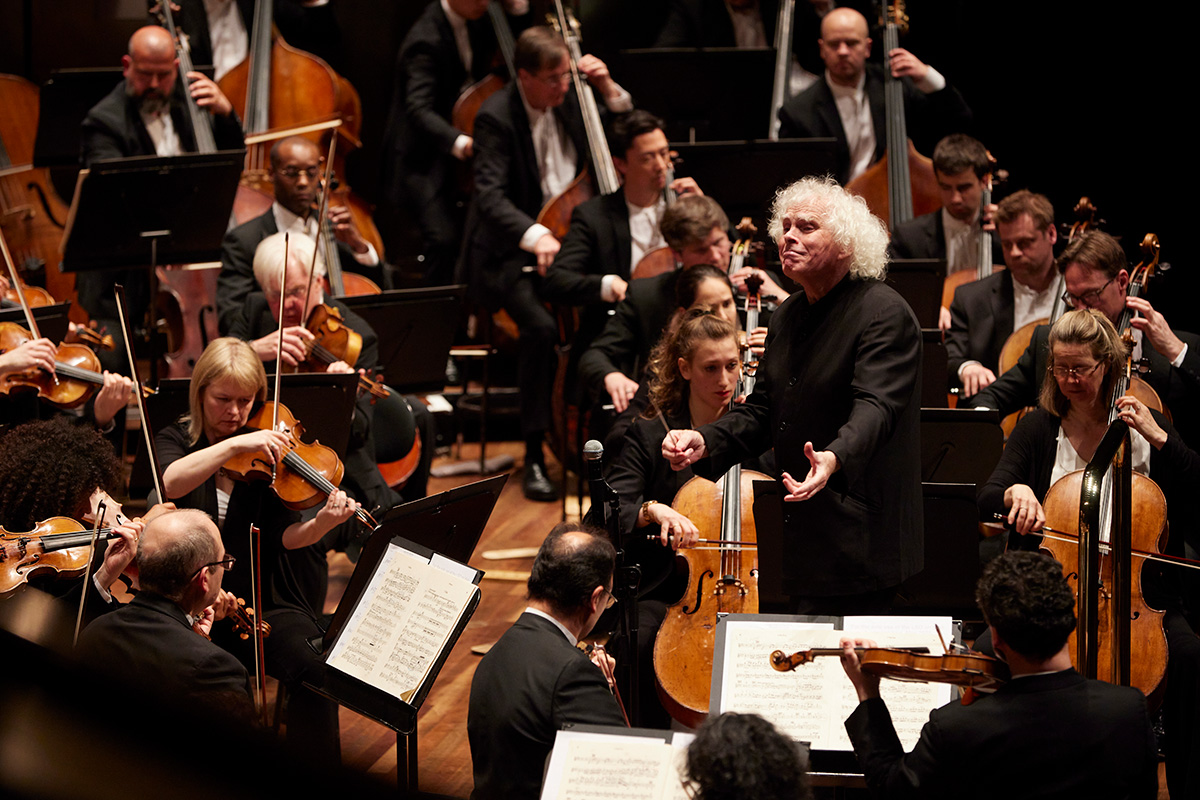 Simon Rattle with the London Symphony Orchestra (photograph by Laura Manariti).
It is tempting to suggest that Mahler has been Rattle’s calling card, especially in his chief-conductorships with the City of Birmingham Symphony (1980–98), the Berlin Philharmonic (2002–18), and the London Symphony (2017–23), in all of which Mahler has bulked large. Overall, however, Mahler is but a component of the complex machinery that drives Rattle’s inner creative being, let alone determines his diverse repertoire. He goes back to J.S. Bach but also charges forward through Romanticism, the New Vienna School, and well beyond. He has championed an astonishing array of contemporary composer compatriots, including Thomas Adès, Mark-Antony Turnage, and Harrison Birtwistle. It’s always worth bearing in mind that one of Rattle’s early mentors was Pierre Boulez (‘a formative experience’).
Mahler, though, is Rattle’s centre of gravity, and his performance of the Symphony No. 7 at Hamer Hall was an epiphany, especially for a work that can be notoriously difficult to fathom. In less capable hands, this eighty-minute symphony can be sprawling, problematic, messy – ‘a bag of pleasant tricks’, an early reviewer dismissively wrote – but Rattle deftly sculptured something that was as expository as it was lyrical, beauteous, and magnificent. Likewise, the lengthy final movement, with its nods to Wagner and Viennese operetta and its abrupt timpani flourishes and horn fanfares, more or less deciphered as much as we are ever going to be able to understand. But that’s down to the composer more than the conductor.
Even more remarkable was the constant freshness and vitality of the playing across all sections. All the orchestra’s fabled hallmarks were on display. I think particularly of the lustrous, piercingly clear first and second violins and violas (fine solo work from the LSO’s guest leader, José Blumenschein) and mellow, often growling, deep cellos and double basses. The brass, horns, and woodwind were impeccable, as was the battery of percussion (nine players), right down to that beguiling clatter of cowbells in the closing bars. But there was delicacy, too, for example in the two Nachtmusik movements, when balance was never muddled or obscured, but mysteriously evanescent and translucent.
This, the final concert of the orchestra’s brief but hectic ten-day Australian tour, which also included works by Bruckner, Debussy, Ravel, and John Adams, sounded as if were the first. But, then, Mahler works are an enduring part of the LSO’s heritage, as one would expect from its association with Willem Mengelberg, Leonard Bernstein, Claudio Abbado, Michael Tilson Thomas, and, of course, Rattle himself.
Wisely, I think, the Mahler was a stand-alone program. Well, apart from four other works. At the outset came Long Time Living Here, the MSO’s ‘musical acknowledgement of country’, composed and sung by Yorta Yorta woman Deborah Cheetham Fraillon. Afterwards, came no less than three encores, introduced by Rattle in his delightfully idiosyncratic way. The first was a glowing performance of Fauré’s Pavane. The third was a zestful belting of Dvořák’s Slavonic Dance No. 7 in C major, from book two, which whirled an already ecstatic audience out of the hall and into the pouring rain. The middle encore (a musical gift to an audience member who had told Rattle he was turning twenty-one that day) was the most interesting and, at fifty-five seconds, by far the shortest: Stravinsky’s mischievous setting of Happy Birthday, composed for Pierre Monteux, the conductor of the notorious world première of The Rite of Spring in Paris in 1913, and himself a former chief conductor of the LSO, from 1961 to 1964.
The present LSO music director is on the move. Next season, Rattle moves to Munich (taking German citizenship in the process), as chief conductor of the Bavarian Radio Symphony. There can be no doubt that his time with the LSO has been of great and lasting benefit, and it was certainly clear on Saturday the affection in which Rattle is held by his musicians. Their association is to continue, with Rattle in a new role as conductor emeritus. He is also a renowned voice of conscience. Last month, following a concert at the London Barbican Centre, Rattle addressed the audience from the podium on the decline of political support for classical music. The problem is universal. Let Rattle have the last word:
So many of the problems are rooted in a political ignorance of what this artform entails, and more worryingly, there seems to be a stubborn pride in the ignorance. Up and down the country, the situation is similar. What we hope is that over the next weeks and months, many more of these stories will be told. We are in a fight, and we need to ensure that classical music remains part of the beating heart of our country, of our country and of our culture.
Mahler’s Seventh (London Symphony Orchestra) was performed at Hamer Hall on 6 May 2023.