


- Free Article: Yes
- Contents Category: Theatre
- Custom Article Title: Julia
- Review Article: Yes
- Article Title: Julia
- Article Subtitle: Hagiography in secular form
- Online Only: No
- Custom Highlight Text:
First things first, the audience loved it. As Julia Gillard, in a performance that blended naturalism and impersonation, Justine Clarke held the crowd in the palm of her hand. They swooned and sighed to the wholesome depiction of Gillard’s working-class Welsh parents and cackled at the pleasurable jokes made at the expense of Kevin Rudd, Mark Latham, and John Howard.
- Article Hero Image (920px wide):
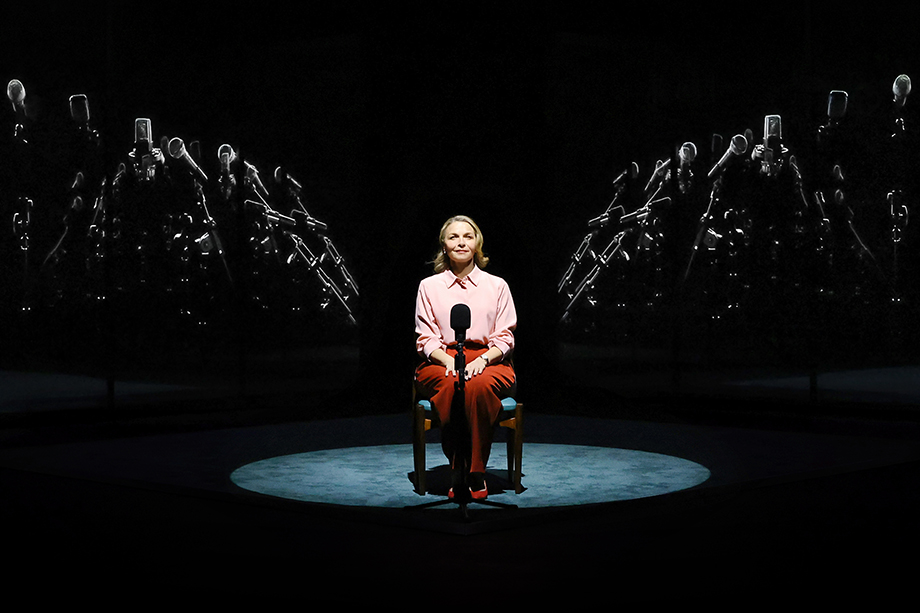
- Article Hero Image Caption: Justine Clarke as Julia Gillard (Prudence Upton)
- Production Company: Sydney Theatre Company
Julia is a hagiography, a saint’s life, albeit in secular form. And as far as hagiography goes, it is beautifully done. The play seeks to persuade the audience that Gillard’s life story offers meaning and exemplarity. She battles the demonic forces of misogyny in Australian public life, and they come close to breaking her, but she emerges unbowed and leaves the stage a heroine, accompanied by a standing ovation at the performance I attended. So, as hagiography, Julia is an emphatic success. As a theatregoer, I have rarely experienced an audience that seemed to be so collectively persuaded, although perhaps the production’s title invited an audience who were ripe to be so.
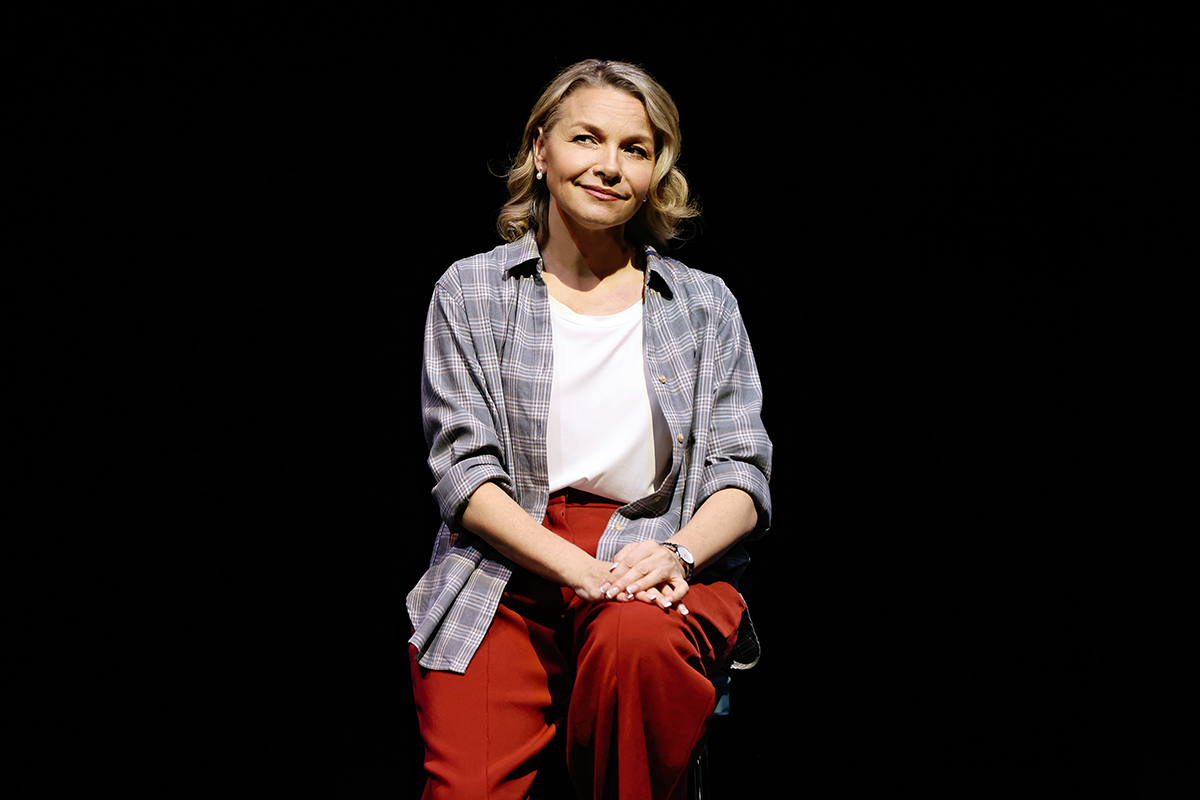 Justine Clarke as Julia Gillard (Prudence Upton)
Clarke’s performance beautifully captures the contradictions of Gillard as everywoman and as wholly extraordinary in achievement. She switches between accents seamlessly, occasionally mimicking Gillard’s distinctive drawl but only offering a clear impersonation when delivering ‘the speech’. She gives us, briefly, the voices of John Howard, Rudd, and Tony Abbott, with excellent timing. Clarke’s Gillard, who is never parodied, is given a repertoire of human moments and reflections that convey the character’s virtuous subjectivity. The same cannot be said of the aforementioned Australian political villains, who are played for admittedly satisfying laughs. But this is Gillard’s hagiography, and so other players in the story can only be foils for our heroine’s journey.
Joanna Murray-Smith’s text illustrates the ease with which we accept Gillard’s account of herself. Julia offers us a Gillard of pithy prose, sharp humour, and plain-spoken cleverness. Murray-Smith writes Gillard as linguistically anti-pompous; she is Machiavellian enough to describe the political game with sharp insight, but humane enough to rhapsodise the pleasure of a cup of tea and a bickie. The writing is at its best, to my mind, when Gillard explains the libidinal pleasures of a political victory or the magic of a successful negotiation. But those moments were all too brief, often displaced by the everywoman character with whom the audience was encouraged to bond. In the same vein, the production design is sparse and precise. When images are projected, such as that of the ocean when Gillard ponders her handling of refugees, they are not deployed to trouble or challenge Gillard’s explanations of her actions. Rather, the play’s projections serve the persuasive qualities of Clarke’s performance, achieving amplification rather than intrigue or contradiction.
Julia is a bona fide hit. The Sydney production is almost entirely sold out for the remainder of its run. No doubt it will tour to other cities. It is a highly successful production, by myriad measures. In particular, Clarke’s performance is, as the man behind me said very loudly to his companion, a tour de force. As someone of Clarke’s generation who watched her every night on Home and Away in the 1980s, I thrilled to seeing Roo Stewart own that stage so decisively, to see the apotheosis of Justine.
It feels churlish, then, to criticise this production, given the clear enjoyment it engendered for its audience. Actually, I can’t fault the production itself. Julia is a highly professional, engaging, and cogent piece of work, one that knows its audience and plays to it adroitly. But in the end, we all know that Julia Gillard was no saint. I do not seek to besmirch her in pointing out her lack of sanctity, but only to suggest nobody is actually a saint. If the play, then, seeks to produce St Julia, for it to be truly creatively successful it should do more than persuade us of her sanctity, it should explain why we need St Julia or what type of miracles she might be able to perform.
Julia (Sydney Theatre Company) continues at the Drama Theatre, Sydney Opera House until 20 May 2023. Performance attended: 14 April.