


- Free Article: No
- Contents Category: Art
- Custom Article Title: Catherine Opie: Binding Ties
- Review Article: Yes
- Article Title: Catherine Opie: Binding Ties
- Article Subtitle: Dramatic chiaroscuro at Heide
- Online Only: No
- Custom Highlight Text:
As the self-proclaimed home of Australian modernism, Heide Museum of Modern Art is largely known for its exhibitions focusing on the story of the Heide circle and the interactions between Heide founders and patrons John and Sunday Reed and the group of artists, including Sidney Nolan, Albert Tucker, and Joy Hester (to name but a few), now referred to collectively as the Angry Penguins.
- Article Hero Image (920px wide):
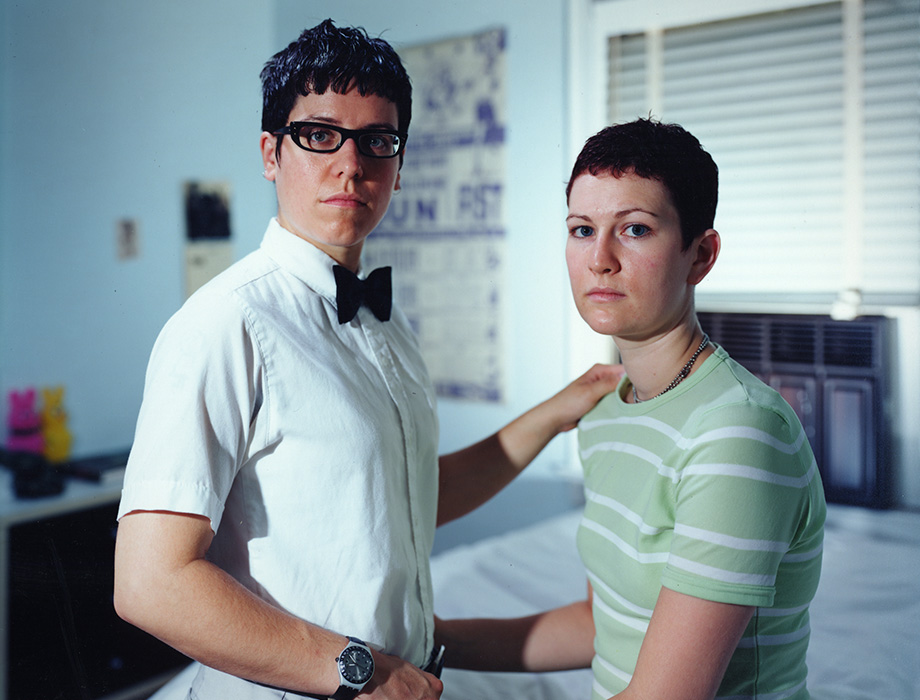
- Article Hero Image Caption: Catherine Opie, Melissa & Lake, Durham, North Carolina 1998 © Catherine Opie (courtesy of Regen Projects and Lehmann Maupin).
- Alt Tag (Article Hero Image): Catherine Opie, Melissa & Lake, Durham, North Carolina 1998 © Catherine Opie (courtesy of Regen Projects and Lehmann Maupin).
- Production Company: Heide Museum of Modern Art
This is achieved by new scholarship of course, but contemporary art also has an important role to play. Exhibitions like the current Paul Yore and Albert Tucker: Structures of Feeling, which brings Tucker’s dark vision of 1940s Australia into dialogue with Yore’s aesthetic of excess commenting on ‘hetero-patriarchal culture, neo-liberalism and Anglo-American imperialism’, is one-way contemporary art can help us engage with this history. Another is through exhibitions by contemporary artists who engage with the history of modernism in their practice. Beyond this, Heide also programs ‘stand-alone’ exhibitions of contemporary artists working outside of this paradigm, that draw their own audiences. Given budget constraints, solo exhibitions by international artists feature rarely in this winning formula, and when they do, the artists are usually major drawcards (Louise Bourgeois, Georgia O’Keefe, and Barbara Hepworth). This makes American photographer Catherine Opie an unusual and interesting choice.
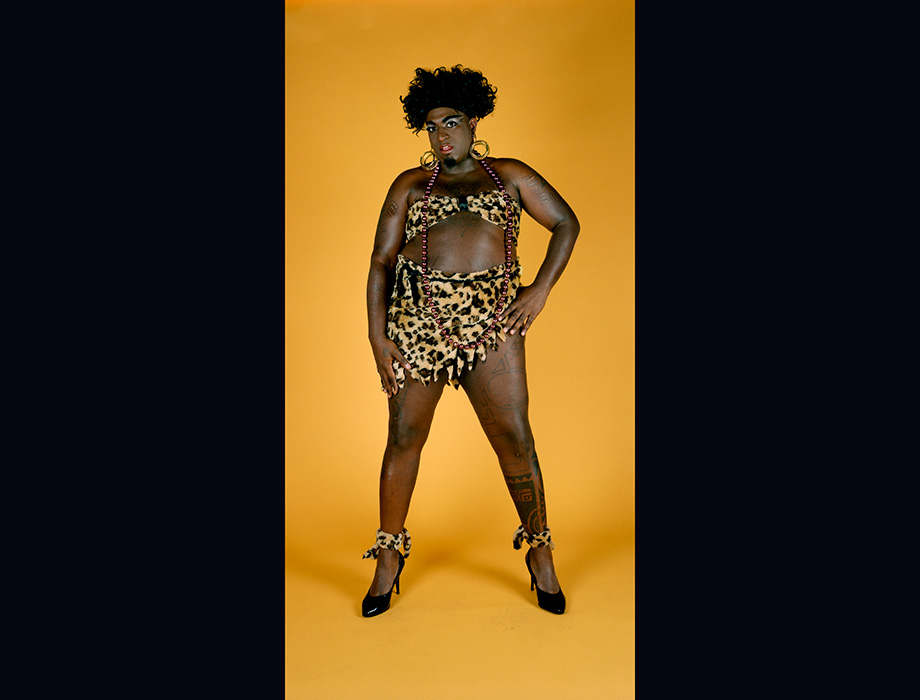 Catherine Opie, Divinity Fudge 1997 © Catherine Opie (courtesy of Regen Projects and Lehmann Maupin).
Catherine Opie: Binding Ties showcases work from the early 1990s through to 2020, providing Australian audiences with our first opportunity to engage with the work of the artist in depth. Opie became known in the 1990s for her commanding portraits of leather dykes, drag performers, and transgender members of the queer community in Los Angeles and San Francisco, where she lived and worked. This is her community, and her images of its constituents within the exhibition present her subjects with a nobility, sensitivity, and beauty that reveals a sense of trust and communion between artist and subject. These works are brought together in Heide’s main gallery with Opie’s portraits of lesbian couples and families and her now iconic self-portrait trio – Self-Portrait/Cutting (1993), Self-Portrait/Nursing (1994), and Self Portrait/Pervert (1994) – which questions society’s limited definitions of parenting, family, and ‘acceptable’ sexuality. While it is true that we may now interpret these works, as Heide’s website explains, ‘in light of contemporary understandings of gender and sexuality as more fluid, the limits of community and kinship as increasingly porous and concepts of citizenship progressively more inclusive and accountable’, for me, given recent transphobic promulgations in Victorian politics, these images highlighted just how far we still to have to go to create an open, accepting, and truly equitable society. Despite being created thirty years ago, Opie’s portraits have lost none of their power.
The exhibition begins with a group of portraits from 2012–17 of people from Opie’s community. These include Opie’s friend and long-term subject Pigpen (who appears elsewhere within the exhibition), fellow artist Kara Walker, and celebrated curator and museum director Thelma Golden, pictured with fashion designer Duro Olowu. Opie’s subjects are silhouetted against black backgrounds and are lit with a dramatic chiaroscuro recalling Renaissance painting. All but one of these portraits are presented in dark oval frames that reinforce this trope. It’s a dramatic start to the exhibition.
While Opie is largely known for her work with portraiture, the depiction of architecture has also figured strongly across her oeuvre, as has an interest in the development and interaction of communities within group activities such as surfing or football (both of which are represented within the exhibition). Opie has never created her images in a linear trajectory – completing one body of work and moving on to another – and neither should she. But this can make representing these different strands of her practice in an exhibition of this scale difficult and interpreting it for audiences new to her work (which, one can fairly assume, is most of Heide’s visitors) somewhat challenging. The introductory didactic to the exhibition states that the works in Binding Ties ‘have been drawn from across Opie’s oeuvre with an emphasis on portraiture’. But it is the inclusion of other bodies of work around the portraits – the placement of the artist’s photographs of swamps in the right-hand side of the first gallery space, for example – that may leave visitors wondering. Magnificent as they are, it is hard to see how they relate to anything else.
My reservations about this exhibition are not a reflection of the quality and contribution of Opie’s work, which is substantial, but of the challenges of curating an exhibition that seems to be sourced entirely from the artist’s studio and gallerists – Regen Projects in Los Angeles and Lehmann Maupin (New York, Hong Kong, London, and Seoul). With the exponential rise in freight costs and the difficulty of securing international loans, this is becoming an increasingly common way of sourcing international exhibitions (one thinks also of the Art Gallery of Western Australia’s current exhibition Yoshitomo Nara: Reach Out to the Moon, Even If We Can’t). This practice means that what is exhibited is limited only to works still available for sale, and to works that can potentially be acquired by museums and collectors while they are in the country. (Opie is represented in Australia by three works in the collection of the Art Gallery of Western Australia and two works in the Art Gallery of New South Wales.)
Is this why there is an entire gallery dedicated to the artist’s beautiful (and more palatable) Surfers series? While I cannot be sure that this is the case with Binding Ties, its limitation as an exhibition is that it looks and feels like it is. The inclusion of a few more didactics to illustrate the breadth of the artist’s practice for visitors, rather than a reliance on extended text on individual artwork labels, would have made all the difference. Regardless, Heide and curator Brooke Babington are to be congratulated for bringing this major exhibition of Opie’s work to Australia, and for giving us the opportunity to explore and appreciate her work in depth.
Catherine Opie: Binding Ties continues at the Heide Museum of Modern Art until 9 July 2023.