


- Free Article: No
- Contents Category: Film
- Custom Article Title: EO
- Review Article: Yes
- Article Title: EO
- Article Subtitle: Life through the eyes of a donkey
- Online Only: No
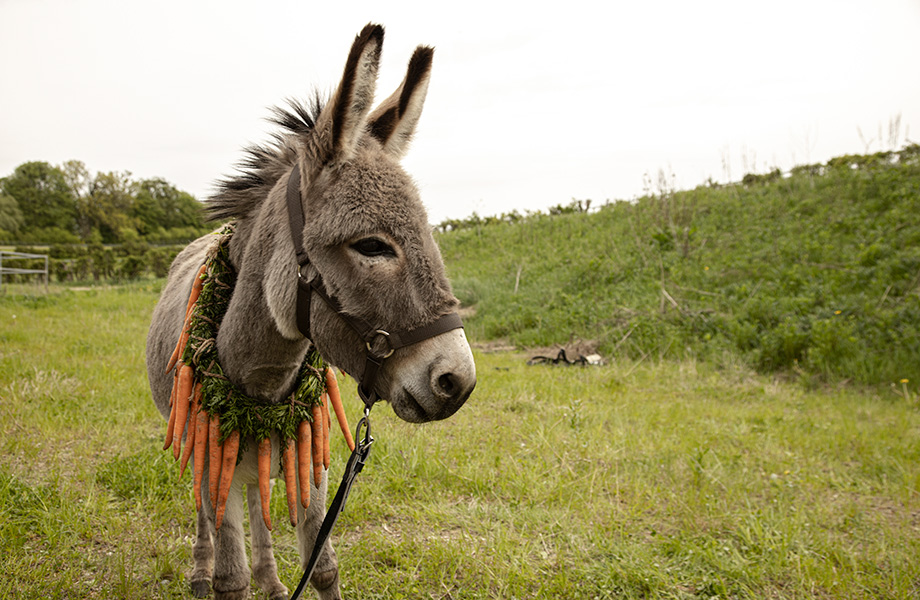
- Custom Highlight Text: There is a boldness to veteran Polish writer-director Jerzy Skolimowski’s latest feature EO, which received the 2022 Jury Prize at Cannes, in that its protagonist is not human, has no lines, but is instead a donkey.
- Article Hero Image (920px wide):
- Article Hero Image Caption: Photograph courtesy of Hi Gloss Entertainment
- Alt Tag (Article Hero Image): Photograph courtesy of Hi Gloss Entertainment
- Production Company: Hi Gloss Entertainment
Skolimowski introduces the viewer to EO as a circus animal, performing with his beloved trainer, Kasandra (Sandra Drzymalska), who gives him affection and shelters him from cruelty. When creditors force the closure of the circus, due to bankruptcy, leading to the seizure of all animals, EO begins a surreal, strange journey across Europe.
 (Photograph courtesy of Hi Gloss Entertainment)
Following his painful parting from Kasandra, for whom he pines throughout the rest of the film (as is expressed in a series of dream sequences), EO finds himself in the midst of a series of disparate human encounters, each allowing Skolimowski to sketch out a different facet of modern-day society: EO winds up in an animal shelter from which he is freed, and is then captured on the streets by an animal control officer who uses him as a mascot for his hooligan soccer team and its supporters. In one of the film’s stand-out, most gut-wrenching scenes, as the team celebrates in a bar, tossing the donkey around like a trophy, the losing opponents enter the pub and proceed to beat up the winning team and EO, typifying the film’s vision of a brutish society. While much of this assault on EO is not depicted, Skolimowksi also shows us the attack from the first-person perspective. In another sequence, EO is tied up on the street, where he is met by a kindly young Italian priest, Vito (Lorenzo Zurzolo), who shows him affection, talks to him like a human, frets about taking him against his will, and brings him home to his disapproving stepmother, an aristocrat (a brilliant, scene-stealing Isabelle Huppert), who rebukes her stepson.
In between these increasingly bizarre situations, Skolimowski constantly puts EO at peril: he barely escapes the clutches of a gang selling donkey and horse meat; EO finds himself in the crossfire of poachers using rifles with lasers to kill deer. In another memorable scene, EO ends up on a fur farm where foxes in cages are waiting to be slaughtered.
There is a sense throughout the film that for an innocent animal in our barbaric world slaughter and violence are pervasive – even for the humans with which EO co-exists. In one scene, EO is picked up by a sleazy truck driver (Mateusz Kościukiewicz). Moments later, the driver is abruptly slashed across the throat by a bandit.
This is not a film interested in a conventional plot. Skolimowski is more interested in an evocation of the donkey’s experience. Often, EO is just an observer, having little to no part in a scene, sometimes relegated to the background of humans interacting. Instead, Skolimowski is more focused on the sounds, score, the ambience, the environment, using these elements to construct an impression of EO’s world.
It is through this unconventional approach that the film excels. Aided by the inventive photography of cinematographer Michał Dymekz and the haunting, drone-like score of Paweł Mykietyn, which vacillates from minimalistic to operatic, Skolimowski effectively puts audiences in the shoes of his beleaguered, titular donkey. Utilising unusual first-person POV footage and fish-eye shots boldly, the film provides audiences with an exaggerated lens to focus on the foibles of human nature.
 (Photograph courtesy of Hi Gloss Entertainment)
For six decades, Skolimowski, a key member of the legendary Polish Film School, together with colleagues Andrzej Wadja, Roman Polanski, and Andrzej Munk, has made films which play with the conventions of cinema and pick apart contradictions within society. His first full-length film, Identification Marks: None (1964), a no-budget feature following a young man drafted into military service, was famously composed of just twenty-nine shots. At eighty-four, he has made a film which feels part of his oeuvre; there is a sense that Skolimowski still delights in shaking up the expectations of audiences, more than sixty years after he made his film debut.
And yet, Skolimowski pulls no punches both in stylistic execution and in his critique of contemporary Poland and society. There is a lacerating criticism of human nature and its basest instincts, which are laid bare: greed, manipulation, violence, selfishness, animalistic behaviour.
Most refreshingly, the film never slides into didacticism, panders to the audience, or offers a simple solution on the mass maltreatment of animals, though this concern is clearly in the forefront of Skolimowski’s mind. Rather, what EO delivers in spades, is a more nuanced, engaging, and thoughtful experience, inviting spectators to empathise with the donkey; to ponder its existence and contemplate our relationship with other species.
EO (Hi Gloss Entertainment), 87 minutes, is in cinemas from 6 April 2023.