


- Free Article: No
- Contents Category: Dance
- Custom Article Title: Don Quixote
- Review Article: Yes
- Article Title: Don Quixote
- Article Subtitle: A safe celebration of Nureyev
- Online Only: No
- Custom Highlight Text: The opening night of The Australian Ballet’s 2023 season, commencing with Rudolf Nureyev’s unforgettable Don Quixote, was like a joyous homecoming to all sectors of the audience, from rusted-on subscribers to some of Australia’s most gifted ballerinas, and a host of people who quickly absorbed the vitality of Marius Petipa’s 1872 ballet, which Nureyev loved.
- Article Hero Image (920px wide):
.jpg)
- Article Hero Image Caption: Rudolf Nureyev and Lucette Aldous, 1972 (photograph by Paul Cox)
- Alt Tag (Article Hero Image): Rudolf Nureyev and Lucette Aldous, 1972 (photograph by Paul Cox)
- Production Company: The Australian Ballet
This atmosphere reminded former company dancers of the frenzied seventeen minutes applause after the ballet’s world première at the 1970 Adelaide Festival, directed by Robert Helpman, co-artistic director with Peggy van Praagh at The Australian Ballet. Many dancers had an advantage when the production began; Nureyev had taught them the ballet in Nice, during its first international tour in 1965.
By 1973, the world could see Nureyev’s Don, and his famous self, with London-based Australian ballerina Lucette Aldous, in the dazzling film made under Nureyev and Helpmann’s direction during a sweltering Melbourne summer, in an Essendon Airport hangar, on an anything-goes timetable. The success was world-wide, and like the company’s acclaimed sixty-nine performances in sixty-nine days in America, enhanced the company’s reputation. Months later, Aldous relinquished her Royal Ballet principal position to join The Australia Ballet as a resident principal.
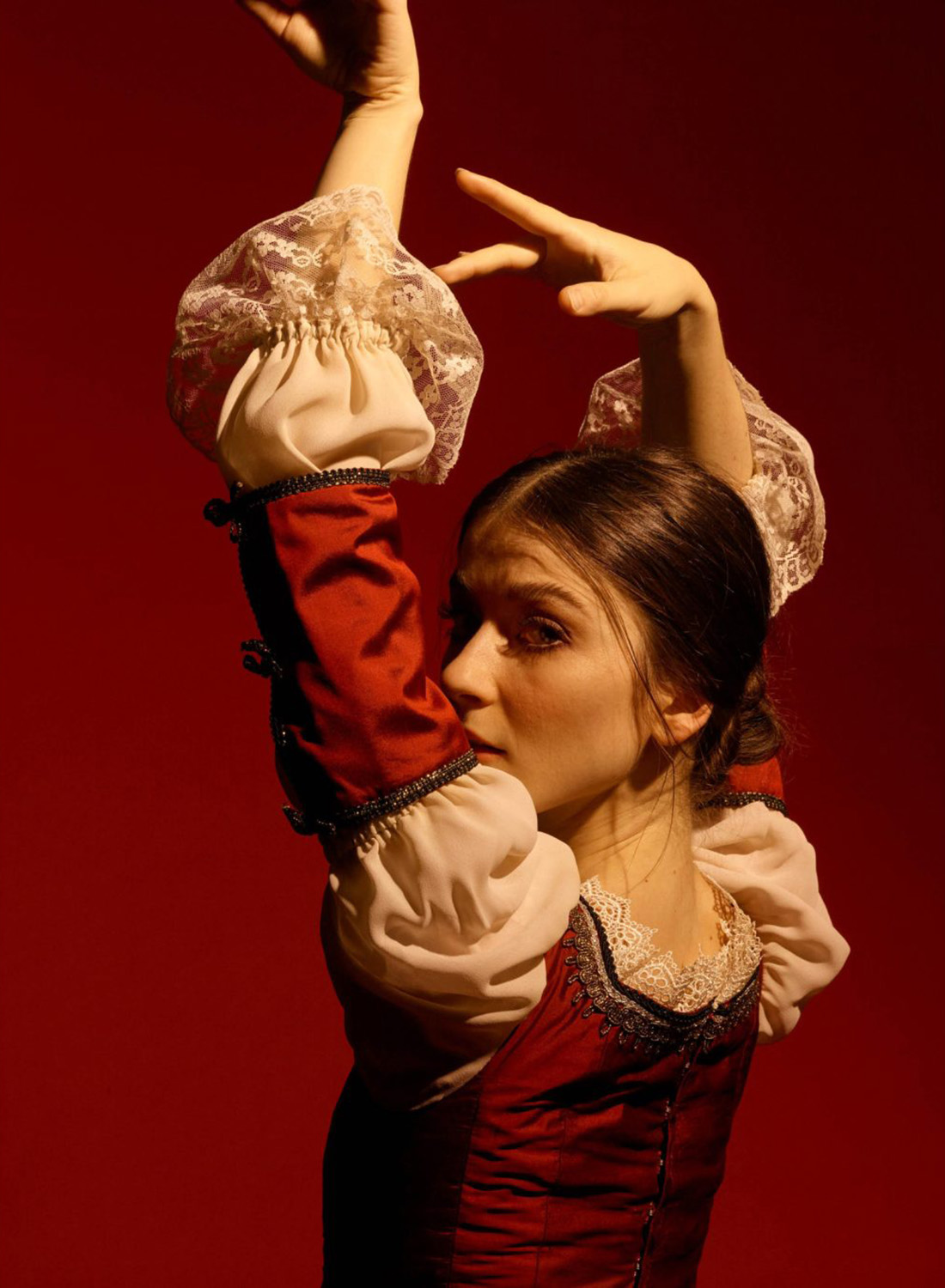 Benedicte Bemet (photograph by Simon Eeles)
It is useful to note that apart from the tale of the Don and his servant Sancho, the ballet concentrates on another episode in Cervantes’ novel: a love story hindered by an ambitious father. Together they form the basis of Petipa’s original production. Much of the daily action on the Barcelona harbourside and plaza is natural – drinking, eating, playing, fights, arguments, and reconciliations – amid a cavalcade of exotic Spanish and Romani dances, and many more based on pure classical technique. Meanwhile, comedic mime tells the story of a fading personage who dreams of a beloved beauty, Dulcinea; a foppish aristocrat Gamache, dying to marry the strong-willed tavern-owner’s daughter, Kitri; the fake suicide of her barber–boyfriend Basilio; and a host of Romani who protect the lovers from their elders.
Both dance and mime alternate throughout all three acts. The challenge for every dancer is enormous, required as they are to change attitude, costume and style of movement many times over. The gift in it all should be instantaneous delight from the audience, and that cannot be taken for granted.
Not surprisingly, principal artists Kondo and Guo delivered with open, lively faces, and a level of attack that drives and rounds out their work. The two girlfriends, danced by Jill Ogai and Riley Lapham, were tight and sharp in several numbers, and loving it. The star turn of the seductive Street Dancer was a gem for Amy Harris, who, in recent years has become a subtle dramatic actor. The leading bridesmaid, Rina Nemoto, was quietly proud, almost floating into positions, and constantly giving her dance over to the audience. That was true, too, of the Don’s famous dream scene – three super-elegant solos and geometrically patterned ensembles, most notably Sharni Spencer’s Queen of the Dryads, Yuumi Yamada’s canary-like Cupid, and Kondo again, as the Don’s immaculate fantasy, Dulcinea.
For all their hard work – lascivious matadors included – some of the men fared less well in interesting roles that felt somewhat shallow. Marcus Morelli as the fiery leading Romani was very appealing, but needed more power to drive this character, while the charming principal Adam Bull in the Don role was patchily unreadable from stalls row R and lacked more colourful characteristics as had been developed in the film’s production.
Behind all this was the project launched by artistic director David Hallberg with a team of creatives, advisers, and coaches. It may have evolved on imaginative ideas, but at this early point, it appears as if it is playing on more than just one cohesive platform. At the first interval, the circulating questions were ‘Why is this show so safe?’ or ‘Why isn’t it gritty, or spicier?’ At the second interval, the question was ‘Why does the orchestra sound so smooth, like concert hall music?’ This means that the dancers’ need of suitable tempi is not met. Another person asked, ‘Is the conductor [Chief Conductor Jonathan Lo] “playing safe” on request from the ballet team?’ This performance seemed uncharacteristic compared to earlier ones from this new and welcome music director to the company.
The design of popular lighting wizard John Buswell often seemed less specific to the dance and emotional tones than one would expect in this ballet, particularly in the Don’s transit into the Dyad’s space, and the busy third act, where the downstage space sometimes looked empty and glaring, while upstage looked crowded and jumbled.
Fortunately, the design work is more coherent. Renowned Melbourne designer Richard Roberts has created a striking suite of sets that reflect the intentions of the ballet’s original designer, London-based Australian Barry Kay. These include Kay’s aesthetic of three-dimensional spaces and, appropriately, the sparking rows of lights and glorious textiles for voluptuous Velázquez-inspired gowns for fandango dancers, which echo the contrasting luxury and status found among the community of people at the wedding.
There is no doubt that this production can flourish in time, but the creative and coaching teams cannot be too precious in finessing their achievement to fulfil their aspirations.
Don Quixote (The Australian Ballet) continues at the State Theatre, Melbourne, until 25 March 2023. Performance attended: 15 March. Don Quixote will be performed at the Sydney Opera House from 8 to 25 April 2023.