


- Free Article: No
- Contents Category: Theatre
- Custom Article Title: Bernhardt/Hamlet
- Review Article: Yes
- Article Title: Bernhardt/Hamlet
- Article Subtitle: A striking production of a disappointing play
- Online Only: No
- Custom Highlight Text: More than a century ago, long before gender-blind casting became modish, the incomparable Sarah Bernhardt (1844–1923), a woman in her fifties, had the audacious idea that she would play Hamlet. Not only would she – scandalously – don breeches to do so, but she would also defy the critical consensus that Hamlet was a man in his early thirties.
- Article Hero Image (920px wide):
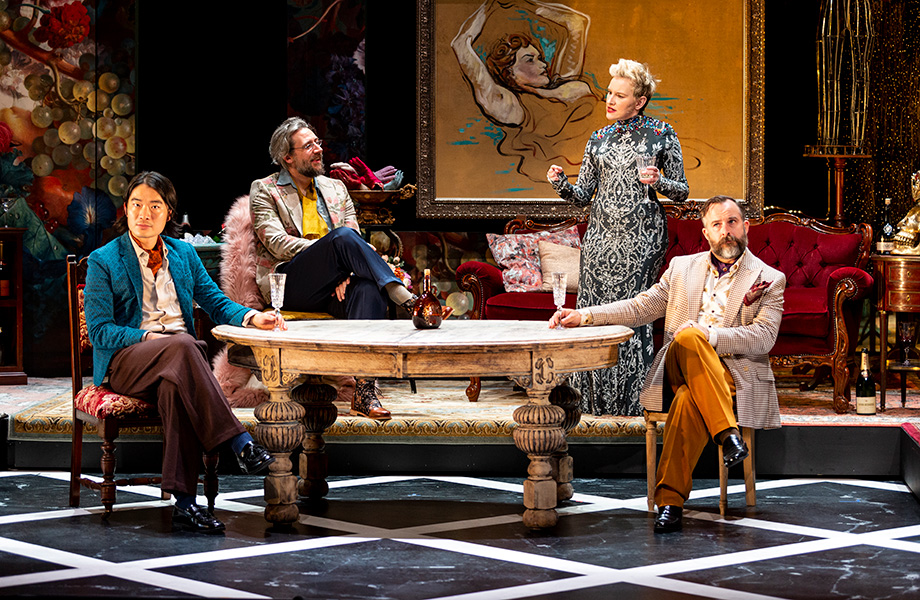
- Article Hero Image Caption: L-R Charles Wu, Tim Walter, Kate Mulvany, John Leary (photograph by Pia Johnson)
- Alt Tag (Article Hero Image): L-R Charles Wu, Tim Walter, Kate Mulvany, John Leary (photograph by Pia Johnson)
- Production Company: Melbourne Theatre Company
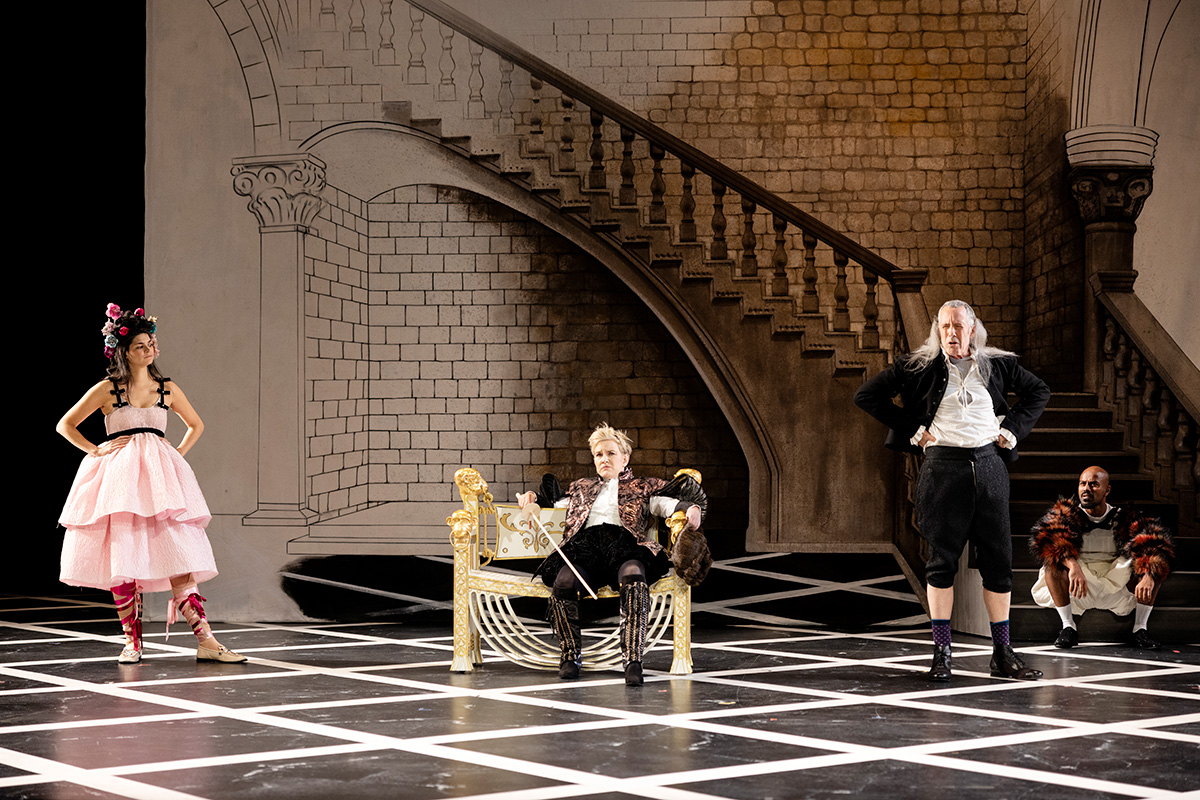 L-R Tahlee Fereday, Kate Mulvany, Marco Chiappi, Dushan Philips (photograph by Pia Johnson)
As the play opens, Bernhardt – Kate Mulvany in a cleverly overstated, almost post-punk rendition of Elizabethan garb (costume design by Marg Horwell) – is wrestling with one of Hamlet’s soliloquies. Her acting company gather around her, among them Constant Coquelin (Marco Chiappi), who has himself played Hamlet four times. They prompt her when she seems to lose a line, offer their insights into Hamlet’s motivation. But Bernhardt cannot fathom Hamlet’s lack of action, his endless monologues. Even Shakespeare is not above her censure: his writing, she declares, can at times be ‘inauthentic … Anyone who writes as much as he did is bound to slip once in a while.’
Mulvany has great fun with Bernhardt, captures her reputation as, according to biographical accounts, ‘the queen of the pose and the princess of the gesture’. She seamlessly pivots Bernhardt from laughter to anger to tears. Mulvany’s movements around the stage – the constant yanking on and off of her pageboy wig as she contends with Hamlet, her studied posture as she gathers her emotions and delivers Hamlet’s lines – are precisely measured, encapsulating the grandiloquent style of the times without pushing the whole over into farce. Her attitude is forceful, her voice deep and rich, with just a hint of Hepburnesque vibrato, but underneath the layers of fearlessness and self-conceit, Mulvany finds just enough vulnerability to keep Bernhardt human.
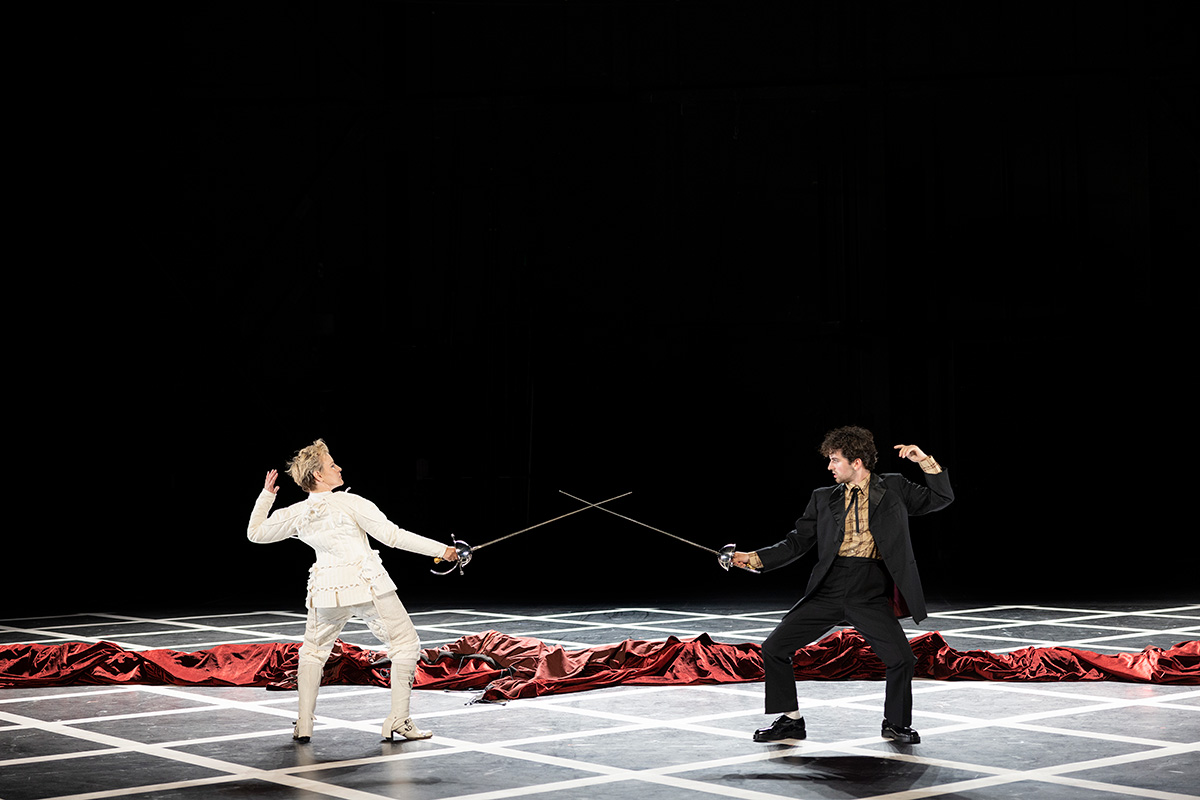 L-R Kate Mulvany, William McKenna (photograph by Pia Johnson)
Bernhardt’s struggle to grasp both Hamlet and Hamlet is the beating heart of Rebeck’s play. Watching Bernhardt and her company as they rehearse, with Bernhardt striving to reconcile her own disposition with Hamlet’s – ‘I do not play him as a woman,’ she says, ‘I play him as myself’ – is magical. Dushan Philips and Sahil Saluja shine in their roles as bit-actors charged with keeping Bernhardt’s ego afloat. Chiappi matches Mulvany gesture for gesture, impeccably navigating his way from clown to tragedian and back again. When, for example, Bernhardt is unable to decipher the scene on the battlements when Hamlet encounters his father’s ghost, she begs Constant to improvise with her. Their spontaneous parleying – at first reluctant, then impassioned – converges effortlessly with Shakespeare’s words, a moment of theatre that, in the hands of Chiappi and Mulvany, and under the incisive direction of Anne-Louise Sarks, is both profound and enthralling.
What these rehearsal scenes encompass is an interrogation of Hamlet: What is Hamlet? Who is Hamlet? Who has the right to claim him, to define him, to embody him? (Even in the few years since the play’s first performance, the question of whether or not Hamlet has a penis – whether he is required to have a penis – has taken on a whole new resonance.)
When Bernhardt is allowed to grapple with these questions within the context of honing her performance, the play soars. When, however, the immediacy of the ‘onstage’ action gives way to expository conversations and dinner-party debates, the play falters. In particular, the dramatic force of the collision between Bernhardt and Hamlet – the collision made manifest in the forward slash of the play’s title – is undermined by a plotline concerning a (fictitious) love affair between Bernhardt and the not-yet-famous poet and playwright Edmond Rostand (Charles Wu), his greatest play Cyrano de Bergerac little more than a first draft.
There is a compelling dramatic force in the tempestuous liaison between Bernhardt and Hamlet, but that force is diluted by Rostand’s presence and by the gradual tilting of the play away from Hamlet and towards Cyrano de Bergerac (the second act of the play might as well be called Rostand/Cyrano).
Wu is a fine actor, but he seems miscast as Rostand. He is more Christian than Cyrano, a bloodless lover when what is needed to balance the play is a passionate, beguiling poet. Nor does he have the heft to co-anchor with Mulvany the play’s second act. In this, he is not helped by a drab costume that has the air of a 1970s menswear catalogue, while all the other men in the play look as though they have raided Harry Styles’s wardrobe.
Despite the razor-sharp scorn with which Mulvany imbues Bernhardt’s criticisms of Roxanne (the heroine of Rostand’s play), and of all that Roxanne denotes about the rights and representation of women, the moment offers little more than a reiteration of arguments more effectively demonstrated in the first act. The flash of heat that comes with Bernhardt’s denunciation of the ‘moping flower’ roles within which women are confined soon dissipates and the play limps towards its conclusion.
Inexplicably, Bernhardt/Hamlet’s penultimate scene is the name-calling episode from Cyrano (one of two unduly long and ineffectual passages from that play). This is followed by a brief parrying of swords between Bernhardt and her son, Maurice (a delightfully sulky performance from William McKenna). A nod towards the film footage of Bernhardt duelling with Laertes, the scene nevertheless feels like an after-thought. Both Bernhardt and the play deserve better.
At one point, arguing with a critic, Bernhardt says, ‘Your point has muddled itself with overreach.’ The same might be said of Bernhardt/Hamlet. This is a striking production of a disappointingly lopsided play.
Bernhardt/Hamlet (Melbourne Theatre Company) continues at the Southbank Theatre until 14 April 2023. Performance attended: 8 March.