


- Free Article: No
- Contents Category: Music
- Custom Article Title: Ngapa William Cooper
- Review Article: Yes
- Article Title: Ngapa William Cooper
- Article Subtitle: Nigel Westlake and Lior’s new collaboration
- Online Only: No
- Custom Highlight Text: For anyone who encountered Compassion, the profoundly moving and beautiful song cycle by Lior and Nigel Westlake from a decade ago, the prospect of hearing another work from them was always going to arouse interest. Would their newest collaboration rise to the same magical level as their first, or perhaps even surpass it? Would it be entirely different?
- Article Hero Image (920px wide):
- Article Hero Image Caption: Lou Bennett and muscians performing at Ukaria (photographer Adam Forte)
- Alt Tag (Article Hero Image): Lou Bennett and muscians performing at Ukaria (photographer Adam Forte)
- Production Company: Adelaide Festival
 Lior, Lou Bennett and muscians performing at Ukaria (photographer Adam Forte)
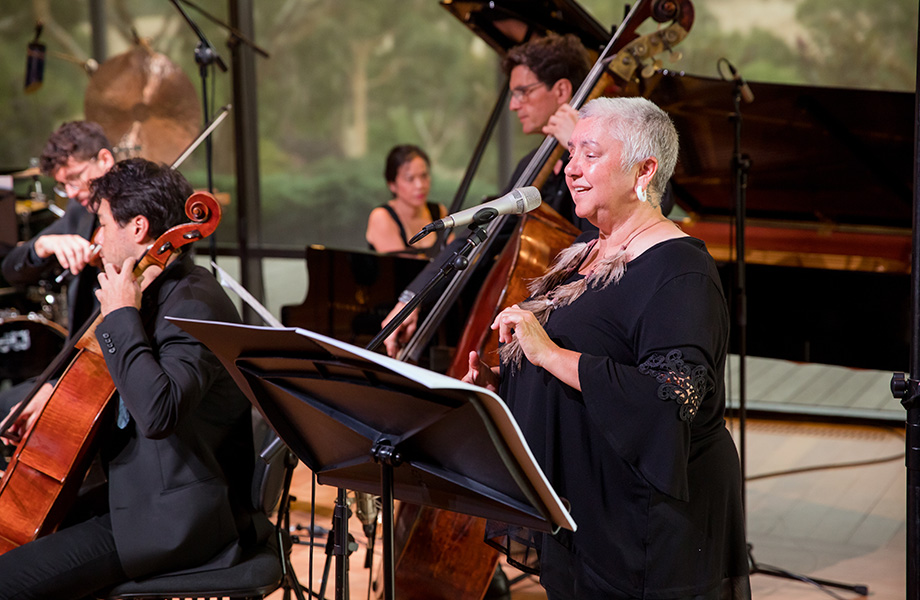
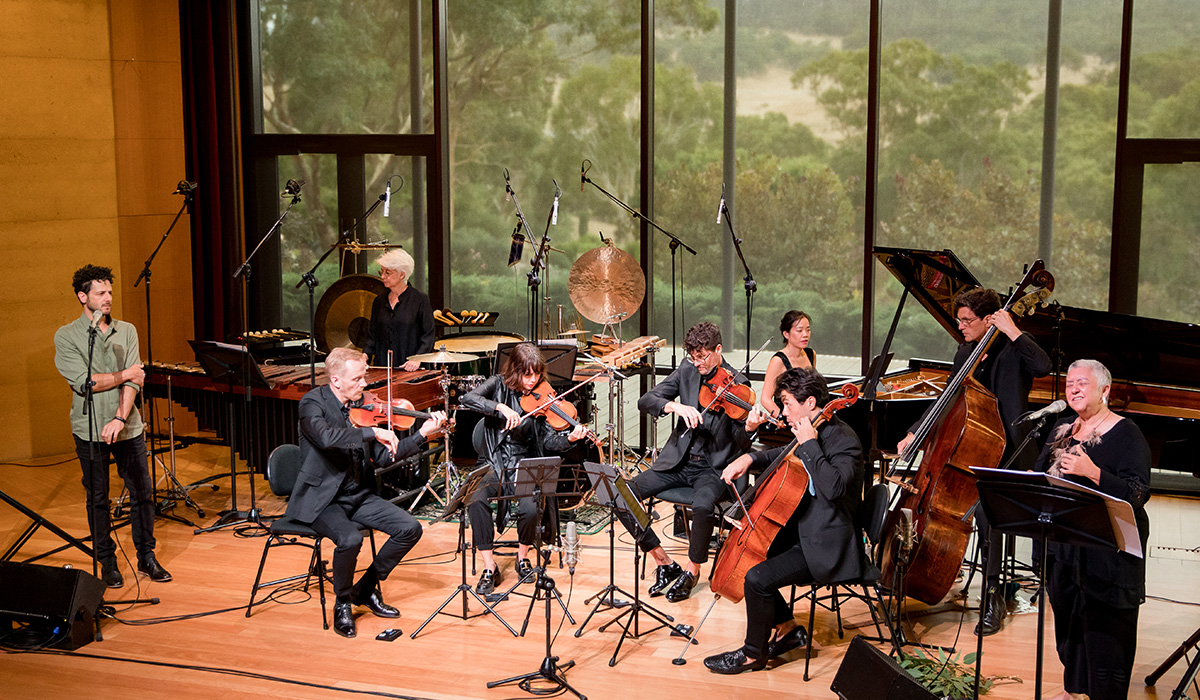
Less like Compassion than one perhaps expected, Ngapa feels like a bigger and bolder conception in every aspect. It is certainly the more viscerally powerful of the two works. In large part, this owes to it being written for two singers, rather than one, and consequently focus is thrown onto the relationship between them. Lior and Lou Bennett share vocal duties, neither one personifying Cooper but articulating his inward voice through the seven sections of this work: his despair, his resolve, and his reflections. These sections are not songs so much as scenas in an oratorio where singers sing separately in solo, exchange phrases in duet, or walk right up to each other as if merging into one persona.
In two of the sections, ‘The Meeting’ and ‘The Protest’, we hear audio recordings of Cooper’s grandson, Uncle Alf (Boydie) Turner, reading portions of the letter that was served to the German Consulate. Thus Cooper, through his living grandson, becomes a direct participant in the work.
The power of these elements combines to make Ngapa an experience that grips one’s whole being. One could enjoy and be moved by Compassion for its sheer contemplative rapture, but this new work is different: it wrests one’s attention and never lets go. Yet while realising full well its intent, one could not help feeling hungry for Compassion’s special luminous beauty. It’s there, more dramatic than static.
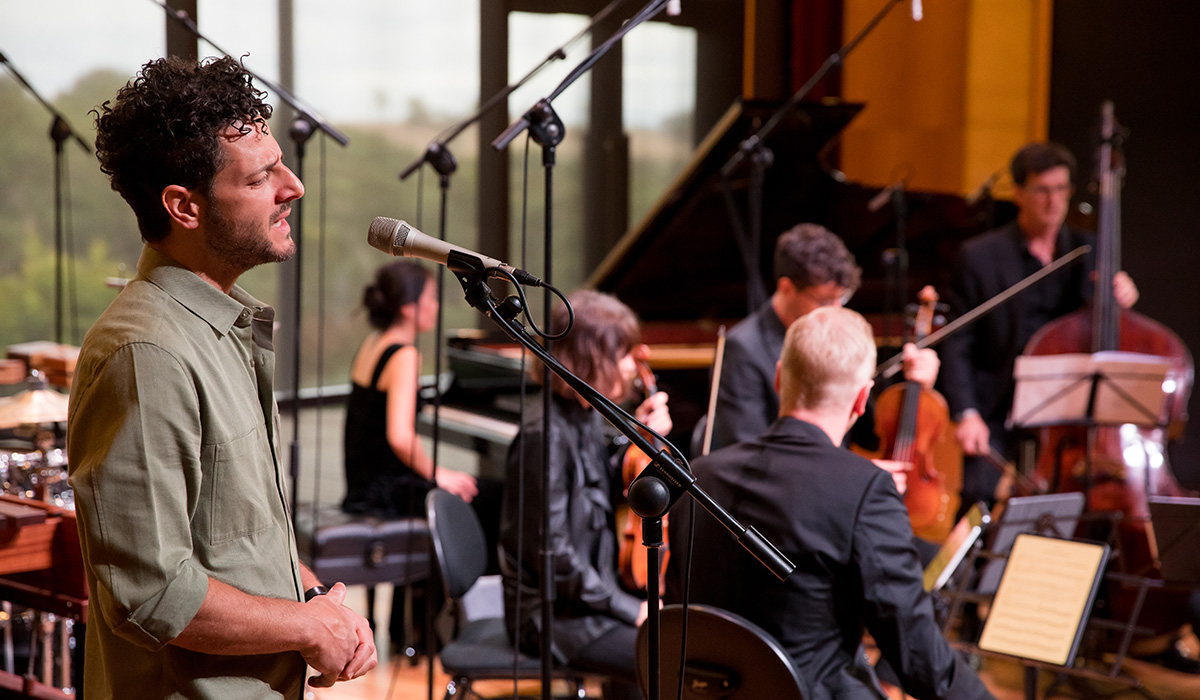
A growling ferment of sound erupts in ‘The News’. The mood is sinister as a solo cello wraps around Lior’s voice and glistening sounds from the ensemble accompany his words about Kristallnacht. The guttural harmonic gestures are unmistakably those of Westlake, and the players are in top-notch form: a tight little ensemble, they comprise the Australian String Quartet, pianist Andrea Lam, double bassist Kees Boersma, and percussionist Rebecca Lagos. With a couple of changes of personnel, it is the same combination that presented Compassion in a highly successful chamber version at Ukaria for the 2019 Adelaide Festival. Obviously, that experience gave its creators much inspiration in forging this new work.
 Lior and muscians performing at Ukaria (photographer Adam Forte)
‘The Meeting’ starts with a bare fifth in Dale Barltrop’s violin, and the string quartet dances ecstatically. It is a gorgeous score – Westlake at his best. In ‘The Protest’ that follows, the lights turn red and we hear the ensemble work hard in an episode of high virtuosity. The players are right up to the challenge. Rock drumming breaks out and the mood is full of jubilation as Cooper and his comrades unite in their cause. Lior and Bennett soar in anthemic unison.
‘At the End of My Days’ sees the two singers reflect on a life led by conscience and unperturbed by surrounding ignorance. ‘I will have crossed the divide,’ they sing. Telling words they are, and ones that resonate through the decades to remind us all how battles for Indigenous justice are far from over: indeed. Rich harmonies rise up here, perhaps Westlake’s most beautiful music.
Can composers ‘do’ beauty anymore? Most surely yes, in the case of Lior and Westlake: here’s another score where it exists in abundance.
One can admire so many things about this new work and its performance. The two voices of Lior and Bennett find a complementary perfection in their shapely lilt and the heart and warmth of their delivery. Bennett has a wonderfully open expression that is heightened by her poetic gestures. Lior has a unique intensity, placing his notes with special deliberation, like a painter applying paint to a canvas.
If Michael Tippett could present a child of our time in his great secular oratorio of that title, honouring the life of the Polish Jew Herschel Grynszpan, whose actions precipitated Kristallnacht, Lior and Westlake have presented a man of our times in their musical portrayal of William Cooper. It shares the same musical DNA as its forebear Compassion. It is a work of sweeping power and truth. The standing ovations that followed each performance attested to that.
Two American works came earlier in this concert. Bristling with jagged rhythms, Bryce Dessner’s Aheym (‘Homeward’ in Yiddish), from 2009, felt like a fairly accurate encapsulation of contemporary times. The ASQ performed it with terrific speed and conviction. Revisiting mid-1980s minimalism in the form of Philip Glass’s String Quartet No. 3, ‘Mishima’ (themed on Yukio Mishima, the novelist and political dissident who suicided in 1970), was interesting. Glass’s music, if anything, gains in stature over the decades: it possesses a wistful nostalgia. Played with such loving warmth as it was by ASQ, it was almost like hearing Schubert.
Ngapa William Cooper was performed at Ukaria on 5 March and at the Adelaide Town Hall on 7 March 2023. Performance attended: 7 March.