


- Free Article: No
- Contents Category: Theatre
- Custom Article Title: The Goat, Or Who Is Sylvia?
- Review Article: Yes
- Article Title: The Goat, Or Who Is Sylvia?
- Article Subtitle: Edward Albee’s ‘comedy of horrors’
- Online Only: No
- Custom Highlight Text: In a tastefully designed, beautifully arranged living room, a couple are engaging in the sort of mildly erotic verbal jousting in which long and happily married couples might indulge. They are Martin Gray, a Pritzker Prize-winning architect, just turned fifty, who has been chosen to design a futuristic, two-hundred-billion-dollar World City and his, in his words, bright, resourceful, intrepid wife, Stevie.
- Article Hero Image (920px wide):
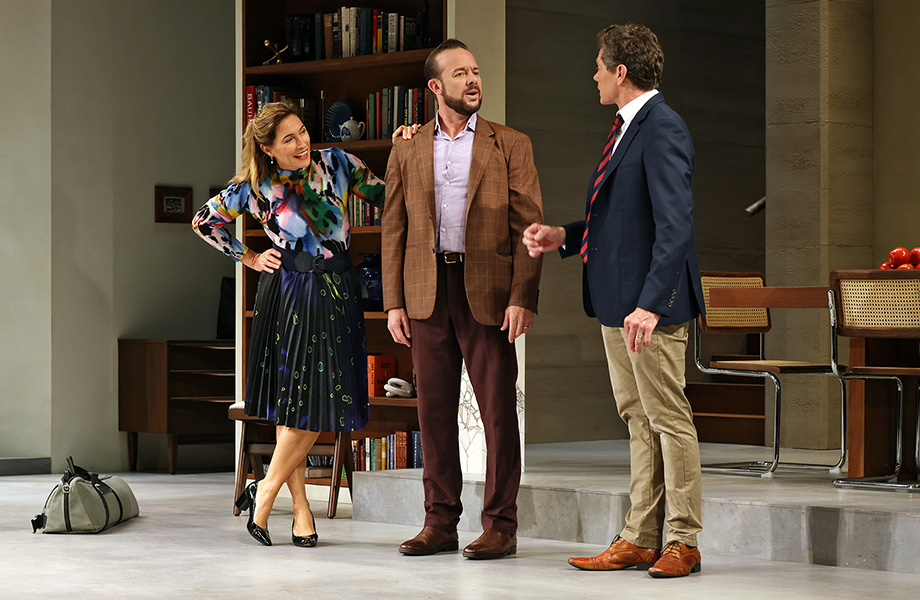
- Article Hero Image Caption: Claudia Karvan, Mark Saturno and Nathan Page (photograph by Prudence Upton)
- Alt Tag (Article Hero Image): Claudia Karvan, Mark Saturno and Nathan Page (photograph by Prudence Upton)
- Production Company: Sydney Theatre Company
When Ross, a liberal television interviewer, arrives, he senses that Martin is distracted but is appalled when he discovers why. Martin has fallen in love with a goat he has named Sylvia. Though Albee makes considerable comic mileage out of this fact, the play is not about bestiality. In fact, the two most shocking moments in the play have nothing to do with Sylvia. Albee is attempting to test at what stage our empathy and permissiveness reach breaking point. As he says: ‘Every civilisation sets quite arbitrary limits to its tolerances. The play is about a family that is deeply rocked by an unimaginable event and how they solve that problem. It is my hope that people will think afresh about whether or not all the values they hold are valid.’
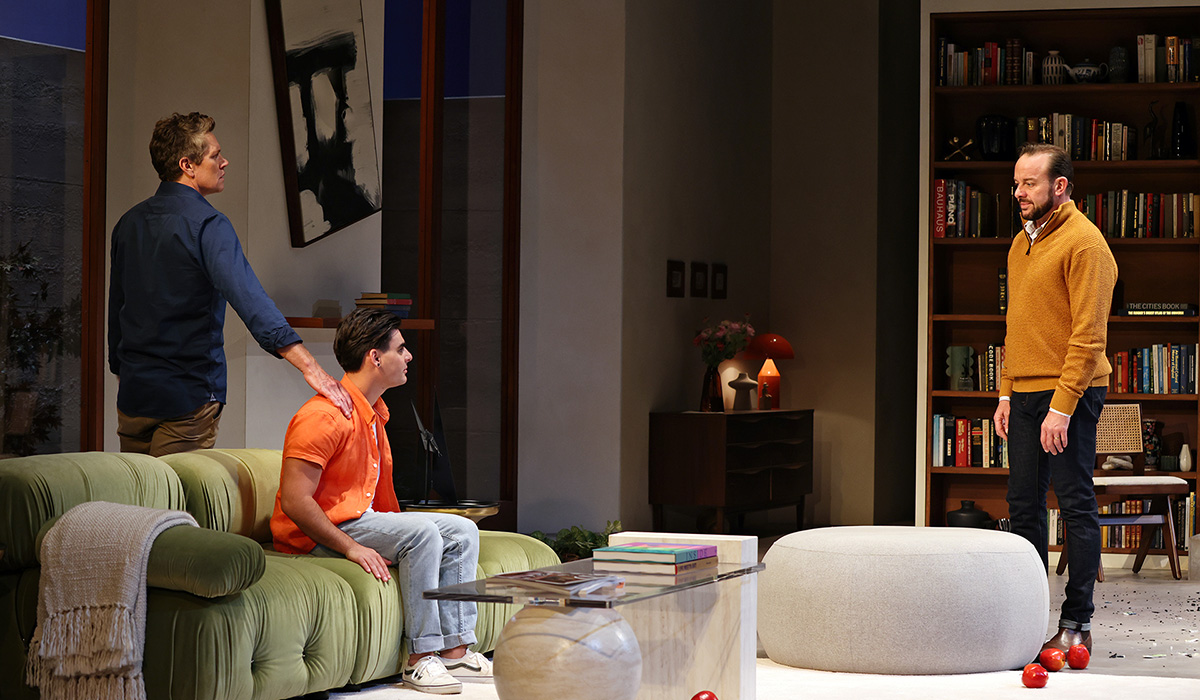 Nathan Page, Yazeed Daher and Mark Saturno (photograph by Prudence Upton)
Stevie and the Gray’s fragile, gay son – the perhaps too obviously named Billy – attempt to come to terms with the unacceptable, while the interfering, obtuse Ross makes everything worse. The play gets darker as it moves towards a conclusion that bears out Albee’s subtitle for the piece, ‘Notes Toward a Definition of Tragedy’, and reminds us that the word tragedy comes from the Greek for goat song.
The challenge for any director of The Goat is to balance the dark and the comic aspects of the play. When Stevie makes a flippant remark and Martin implores her to ‘be serious’, she responds: ‘No! It’s too serious for that.’ Underneath the quickfire dialogue, there must be a palpable sense of hurt, bewilderment, and fury that leads us to the play’s gruesome denouement.
This darkness is completely missing in Mitchell Butel’s inept, superficial production. What should be a disquietingly humorous, unsettling piece is played like a farce. Except a farce would need actors with better timing than the quartet presently floundering around on the stage of the Roslyn Packer theatre. One wonders if they and their director actually have any understanding of the work they are massacring or if they do understand but are just incapable of bringing it off.
Claudia Karvan’s Stevie flounces around the stage as if she were in a Neil Simon comedy. There is no sense of danger in her performance. There is a moment when Stevie howls, which should be Lear-like in its intensity. Karvan produced merely whimpers. The audience laughed merrily through her final entrance, which should be shattering in its effect.
Nathan Page, as Martin, fares a bit better. His may be a one-note performance, but that note, bewilderment, is a central part of Martin’s make-up. We get no real sense of the obsession that is tearing him and his family apart. His protestations of caprine adoration come over as merely words. We should be both repelled by, and attracted to, Martin, but Page’s perfunctory performance makes him merely a figure of fun.
Yazeed Daher’s whining Billy and Mark Saturno’s blustering Ross add little to the proceedings.
Albee’s plays are challenges for both the presenters and the audience. It is a shame that in this case the challenge has been so comprehensively failed.
The Goat, or Who Is Sylvia (Sydney Theatre Company) continues at the Roslyn Packer Theatre until 1 April 2023. Performance attended: 4 March.