


- Free Article: No
- Contents Category: Theatre
- Custom Article Title: Macbeth
- Review Article: Yes
- Article Title: Macbeth
- Article Subtitle: Greenery and the ‘fruitless crown’
- Online Only: No
- Custom Highlight Text: There is a moment often conveyed in romantic films (and it was certainly the case with Baz Luhrmann’s Romeo and Juliet) when fresh eyes meet across a crowded room and become fixated, unable to stop ‘looking’, searching for more and more of the alchemical fire that triggered an intense magnetism.
- Article Hero Image (920px wide):
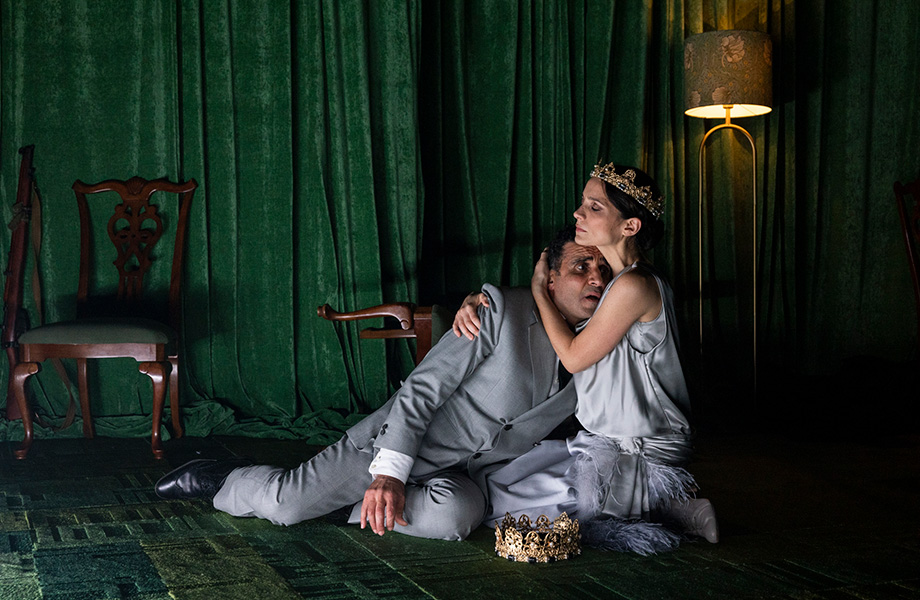
- Article Hero Image Caption: Hazem Shammas as Macbeth and Jessica Tovey as Lady Macbeth (Photograph by Brett Boardman)
- Alt Tag (Article Hero Image): Hazem Shammas as Macbeth and Jessica Tovey as Lady Macbeth (Photograph by Brett Boardman)
- Production Company: Bell Shakespeare
As early scenes unfold, the actors rarely leave the stage but often creep towards a patch of curtain to make themselves discrete, like warm bodies skulking in individual tableaux. ‘Pausing’ actors on stage seems to me a dicey ploy, with great potential for de-energising the action, but it works well in this production, for interesting reasons. The program proposes that the characters are at ‘a perpetual banquet and séance’, so perhaps all the greenery conveys the sumptuousness of a banquet as well as the gothic ethereality of communing with the dead.
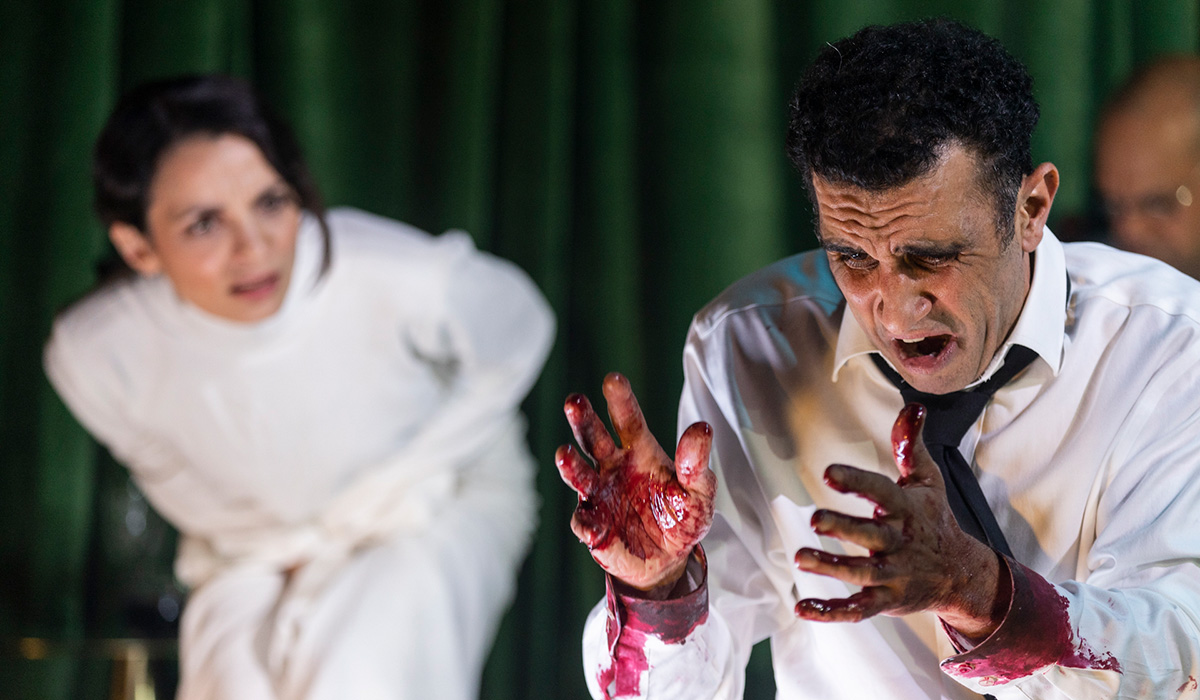 Jessica Tovey as Lady Macbeth and Hazem Shammas as Macbeth (photograph by Brett Boardman)
Evan’s production really kicks into gear when it settles into the psychological embroilment of anxiety, guilt, and trauma that harries Macbeth and Lady Macbeth (Hazem Shammas and Jessica Tovey) when they begin to navigate the fraught terrors of premeditated murder and the daunting consequences of obtaining a ‘fruitless crown’. Shammas commits himself fully to the leading role, breaking the shackles of imposing realism as he produces an authentic bodily connection to the sense of Shakespeare’s verse, delivering a dynamic performance that must have thoroughly tested the boundaries in the rehearsal room. The dagger scene is terrific, the banquet scene superb. Tovey’s Lady Macbeth also finds excellent range, one minute sultry and alluring, the next forceful and domineering, then covering comically for her husband, who appears to have gone completely mad.
All this is assisted by the compressed restriction of the stage. With few exits and entrances, the performers must use Shakespeare’s language to evoke the location and mood of each scene, so the sense of the verse is truly driving this production, as it should, despite all the snazzy costumes and lights. What shimmers forth when this happens (apart from the excellent acting) is Shakespeare’s craftsmanship, conveying a nuanced impression of the pathological villainy of pursuing a ‘vaulting ambition’.
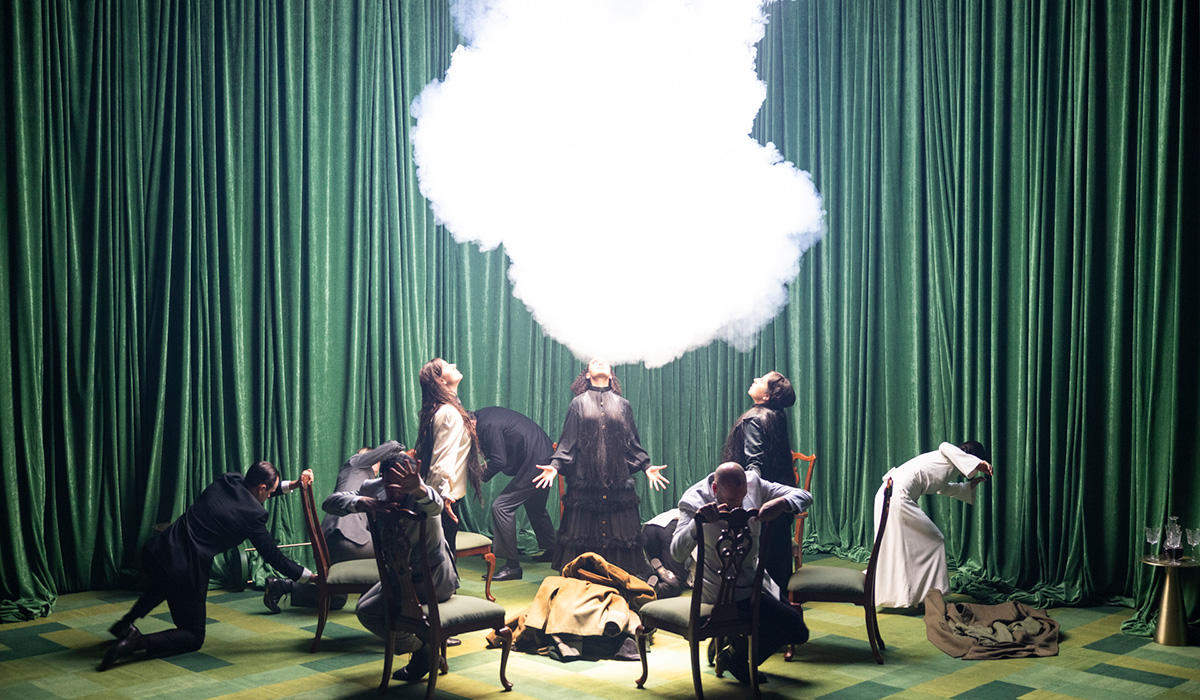 The cast of Macbeth (photograph by Brett Boardman)
Standout performances included Julia Billington as Banquo, who struck the right notes as an affable chum and comrade for Macbeth, and James Lugton as King Duncan, but perhaps more so as the comical Porter (if only he emptied his hat on the audience!). Lady Macduff and her son (Isabel Burton and Eleni Cassimatis) capture the sweet snapshot of the Macduff family home before tragedy strikes, but this scene seems truncated, and the pathos of Macduff (Jacob Warner), sometimes the most excruciating moment of the play, seems still to be finding its feet. One missed opportunity in this production was the treatment of the three witches, who didn’t seem particularly ‘witchy’ at all – neither vocally nor in their costumes. Has ‘witchiness’ been cancelled? Are the stereotypes of the ‘witch’ considered too crude for the contemporary stage? Did the opportunity fall prone to the dominating modes of realism? At best, the witches seemed to become mere ‘Blavatskian’ spiritualists, despite their segments being supported by some impressive pyrotechnics. The program devotes two pages to fifteen costume designs by Tregloan, yet none of them was for the witches. This seems unMacbethian to me. Nonetheless, I am still applauding the actors, days after the standing ovation they received on opening night.
Macbeth (Bell Shakespeare) is at the Sydney Opera House until 2 April 2023. Performance attended: 1 March.