


- Free Article: No
- Contents Category: Opera
- Custom Article Title: A Deep Black Sleep
- Review Article: Yes
- Article Title: A Deep Black Sleep
- Article Subtitle: A new opera about political expediency
- Online Only: No
- Custom Highlight Text: In 1990, composer and artistic director Konstantin Koukias and production director Werner Ihlenfeld founded IHOS Opera in Tasmania. Audiences were excited and astonished by the scale and ambition of the director’s vision when they attended his earlier, spectacular productions such as Days and Nights of Christ, To Traverse Water, and Tesla.
- Article Hero Image (920px wide):
- Article Hero Image Caption: A Deep Black Sleep (photograph by Mona/Jesse Hunniford)
- Alt Tag (Article Hero Image): A Deep Black Sleep (photograph by Mona/Jesse Hunniford)
- Production Company: IHOS
Days and Nights of Christ and To Traverse Water – similarly large in scale, musically and visually moving works – were based on Koukias’s family experience. The first was modelled on his brother’s schizophrenia, the second on his mother’s departure from Greece and her arrival in Australia.
No one was surprised when Hobart became too small to contain IHOS – meaning ‘sound’ in Greek – and when its creative director moved his company to Amsterdam, where it has continued to thrive for the past ten years. Its latest production, A Deep Black Sleep, which had its première at Mona Foma last weekend, attests to its continuing scope and ambition.
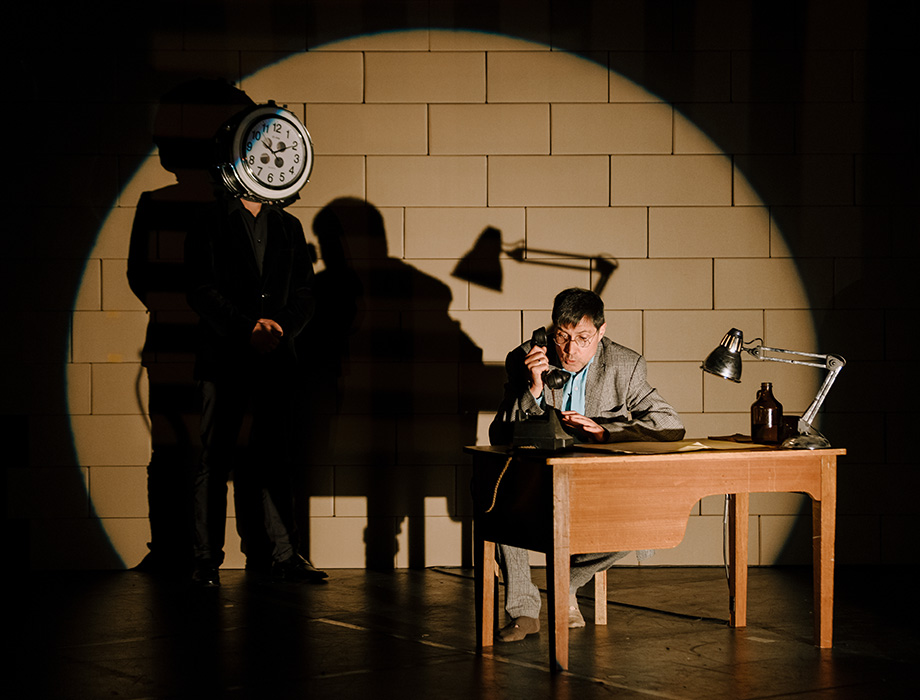
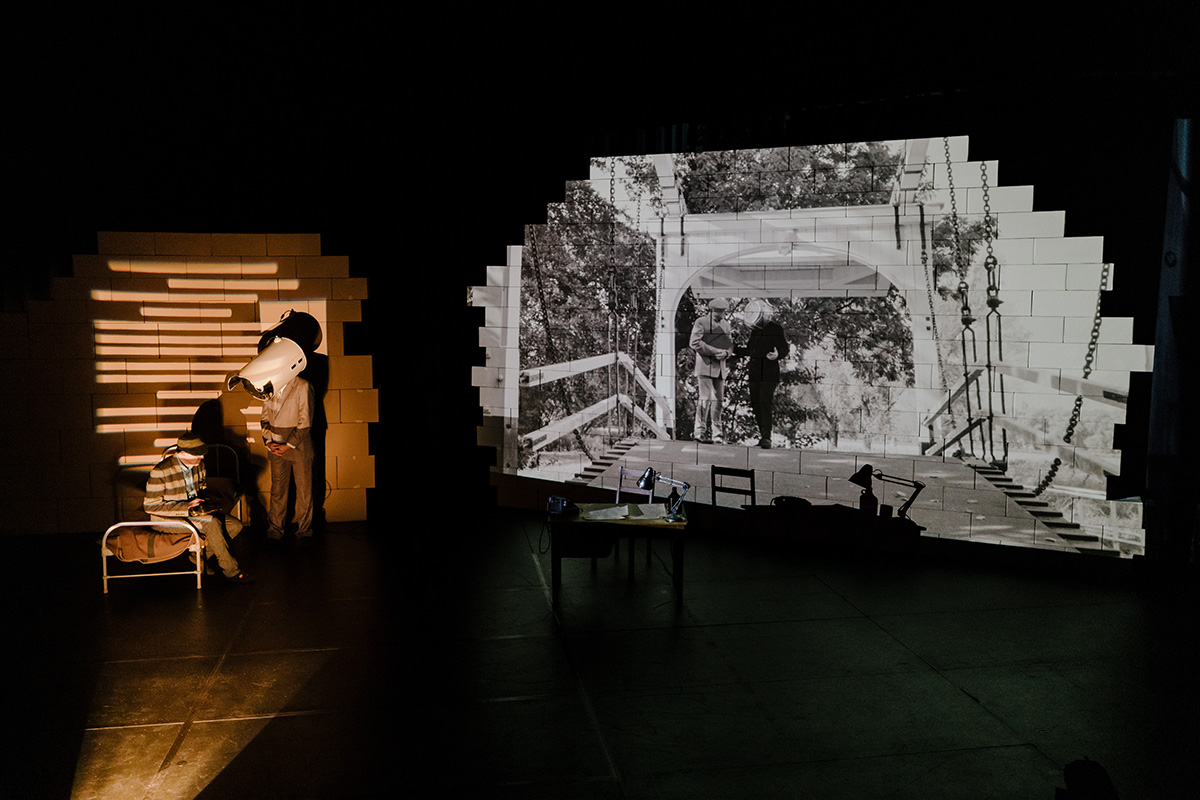
‘Totalitarianism starts when the difference between your public life and your private life is effaced,’ wrote Timothy Snyder. This might be the central tenet of A Deep Black Sleep, which features gifted UK tenor, musical director, actor, and composer Tyrone Landau as its protagonist. The libretto is written by Alan Mauritz Swanson, an American composer and academic who lives in the Netherlands. The production is a sung monologue, more intimate in scale than IHOS’s early works, though its topos is broad in magnitude. Lighting and chiaroscuro are pivotal effects in probing the tensions between state and individual, artistic integrity, and the demands of authoritarian ideology. The stage is simple: a bed and desk with lamp are placed before an imposing wall on which, in film noir mode, slatted shadow and light are projected. We meet the nameless composer, who is working on a commission which seems senseless to him. What he desires most of all is a commission to compose music for the libretto a dying friend has sent to him, a work of great meaning.
 A Deep Black Sleep (photograph by Mona/Jesse Hunniford)
The musicians – composer/performer Gabriella Smart, violinist and electronic composer Hayato Simpson, Julius Schwing, Derek Grice, and Konrad Park, conducted by Don Bates – perform out of sight, behind the wall, doubling up on stage as faceless materialisations of the junta. It was a pity for the audience not to be able to see the instrumentalists, though difficult to imagine how this could happen without interrupting the essential spareness of the scene.
Remarkably, the music to the whole work was conceived through improvisation. Musicians and conductor met together for the first time eight days before the first performance, the work thus becoming ‘rehearsed improvisation’. This is ‘[a]bout as far away from La Bohème as you can get’, as a reviewer for The Australian wrote of an earlier IHOS production. An improvised opera is certainly hard to imagine, but the long experience and collaboration of Landau, Koukias, Smart, and Bates, is clearly in evidence in their adroit cohesion. Much of the narrative is conveyed as recitative. The parts in which the masterful Landau exercises his full vocal expertise are arresting. Bates’s efficiency, sheer bravery, and accomplishment in bringing together Koukias’s concept deserves plaudits. Landau’s poise and ability to sustain the monologue are remarkable.
For me, the ending disappointed. The production cumulatively sets up a situation of inconclusion, ambiguity, and uncertainty, which need to be maintained to the last moment. Mostly, though, I found the experience of this work to be poetic, conceptually, musically, and visually. The wistful black-and-white film footage projected on the rear wall interacts permeably with psychological events unfolding on stage. There is method to the emerging narrative, which has no temporal sequence. The composer struggles under the increasing pressures of the system, with its demands that he direct his creativity to the Cause (which becomes our Cause and ultimately my that is, the composer’s – Cause). A mood of frustration, whimsy, and emotional impoverishment is created. In the piecemeal yet cohesive interaction of recitative, singing, film, stage, and symbolist imagery, I found T.S. Eliot coming to mind. Surrealist effects are present throughout. Manifestations of the many-layered agencies of the regime appear one by one in the composer’s room. Each communicates with him menacingly and with unbalancing ambiguity. None speaks, each identified by picturesque head gear: a cage full of birds, a clock face, heavy metal thugs have heads entrapped in alfoil. A live horse enters at one stage to exhort the composer to comply. The single agent who is always present and on stage, a Cyclopean human camera, is disturbingly the one who is invisible to the composer. Surveillance is a chilling part of the contemporary world. An opera about artistic values and political expediency, the vulnerability of the artist in an authoritarian regime, is more topical than one would wish.
A Deep Black Sleep (IHOS Amsterdam) was at Mona Foma from 23–25 February 2023. Performance attended: 25 February.