


- Free Article: No
- Contents Category: Theatre
- Custom Article Title: Prima Facie
- Review Article: Yes
- Article Title: Prima Facie
- Article Subtitle: The return of the Griffin production
- Online Only: No
- Custom Highlight Text: Since first being produced at Sydney’s Griffin Theatre in 2019, Suzie Miller’s play Prima Facie – a legal drama about consent and sexual violence – has become something of a phenomenon. Awarded Griffin Theatre’s playwriting prize in 2018, the subsequent production was enthusiastically received by audiences and critics alike. A 2022 West End production – propelled by the star power of Killing Eve’s Jodie Comer – garnered international acclaim, the National Theatre’s live screening of the production becoming one of 2022’s highest grossing British films.
- Article Hero Image (920px wide):

- Article Hero Image Caption: Sheridan Harbridge as Tessa Ensler (photograph by Brett Boardman).
- Alt Tag (Article Hero Image): Sheridan Harbridge as Tessa Ensler (photograph by Brett Boardman).
- Production Company: Melbourne Theatre Company
In interviews, Miller notes that since she traded in her own law career for playwriting, she has been aware of the dramatic potential in the tension between (to quote from the play itself) ‘a woman’s experience of sexual assault … [and] the male-defined system of truth’ that underpins our system of justice. When she finally turned that idea into a script, Miller found few theatre companies interested in taking it on, and it wasn’t until it won the Griffin Prize and was championed by Griffin’s then artistic director, Lee Lewis, that Prima Facie was given its opportunity.
Prima Facie is an expertly crafted monologue, and a gift for any actor to play, but that in itself doesn’t explain the extraordinary response the play has received. Indeed, one suspects that the play may well have suffered the fate of most other fine Australian plays – a short run of performances and a flurry of favourable critical notices – were it not for the serendipity of its timing.
 Sheridan Harbridge in Prima Facie (photograph by Brett Boardman).
In 2017, #MeToo became a global movement. While feminists had been agitating for decades about defects in the way the legal system handled cases of rape, the amplifying effects of social media succeeded in focusing unprecedented attention on the profound power imbalance that drives sexual assault against women and the obstacles women face in bringing perpetrators to justice.
Prima Facie not only speaks to the #MeToo moment, it crystallises the experience of women who suffer sexual assault. Crucially, it also painfully demonstrates how, in enforcing the right of the defendant to a presumption of innocence, the law imposes an undue burden on women not just to prove their case but to justify their right to be believed. The experience of rape, as Tessa reminds us, is not remembered in the ‘neat, consistent, scientific parcel’ that the law demands.
Sheridan Harbridge’s Tessa begins all sass and confidence. In an expertly conceived opening scene, Tessa describes the adrenalin rush of cross-examination. It is a sport, a competition (‘You’re only as good as your last brief’), and Tessa takes a shameless delight not just in winning, but in winning in a way no one – not the prosecution, not the defendant, not the witness – sees coming. She is unapologetic about her tactics. She doesn’t get emotionally involved. She just plays the game within its rules.
She is, Tessa tells herself as she probes holes in the evidence of a sexual assault victim, merely doing what she has been trained to do. If her client is found not guilty, she reasons, the blame lies with the police and prosecutors who have not done a thorough enough job of proving their case. She trusts in her mantras: there is ‘no real truth, only legal truth’, ‘defence is about human rights’, ‘he did not know there was no consent’.
If there is a question Miller might have interrogated more deeply, it is why so many women like Tessa are, consciously or unconsciously, complicit in the undermining of other women? Why, as Prima Facie suggests, do we need to find ourselves on the other side of the equation before we recognise the insidiousness of the particular social or legal structures we are upholding? Why are we persuaded to believe that trying to beat men at their own game is the only way for women to make their mark?
Miller goes some way towards answering these questions in giving Tessa a working-class background and a compelling need to prove herself worthy of her place in prestigious chambers, surrounded as she is by the offspring of judges and products of the private school system. For all her mockery of posh schoolgirls and ponderous judges, Tessa can’t shake the chip on her shoulder. While this impels much of her allegiance to the ‘legal truth’, it doesn’t entirely account for her refusal to acknowledge the full emotional toll being borne by the women she cross-examines. In allowing Tessa to doubt the law but not her own loyalty to it, Miller perhaps lets Tessa off too lightly.
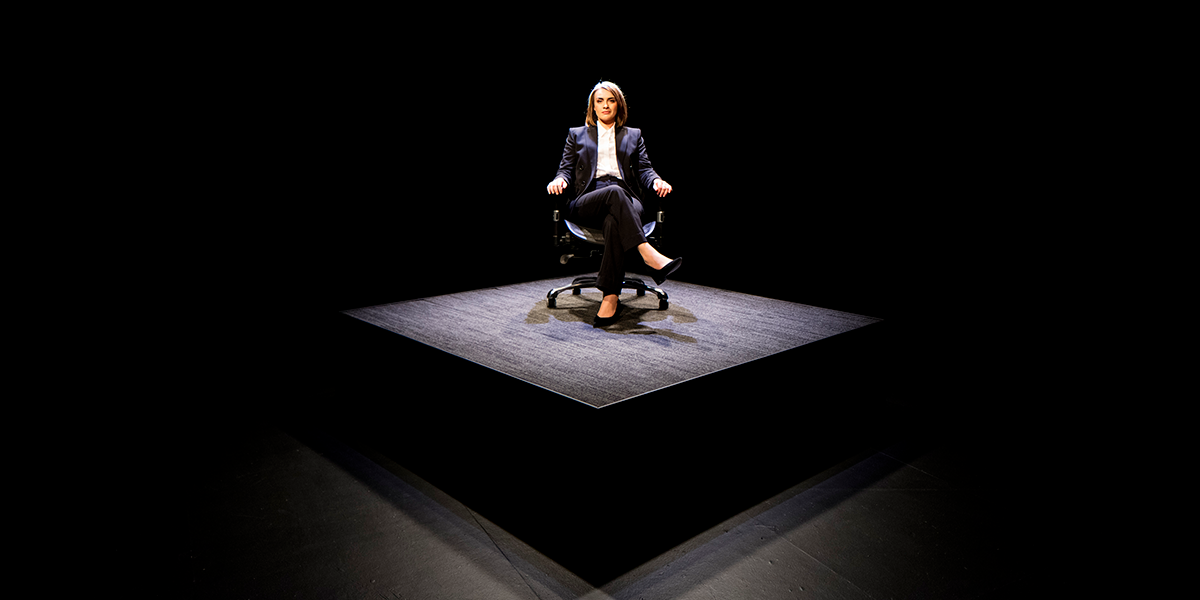
As Tessa, Harbridge skilfully navigates the currents that carry her from exhilaration to confusion to despair. In a perceptively calibrated performance, Harbridge brings not only emotional heft to Tessa’s story but also a striking physicality, notes heightened by Lee Lewis’s sensitive direction. As Tess manoeuvres a single black office chair (set design by Renée Mulder), we witness the joy she takes in her own body, from her embodiment of those people she mimics and mocks to her abandoned dancing on a night out with colleagues. Not only does the sexual assault rob Tessa of her own agency in her body – her delight in her own sexuality – there is in Harbridge’s performance a palpable sense of the deadening shift in Tessa’s centre of gravity.
Watching Prima Facie in 2023, it is impossible not to feel the echo of what was, in effect, the trial of Brittany Higgins as she sought to press a case of sexual assault against her colleague Bruce Lehrmann. While Prima Facie deftly encapsulates the issues arising out of that aborted trial, there is now a sense that this is a play running behind the news rather than ahead of it. Notwithstanding, both the play and its real-life mirror ask the same pivotal question of our judicial system: why are the women in these cases forced to lay out their heart and soul for ‘the law’ to pick over, while the men are permitted not only to remain silent but also to let ‘the law’ do their speaking for them?
Prima Facie may offer no answer as to how we might make the legal system more equitable for victims of sexual assault while still enforcing a necessary right to the presumption of innocence. Nevertheless, it is a forceful and moving argument against the status quo.
Prima Facie (Melbourne Theatre Company) continues at the Fairfax Studio, Arts Centre Melbourne until 25 March 2023. Performance attended: 11 February.