


- Free Article: No
- Contents Category: Film
- Custom Article Title: The Son
- Review Article: Yes
- Article Title: The Son
- Article Subtitle: Parenthood as a horror show
- Online Only: No
- Custom Highlight Text: Given the success of the film adaptation of his previous play, The Father (2020), with an Academy Award-winning lead performance from Anthony Hopkins and a slew of nominations for himself, it seems only natural that writer–director Florian Zeller should turn to another in his trilogy of plays, The Son, for his next film project. (Zeller’s play, Le Fils, had its première in Paris in 2018.) Co-written by famed English playwright Christopher Hampton and shot by cinematographer Ben Smithard, who both worked on the earlier film, The Son represents, in many ways, a consolidation of Zeller’s talents, even if it doesn’t quite reach the harrowing intensity of The Father.
- Article Hero Image (920px wide):

- Article Hero Image Caption: The Son (courtesy of Transmission Films)
- Alt Tag (Article Hero Image): The Son (courtesy of Transmission Films)
- Production Company: Transmission Films
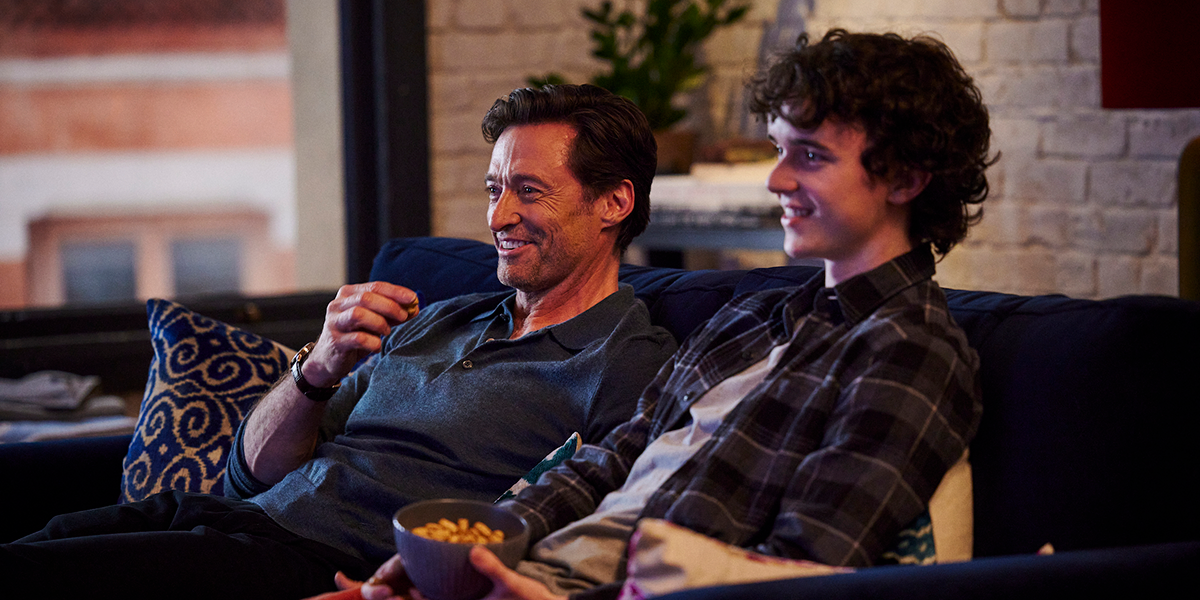 Hugh Jackman and Zen McGrath in The Son (courtesy of Transmission Films)
There are three sons in The Son; the title could refer to any of them. Theo, the first one we meet, only months old when the film opens, is the newborn son of Peter (Hugh Jackman) and Beth (Vanessa Kirby). Soon, ex-wife Kate (Laura Dern) interrupts their idyll with troubling news regarding Peter’s first son, Nicholas (Zen McGrath), who has been skipping school. Kate is not simply worried about Nicholas; she admits to being, in a hushed tone of parental failure, afraid of him. Soon Nicholas comes to stay with his father and stepmother, in a move designed to fix a problem we suspect will only worsen.
This set-up is reminiscent of a sub-genre of horror cinema sometimes referred to as the ‘evil child’ film, most luridly exemplified by The Bad Seed (d. Mervyn LaRoy, 1956). This flirtation with genre is a curious feature of Zeller’s work, who leant on and then subverted horror tropes in The Father. Here he allows the idea of Nicholas’s malignancy to occupy the centre of the story without necessarily exploiting it. Moments that in other films would be leveraged for maximum tension, such as when Beth balks at the idea of Nicholas’s being left alone to babysit Theo, are revealed to be sadder and truer for their compassion and honesty. Depression is shown as burdensome for the entire family, frightening in its irrationality and resistance to succour, but also beyond the power of the teenager to control. There is nothing romantic about this existential aloneness; only a dark, centrifugal void, threatening to suck them all in.
 Zen McGrath as Nicholas in The Son (courtesy of Transmission Films)
While Nicholas is the inciter and engine of the film’s crisis, it is really Peter who interests Zeller most. Jackman proves worthy of the attention, delivering one of the finest performances of his career. Harried, conflicted and achingly well-meaning, Peter often seems to be caught in a pincer movement between the past and the present. Jackman’s natural charm and magnetism stand here as a mask or prop against despair, which appears to churn dangerously under the surface. Self-composure, competence, and the trappings of success feel not just unstable in The Son but wilfully dishonest; it is to Jackson and Zeller’s credit that we see these lies as necessary bulwarks against a collapse of the self.
Much of this psychic tenuousness can be traced back to Peter’s relationship with his own father, played with malevolent indifference by Anthony Hopkins – closer in pathology to his Hannibal Lecter than the paterfamilias of Zeller’s previous film. Hopkins has a single scene in The Son, but it resonates, poisoning as it goes. Philip Larkin’s ‘coastal shelf of misery’ comes to mind here, but it is also worth noting that Peter’s father has some words of advice for his son that contain more than a little truth. One of Shakespeare’s favourite tricks is to put words of sagacity into the mouth of a villain.
Performances across the board are excellent. Dern brings a weariness and longing to Kate that suggests the ongoing pain of broken relationships and dashed hopes. Kirby – terrific in a sparsely written part – manages to convey a series of doubts and concerns with the subtlest of expressions. As the troubled son, Melbourne-born actor Zen McGrath is deeply affecting, mercurial and untrustworthy and yet simultaneously fragile and sincere. Zeller lets us see how frustrating, even irritating, his illness can be for others, but he never lets us forget the boy’s torment.
As in The Father, the film’s ‘opening out’ of the play is seamless and thoughtful; it sacrifices none of the original’s emotional telescoping or thematic complexity. Despite pacing that waxed and waned, The Father was an incredibly lean, economical ninety-seven minutes. A good half hour longer, The Son occasionally risks a slackening in tension.
The film The Son most seems to riff on, or perhaps stand as a rejoinder to, is Ordinary People (d. Robert Redford, 1980). That took the theme of suicidal ideation in teenagers as a chance to open wounds in the American family structure, although it had the unfortunate tendency to blame the mother. The Son places the blame squarely on fatherhood, or rather traditional fatherhood’s flawed social legacy. At one point, Peter tells his son, ‘When you hurt yourself, you’re doing it to me.’ Nicholas’s response is swift and devastating: ‘When you hurt mom, you did it to me.’
The Son (Transmission Films), 124 minutes, is on general release from 9 February 2023.