


- Free Article: No
- Contents Category: Film
- Custom Article Title: TÁR: Todd Field's magnificent new film
- Review Article: Yes
- Article Title: TÁR
- Article Subtitle: Todd Field's magnificent new film
- Online Only: No
- Custom Highlight Text:
I worked front-of-house at the Melbourne Recital Centre for the better part of my twenties, sitting in on hundreds of classical music performances during that time. The highlight for me was a performance by the Australian Chamber Orchestra of Wojciech Kilar’s Orawa. I was to accompany a number of VIPs who would be seated onstage for the duration of the performance, just behind the orchestra, facing out – inverting the perspective I had grown so accustomed to. Now, with the musicians’ backs to me, and the audience in darkness, there was only one person for me to focus on: the conductor.
- Article Hero Image (920px wide):
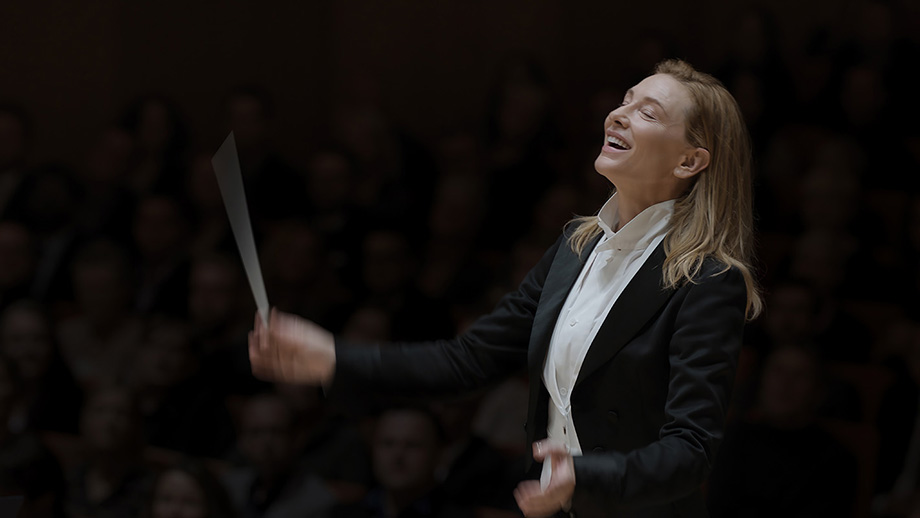
- Article Hero Image Caption: Cate Blanchett in TÁR (Universal Pictures Australia)
- Production Company: Universal Pictures
For the first time, I saw what an orchestra sees during a recital – the maestro’s immense physicality and emotion, shared with the players but concealed from the crowd. Surely there is no other position in the arts quite so rarified or contradictory – these are top-billed, international superstars who mount the podium, silently turn their backs, then remain that way all night. Their performance is measured by the power they wield over others. Perhaps this is why writer–director Todd Field chose to centre his new film, the magnificent TÁR, on the figure of a conductor, as the role holds a unique and inherent duplicity; what those in the conductor’s inner sanctum see is not what the rest of the world sees. Their lives are a delicate balance between public and private performance.
TÁR is many things – a treatise on authority and its innate corrosiveness; a blistering satire of the classical music industry (though this could be substituted for any institution that thrives on cliquishness and hierarchy); a chilly, European ghost story; and a career-best performance from Cate Blanchett, who, if she hadn’t already by now, cements herself as one of the definitive performers of this or any time. Yes, this is also a film about ‘cancel culture’, a term which may spark either ire or exhaustion in you, depending on how much time you spend on Twitter. But TÁR trumps most stories that have attempted to grapple with this thorny concept in recent years, in that it is everything both the decriers and proponents of moralistic mob justice are not: nuanced, detailed, and painstakingly thorough. Which is not to say that Todd Field wishes to remain ambivalent on the matter or to let his problematic protagonist off the hook. As in his two other films, In the Bedroom (2001) and Little Children (2006) – richly human character studies of murderers, paedophiles, and adulterers – he is simply committed wholeheartedly to the act of understanding.
Lydia Tár (Blanchett) is not a real person, and this is not a biopic. It feels necessary to state this outright, given that some people on the internet have expressed feeling ‘cheated’ after viewing the film, having assumed it was the dramatic retelling of a true story. This is both a sad indictment of the entertainment landscape’s reliance on existing IP, and a backhanded endorsement of how vividly Field and Blanchett have brought the character to life.
We meet Lydia onstage at a New Yorker event, in conversation with real-life staff writer Adam Gopnik, who introduces her as one of only a handful of EGOTs (having won an Emmy, Grammy, Oscar, and Tony). She’s the conductor of the Berlin Philharmonic, and shares a home, and daughter, with the first violinist and concertmaster, Sharon Goodnow (the brilliant Nina Hoss). She wears suits by Egon Brandstetter, flies in private jets, and appears on Alec Baldwin’s podcast. She is about to release her memoir (TÁR ON TÁR) while preparing to record Gustav Mahler’s Fifth Symphony, her white whale, the crowning achievement of her life’s work, which will immortalise her as one of classical music’s all-time greats. But her assistant, Francesca (a captivatingly strung-out Noémie Merlant), has been receiving troubling emails from one of Lydia’s ex-protégées, a young woman named Krista Taylor. When Lydia blatantly undermines a blind audition for a new cellist in order to hire the beautiful young Olga Metkina (Sophie Kauer), it becomes clear that this is a pattern of behaviour which Lydia’s status has thus far enabled her to indulge in unchecked – but which may be about to catch up with her.
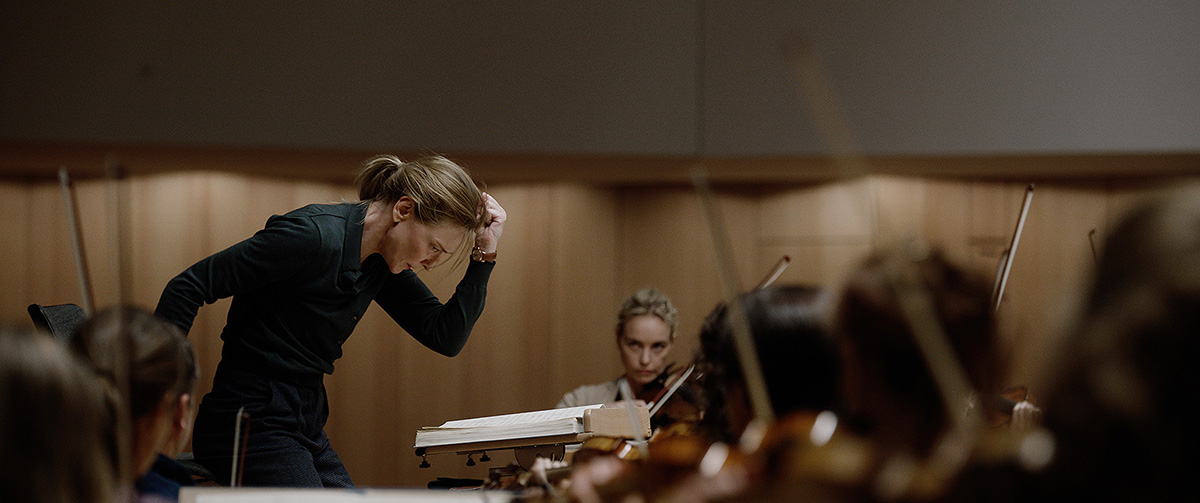 Cate Blanchett in TÁR (Universal Pictures Australia)
Here the film shifts gears from poised character study to simmering psychodrama. Lydia is afflicted by phantom pains and grows sensitive to invasive sounds, like the rattling of a car’s airconditioning or the overt hum of a refrigerator. She hears a woman screaming in the woods. She is sent mysterious packages. Field adorns his frame with eerie background figures and unsettling negative space. Externally bedevilled though she may be, it is Lydia who is the spectre at her own feast; her own reckless obsessions which threaten to unmask her, forcing what was private into public. This is how TÁR quietly asserts its position on the cultural arguments at its core, clarifying that while greatness offers prodigious opportunity for both altruistic and amoral behaviour, it is ultimately an individual’s choices which will cement either their renown or ruin.
As an actor, Todd Field played the pianist Nick Nightingale in Stanley Kubrick’s Eyes Wide Shut (1999), supposedly shadowing the great director on set and absorbing everything he could. It shows to this day – TÁR is nothing if not Kubrickian in its intentionality. As a film about control, every moment is fittingly deliberate, and technically flawless. Field and his cinematographer, Florian Hoffmeister, capture the brutalist environments of Lydia’s life and work with restrained admiration. Actors are arranged in compelling wide shots that build more and more tension the longer they are held (one early sequence, in which Lydia dresses-down a Gen Z Juilliard student, unfolds in a single, breathless take). Hildur Guðnadóttir – referenced in the film itself as a trailblazing female composer – oversees the original music, working hand-in-glove with the featured classical pieces. Every piece of furniture and item of clothing is beautiful, considered, and somehow insidious. Equally exacting are the choices Field makes regarding which parts of the story we see, and which parts we do not. Seemingly pivotal plot points are omitted in favour of moody, symbolic detours, and the back half of the film is cunningly constructed in such a way as to force us to see the world through Lydia’s eyes, through the lens of her self-aggrandisement. This could be misread as an attempt at forced empathy, but Field isn’t asking us to pick a side – simply imploring us not to look away.
When discussing the music of Bach (luminary symphonist and father of twenty), Lydia suggests that good composers understand ‘it’s the question that involves the listener – never the answer’. Todd Field understands this, too. It’s hard to remember a modern film which treated its audience with this much respect, or trusted them to do so much work to get at the heart of a movie – but in TÁR, the clues are everywhere, both visual and sonic. When they are assembled the right way, not only do the film’s many thematic threads coalesce into a remarkable symphonic whole, but you realise – somewhat surprisingly – just how bleakly funny it all is. Without spoiling anything, the closing stretch is a staggering grace note (or punchline, perhaps) which lands once the film seems to have wrested control from its own domineering protagonist. At the start of the movie, scenes last ten or fifteen minutes at a time – the audio is mixed in mono – the hermetically sealed interiors that Lydia frequents are perfectly and oppressively silent (all the better to be cut through by an explosion of orchestral music or a distant, ominous noise). But over its hefty 160-minute runtime, the film changes – imperceptibly at first, then more and more noticeably. The pacing accelerates and the sound mix opens up, letting in more of the organic noise of the actual, real world. TÁR moves with the serene, sickening pull of inevitability, taking on new life as Lydia Tár loses control of hers. It is a film in perfect sync with the medium, with its creator, and with our times. Bravo.
TÁR (Universal Pictures Australia), 158 minutes, in cinemas from 26 January 2023.