


- Free Article: No
- Contents Category: Film
- Subheading: Herzog’s tribute to two volcanologists
- Custom Article Title: The Fire Within: A Requiem for Katia and Maurice Krafft
- Review Article: Yes
- Article Title: The Fire Within: A Requiem for Katia and Maurice Krafft
- Article Subtitle: Herzog’s tribute to two volcanologists
- Online Only: No
- Custom Highlight Text: 'The devil’s throat’, ‘the devil’s lair’, ‘the devil’s cauldron’: if volcanoes are the hearth of the devil, there is no question that Satan has an irresistible allure. To watch the earth split asunder and spew up its entrails in a roiling inferno is to encounter the elemental turbulence that festers underneath the stable ground we tread. It shakes all certainty to its core. It brings us face to face with all our cultural imaginings of the rage of apocalypse, and we cannot take our eyes off it.
- Article Hero Image (920px wide):
- Alt Tag (Article Hero Image): The Fire Within (courtesy Maurice and Katia Krafft & Titan Films)
 The Fire Within (courtesy Maurice and Katia Krafft & Titan Films)
We know from the first moments of the film that they will die, engulfed by a superheated pyroclastic flow racing toward them at breakneck speed as they waited with their cameras to capture the anticipated explosion of Japan’s Mount Unzen in 1991. There was no chance to outrun it. Death would have been instant. In an interview with a journalist as they waited on the mountain, Maurice said, ‘I have seen so [many] eruptions in twenty-three years that even if I die tomorrow, I don’t care.’ According to Herzog, ‘[a] fire within has taken hold of him. It is the same with Katia. She expressed it clearly in an interview: "I cannot live without volcanoes."' Maurice’s words on the mountain that day are spoken lightly, flippantly, with a smile on his face, but that ‘tomorrow’ will be the day both he and Katia will perish.
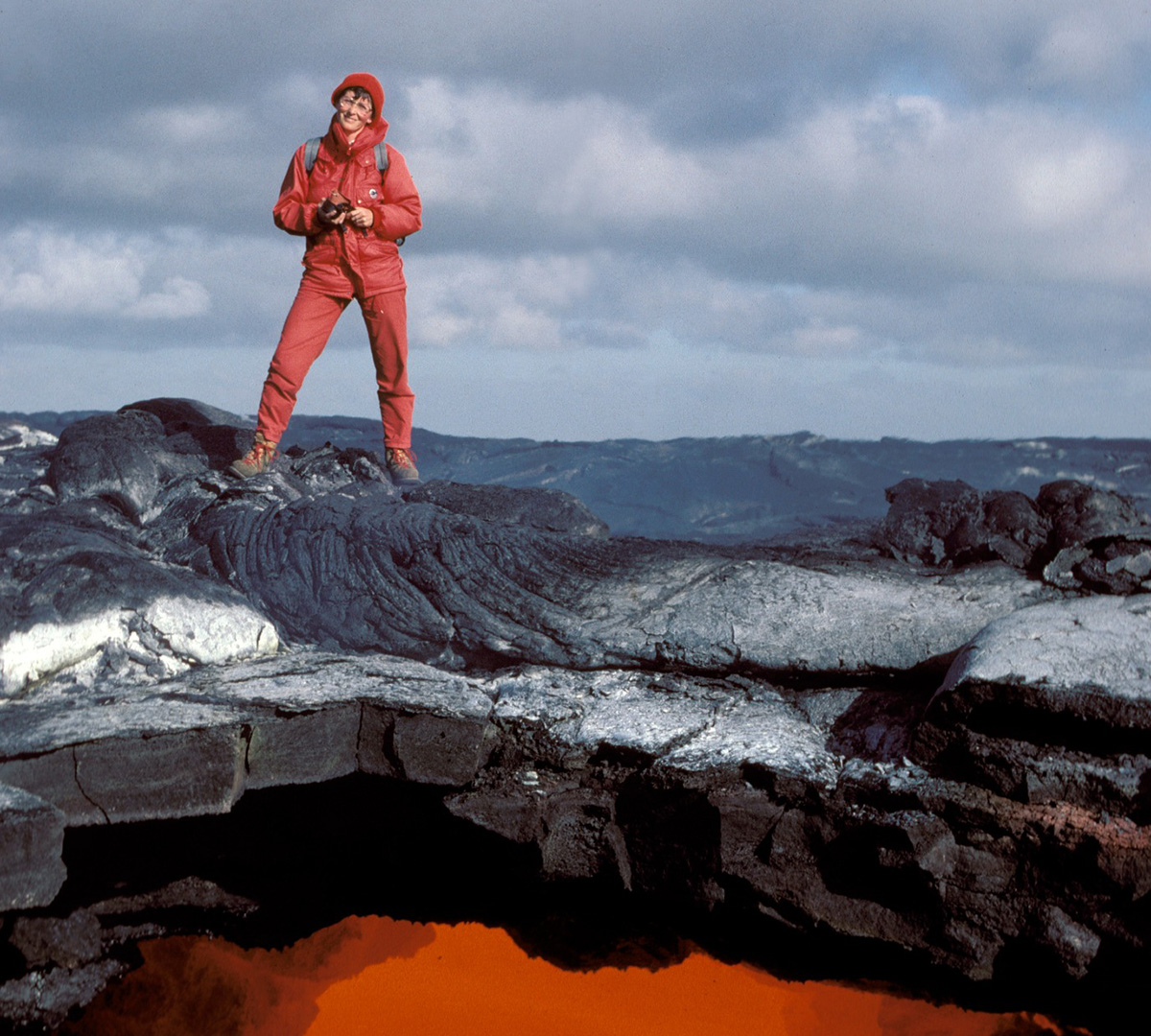
The Kraffts’ spectacular footage of volcanic eruptions forms the energetic core of the film. These images are framed by a series of narrative segments, spoken in Herzog’s characteristically pensive voice, that trace the evolution of their work and recount their travails as they ventured into often remote and challenging terrain to reach the eruptions. Initially, the Kraffts’ study of volcanoes focused on ‘the red ones’: the lava eruptions that shot up plumes of red melt that bubbled and surged over the earth, streaming through the clefts, and cascading in waterfalls and rivulets. In their later years, it was ‘the grey ones’ they chased: the lethal ones that exploded in vast billowing clouds of ash, debris, and gas: the pyroclastic flows that catapulted across the land, devouring everything in their wake.
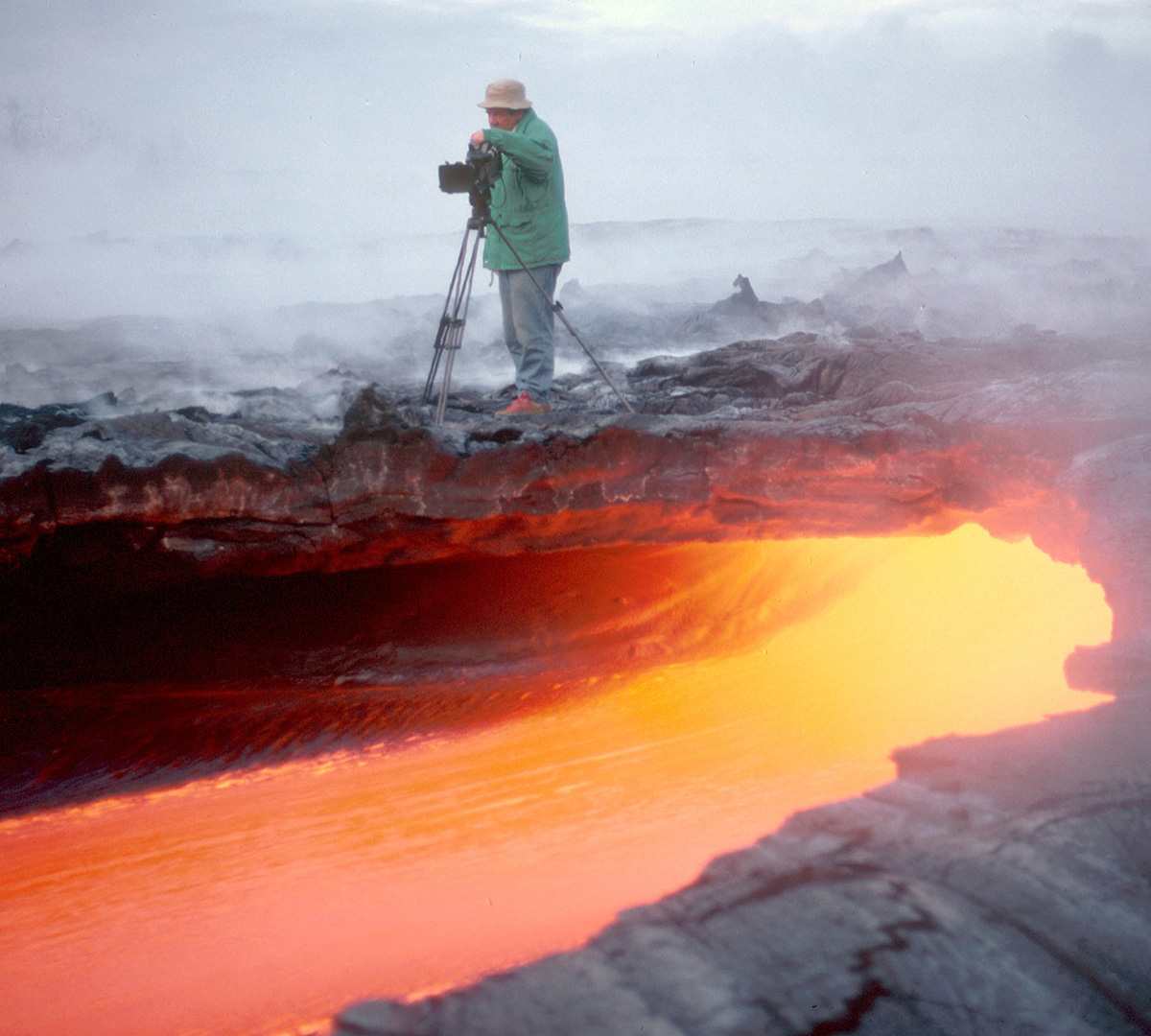
Herzog’s narrative segments give a context; they serve as a springboard to launch into the real work of the film: extended montage sequences of the eruptions. These superbly edited montages break out of any story logic and transport us to a place of rapture. The Kraffts’ camera takes us into a world distilled to the elements – earth, fire, water, air – a surreal, alien landscape pared back to black, white, and the red-yellow end of the spectrum: a furnace of fire, lava, and ash. Writhing serpentine folds of red, marbled with orange and yellow streaks and rippling black splotches, course across the land, set against a leaden sky. A viscous, tar-black skin creeps in a relentless primeval ooze, rupturing, festering, and weeping vermillion and amber pus. White chimneys protrude from a village entombed in black pitch, as fountains of red lava spew across the horizon and steam wafts up from fumaroles, shrouding the land in a ghostly white. A deluge of black lava rolls like molasses down a mountain, tipped with rills of red and orange. It is like watching the mountain dancing in slow motion in an ebony flamenco skirt, fringed with rows and rows of shimmering carmine and tangerine frills. As Herzog says of the Kraffts at the peak of their cinematic work, ‘They are no longer volcanologists. They are artists who carry us the spectators away in a realm of strange beauty. This is a vision that exists only in dreams. There is nothing more that should be said. We can only watch in awe.’
In Herzog’s montages, language falls away and the roar of the volcano yields to a soaring, ethereal soprano and the sepulchral rumble of an operatic bass – so deep it feels dredged from the bowels of the earth. Fauré, Verdi, Bach, Vivaldi, and the haunting laments of composer Ernst Riejseger sweep us into the flow of the images and forge the hypnotic sequences into mournful operatic arias. The harmonies of a requiem mass carry the experience of the volcanoes onto the plane of the sublime: profound, exquisite, moving. It is worth watching the film as a musical experience alone. So powerful is this fusion of music and image that it is easy to lose sight of what Herzog is doing here.
 Werner Herzog in Into the Inferno (2016) (photograph courtesy of IMDb)
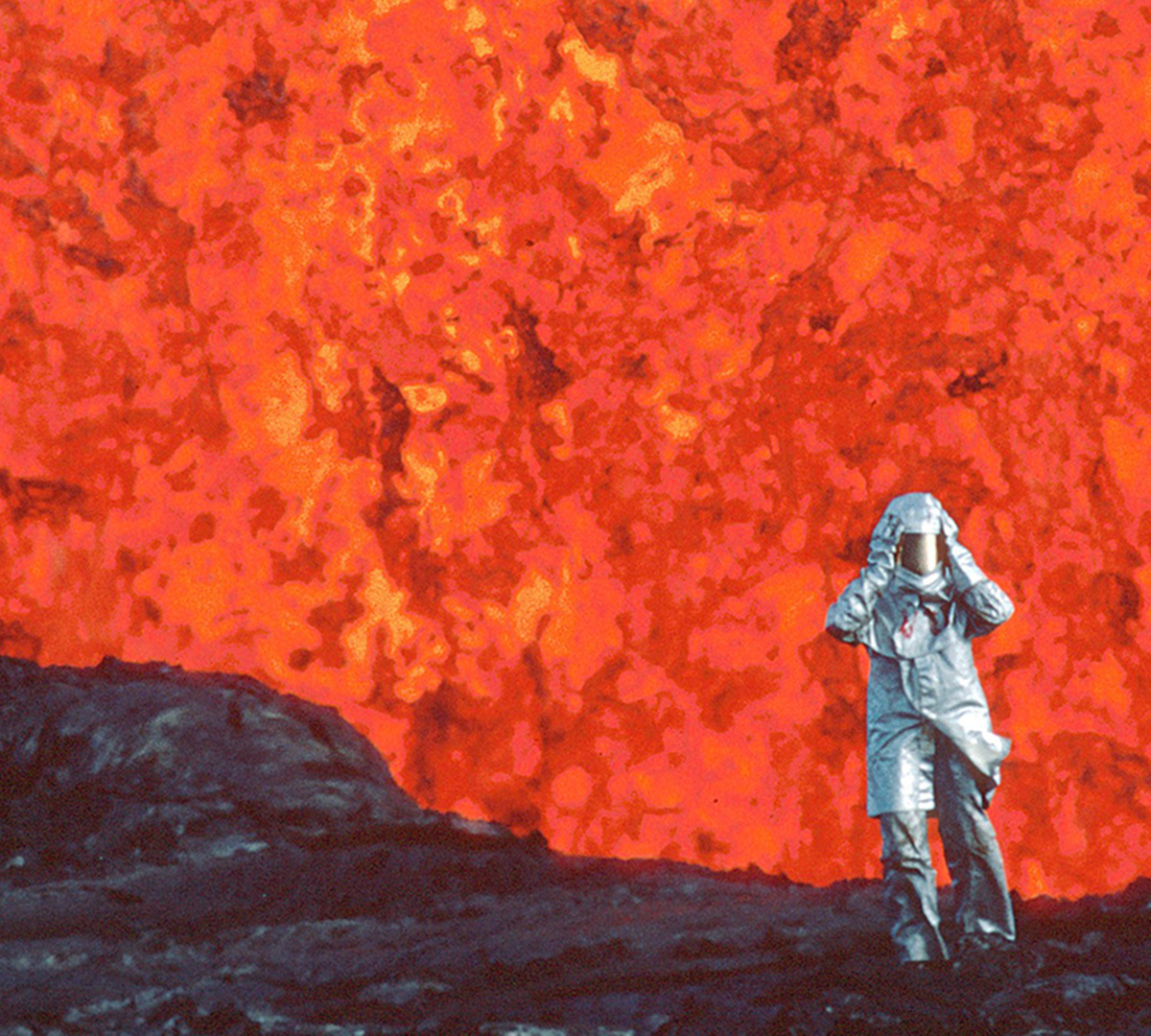
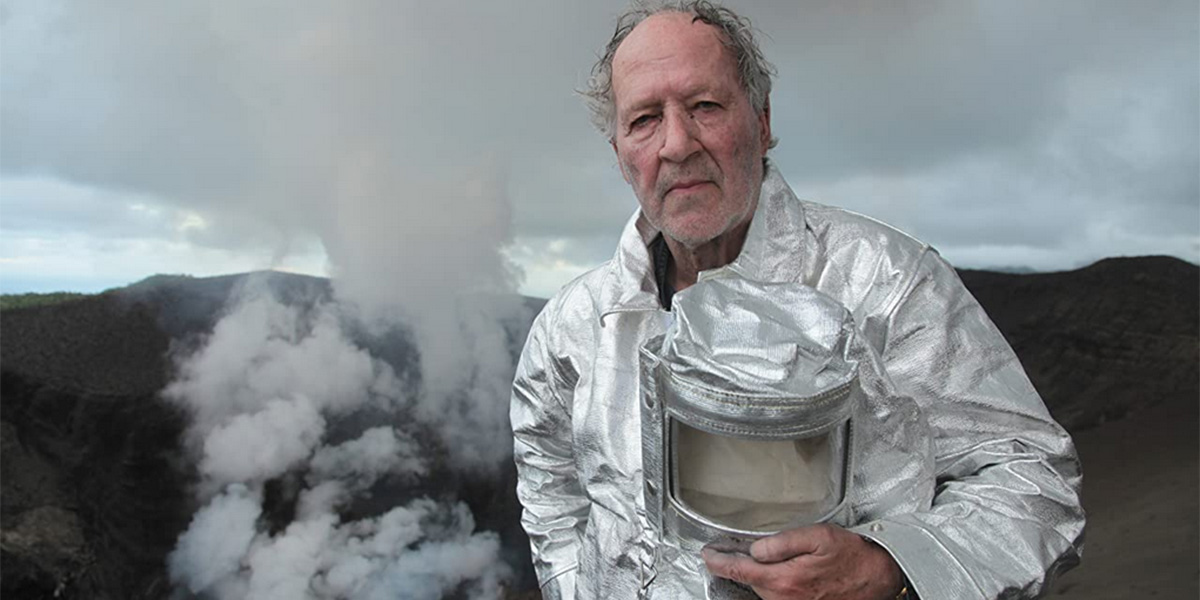
In the film, we see a diminutive figure in a shiny silver protective suit standing on the very edge of a torrent of red lava: Katia with her microphone. She was both photographer and sound recordist. The Krafft Medal awarded to a volcanologist every four years honours the work of the Kraffts, not just in filming and photographing, but also in recording volcanoes. In editor Marco Capalbo’s virtuoso montage sequences, however, the sound of the eruptions is erased: this is a silent, visual spectacle. As we watch the earth exploding into the sky, rupturing and remaking the land before our eyes, there is no noise, no sulphurous blast to ground us in terrestrial tumult. The musical score leaves the earthly realm behind and lifts us up into a transcendent vision of a divine act of creation. Excising the image from the sound and fusing it with a musical rendition of the European sublime moulds the footage into Herzog’s own personal imaginary. In his recent work, such as his earlier film on volcanoes, Into the Inferno (2016) and his exploration of meteorites, Fireball: Visitors from Darker Worlds (2020), this imaginary emerges in the pursuit of a mythical-mystical cosmology to integrate our place on the planet and in the universe.
Herzog has said that he is an atheist, but the musical lexicon he uses to convey awe and mourning is freighted with the cultural frameworks of Christianity. The Latin lyrics would be out of reach to most viewers, but many would be familiar with the repertoire: Pié Jesu (‘Merciful Jesus, grant them rest’), Stabat Mater (‘The sorrowful mother was standing beside the Cross weeping’), Dies Irae (‘The day of wrath … when the judge comes’), and others. In setting the hymns to music, it was this religious emotion that the composers were embodying in a musical idiom, and this religiosity is carried over into the way the montage shapes our experience of the volcanic eruptions. Unless, of course, we baulk at this finely crafted cloak that Herzog has wrapped so deftly around us.
The Christian narratives of redemption and of a divine act of creation proffer a cosmology that locates fire and brimstone in the afterlife – the hell that we can avoid if we stay on the straight and narrow. This reassuring narrative serves, in our cultural imaginary, to defuse the ticking time bombs in the mantle of the earth, to temper the tumult they evoke with the offer of heavenly salvation from the tribulations of earthly existence. There is none of the volatile, capricious, vengeful power of the pagan gods here; no clash of the gods hurling bolts of thunder and fury, whimsically toying with humans and liable to wreak havoc at any moment; no sense of chaos to knock us off our feet – none of the voluptuous materiality of the cataclysm. It is as if ‘incense triumphs over sulphur’, as geologist Salomon Kroonenberg writes in Why Hell Stinks of Sulfur.
There are other moments in the film when a musical choice reveals Herzog’s sleight of hand. As Katia and Maurice are led by a couple of vaqueros (cowboys) on horseback into the site of a Mexican eruption, the music of Mexican singer Ana Gabriel swells, full of that exquisitely suffering, yearning quality that characterises many of the greatest popular Latina singers. The mournful mood of the music matches the mood of the film perfectly, but for anyone who can understand the Spanish lyrics, there is a strange dissonance. In Tú Lo Decidiste, Gabriel is singing of the torment of love betrayed, of abandonment and heartbreak, and this is the emotional resonance of the song. There is a culturally blind corralling of other cultures into Herzog’s own imaginary here that also infuses his earlier film, Into the Inferno. Here he draws on the same Christian musical tradition, this time choruses sung by the monks in a Kiev monastery, spliced onto footage from Indonesia, Ethiopia, Vanuatu.
 The Fire Within (courtesy Maurice and Katia Krafft & Titan Films)
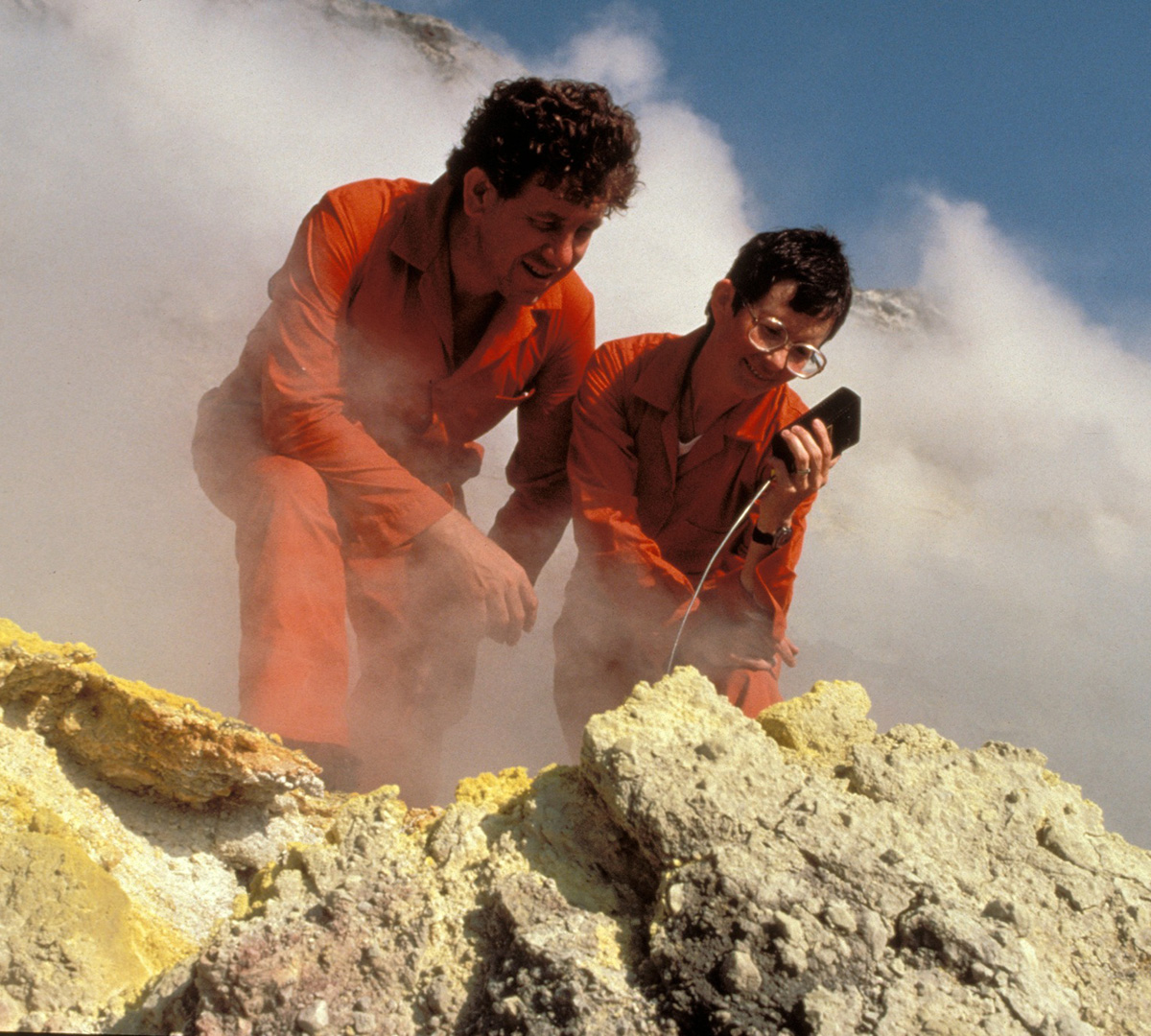
A second film about the life and work of the Kraffts, Fire of Love, directed by Sara Dosa, was released in the same month as Herzog’s requiem. This film takes a very different tack. It is essentially a biopic, framed as a love story, following the lives of Katia and Maurice and their relationship. Fire of Love is more upbeat, with boppy music and beautifully crafted animations. Here we learn much more about the scientific work of the pair – Katia as geochemist, Maurice as geologist – and their commitment to improving how little we know about eruptions and our inability to predict their timing and intensity. The film provides details of their off-volcano lives: Katia as writer and editor of photographic books, Maurice as showster doing lecture tours, both as celebrity volcanologists. We encounter their humour, their existential take on the dangers they face (‘curiosity is greater than fear’; ‘I prefer an intense short life to a monotonous long one’), their obsession (‘If I could eat rocks, I’d stay on the volcano and never come down’), and their commitment to persuading governments of the dangers of volcanoes and the need for timely risk mitigation.
The two films complement each other well, but for this reviewer there is nothing in Fire of Love that would compel me to learn more about volcanic eruptions. Both films feature some of the same footage of eruptions, but in Fire of Love, even though we hear the boom and bubble of the lava, the images do not have the same power: the balance is tilted toward narrative, the footage of the volcanoes more contained. By contrast, Herzog’s aim was to ‘celebrate the wonder’ of the Kraffts’ images.
The Fire Within is, at its core, a film about cinema – what it is, how it can immerse us in the mysterious power of image and sound unleashed in all their exuberant force. It is a rare film that brings us so consistently into an experience of pure cinema: peak moments when the image and sound break free from the shackles of narrative and soar into moments of cinematic rapture, transporting us into the wonder of the moving image: a kinetic delirium conjured up by the orchestration of light, colour, framing, movement, and sound.
 The Fire Within (courtesy Maurice and Katia Krafft & Titan Films)
In an obituary for the Kraffts published in Bulletin of Volcanology, fellow volcanologist Jörg Keller wrote that the uniqueness of their work lies in ‘their sense of aesthetic aspects in documenting scientific facts [that] resulted from the convergence of a personal fascination for volcanic eruptions, and a deep scientific interest in the phenomena’. In this era of STEAM – putting the A (Arts) into STEM – it is this combination that compelled me as a viewer to search out everything I could to better understand the dynamics of volcanoes. After watching The Fire Within, inspired by fascination with these extraordinary images, I was driven to learn about magma chambers and tephra, scoria cones and lahars, calderas and scatter ramparts. I studied the dynamics of pressure and heat and the seismic forces that generate the explosion; learned that the colours of lava are like a thermal map; and discovered that the incendiary gases that flare around smouldering lava produce green, blue and violet eruptions.
Not only did Herzog’s film move me to learn more about volcanoes: it left me contemplating the existential significance of this unfathomable, chaotic force for the way we live our lives, and thinking about how volcanoes figure in the stories our cultures tell us. So insistent are we, who live on the most geologically stable populated continent, in cleaving to the belief that the ground we tread is solid – that we have ‘built on the rock’ – that we ignore the evidence of the ferocious energy that churned and boiled underneath that rock, of its formation in the grinding and buckling of the earth’s tectonic plates, the pressures building to a conflagration, the violent rupturing of the earth’s crust and the sudden cataclysm of rock liquefying and blasting out of the fissure, leaving a charred and scarified wasteland.
Little do most of us in Australia know that the most recent volcanic eruption in Australia was barely 5,000 years ago – a mere flicker in geological time – and those of us who have settled here, but whose stories are not of this land, remain mostly ignorant of how the witness of such colossal acts of destruction and re-creation is carried in the oral storytelling traditions of those whose ancestors felt the earth spasm and roar into a fearsome furnace.
When the jaws of the earth open, belching out sulphurous breath and tongues of fire, when magma is pumped out of the fissure and the earth explodes into the sky, it is as if the jugular of the earth is pierced, spraying out geysers of earthly blood. To witness this fury confronts us with the turbulence that lies at the very heart of our planet. Volcanoes bring us face to face with volatility. They plunge us into a kind of terrestrial vertigo.
In this era of a destabilising planetary system, stories that simply assuage our anxiety about the precariousness at the core of our planet do not serve us. As we plummet towards catastrophic climate disruption, we need new stories that help us to understand the forces that drive our planet and our own place on it.
Watching The Fire Within, I encountered not some reassuring idea of a merciful, divine creator, as Herzog’s musical score suggests; not the infinite but finitude: my own as a tiny speck miraculously clinging to life in this world of unpredictable, elemental forces. As Katia said, of being in those ‘untamed elements’: ‘Once you’ve watched a volcanic eruption, you can’t live without it because it’s so grandiose, so strong. That feeling of being nothing at all.’
The Fire Within: A Requiem for Katia and Maurice Krafft is available for streaming on DocPlay and on iTunes, Google/youtube, Fetch TV, and Amazon.