


- Free Article: No
- Contents Category: Opera
- Subheading: Mary Finsterer’s new opera
- Custom Article Title: Antarctica
- Review Article: Yes
- Article Title: Antarctica
- Article Subtitle: Mary Finsterer’s new opera
- Online Only: No
- Custom Highlight Text:
Picture the scene …
A space. Empty. A fall of white ash which covers all surfaces, enveloping in a fine whiteness. A party of futuristic explorers trudge through the frozen steppes. They are in the colours of artificial, twenty-first century Antarctic wear – bright red, yellows oranges. they come across a figure, buried in the whiteness, near to death, frozen. It is a girl, dressed in nineteenth-century clothes – sepias, browns, deep greens. They warm her, wrap her in insulative blankets. She begins to stammer out her story, a fantastic tale …
- Article Hero Image (920px wide):
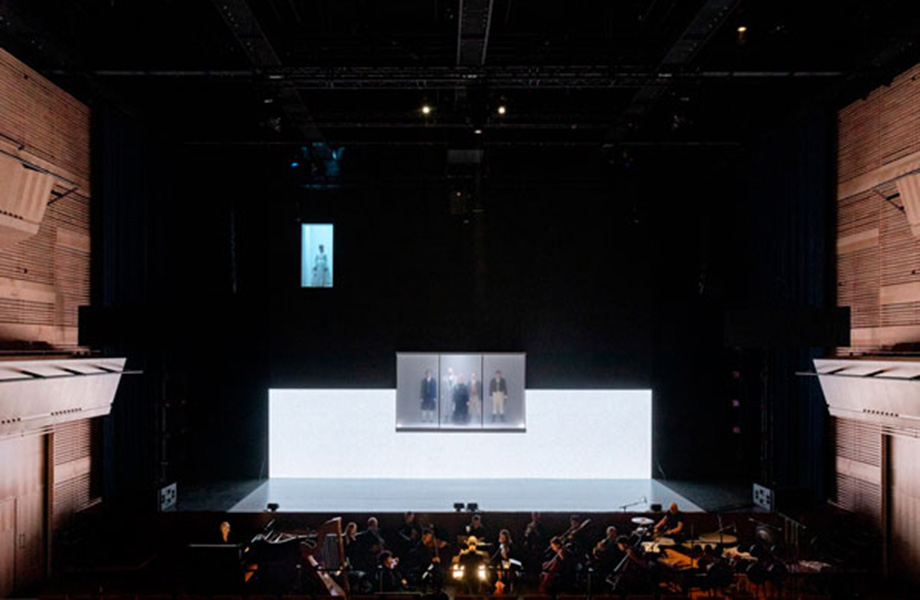
- Article Hero Image Caption: Antarctica (Sydney Festival)
- Alt Tag (Article Hero Image): Antarctica (Sydney Festival)
- Production Company: Sydney Chamber Opera
Antarctica, which had its première in June 2022 at the Holland Festival in Amsterdam, is essentially a fable, or even a form of fairy tale, at the heart of which is a mythic quest, structurally consisting of a series of tableaux set early in the nineteenth century. The opera opens with several archetypical characters: a Cartographer, a Theologian, and a Natural Philosopher, all poring over a map discovered in an Ottoman archive. The Cartographer draws their attention to a vast coastline at the far southern limit of the map. This map, apparently discovered by a Turkish admiral in 1513, imagined the coastline of Antarctica reasonably accurately, 300 years before its actual discovery. The map was the starting point, and Finsterer describes the inspiration underlying the project:
Buried deep beneath three kilometres of ice is a subglacial world, an ancient realm that stretches more than 14 million km². A frontier of mountains, expansive lakes and complex canyons and rivers systems, the continent of Antarctica remains an enigma that has continued to mystify and inspire humanity for hundreds of years. It awakens a vastness of thought; stirring something beyond language. And yet it is interesting that on this southern–most continent, no language exists.
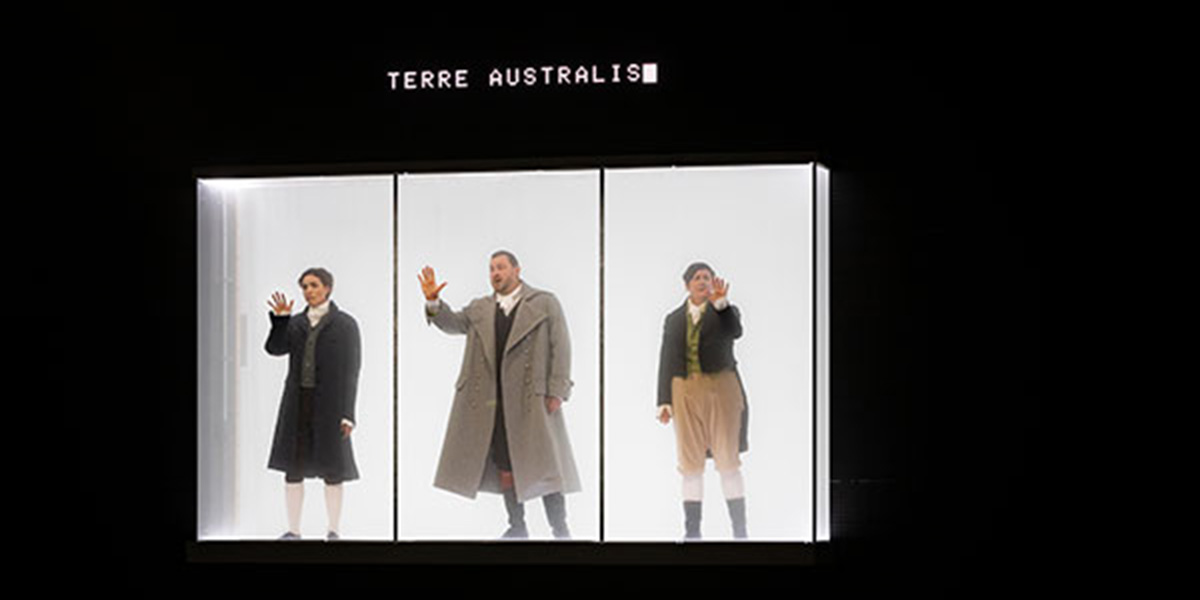 Antarctica (Sydney Festival)
The Cartographer (Michael Petruccelli) proposes that they set off to find and explore this undiscovered land. Each is intrigued by the prospect, but for different reasons. The Natural Philosopher (Anna Fraser) speculates that the land might provide a clue to our origins. The Theologian (Jessica O’Donoghue) muses that this empty land would pose no danger of distraction from following a spiritual path. The Cartographer yearns for a sense of completion in the form of a definitive map, thus enabling the exploitation of the new land, where great truths will be revealed to humanity once the map of the world is complete.
The ‘action’ of the opera is the journey to Antarctica, led by a Captain (Simon Lobelson), assisted by his young Daughter (Jane Sheldon), taking these three Enlightenment figures on their journey. But it’s a strange tale; not only do the human characters have voices, but animals do as well, and even the ship is given utterance through electro-acoustic means – there is a dialogue between The Ship, the Philosopher, and the Cartographer as they sing self-revelatory arias. The ship even has a solo aria.
The music is a fusion of structures and musical devices from the Middle Ages and the Renaissance, paired with contemporary styles. Also prominent is the electronic manipulation of actual recorded sounds from Antarctica: the ocean, sonar, and the movement of tiny animals. The stage design has two chambers providing the playing space, with lighting drawing attention to the figures as they emerge and dissolve in mist. The set by Elizabeth Gadsby consists of a large rectangular flat of video panels on which a wide variety of text appears, and in the middle is a transparent glass panel behind which are the singers, often shrouded in mist or snow. In the top left-hand corner is a much smaller rectangle in which the young girl is seen at different times. The complex video installation is by Mike Daly, with lighting design by Alexander Berlage.
The opera opens with the young girl (Hayden Holmes) being questioned by a male voice about her discovery in the ice: ‘Where are the others?’ She is the only survivor, and the opera ends with her comment: ‘I was there. I have seen the answer.’ The questioner responds: ‘And what does the answer look like’, to which she enigmatically replies: ‘It doesn’t look anything like this. It wasn’t this. It was … the opposite.’
There is much melismatic writing – a reflection of Finsterer’s interest in early music – a striking example being the prominent use of a quote from Hildegard Von Bingen in the aria of the Theologian. Frequent baroque opera gestures occur, particularly in the shaping of vocal lines, often in close harmony and enhanced by the use of Latin texts interspersed throughout the libretto. Finsterer, unlike many contemporary opera composers, writes well for the voice, carving out graceful vocal lines while not eschewing a wide range of extreme vocal effects when appropriate. Part of this skill lies in her drawing on earlier opera, even challenging the singers to decorate their vocal lines.
At times, the ravishing music recalls Renaissance madrigals as the five voices weave around each other in a variety of combinations. Finsterer seeks the warmth, colour, wide range of textures and beauty of the voice, rather than exploiting it as a vehicle to project the text. All the roles in Antarctica are demanding, often stretching the voices to the limits of their range, but the vocal challenges posed can be met by well-schooled operatic voices, and ultimately these are satisfying roles to sing, an often rare occurrence in contemporary opera, unfortunately.
One of the most impressive moments is the confronting and terrifying imprecation of the Captain, who is facing his demise and the destruction of his ship. The map has proven to be a fake, and he inveighs against his passengers: ‘I curse you all, you, with your certainty, your fantasies, your vainglory. Your maps to nowhere are your maps to hell!’ This is a powerful musical episode with the voice extended to the absolute extremes of the range, recalling some of the great operatic curses of the past, notably by Verdi and Wagner. It is a moment that could effectively be excerpted as a stand-alone aria. Here, it was sung with intensity and total vocal commitment by Simon Lobelson.
The cast is the same as that on stage during the Holland Festival, and one is in awe of their focus and concentration: they are faced with particularly challenging performance conditions. As in Amsterdam, the outstanding new music ensemble Asko/Schönberg, comprising fourteen musicians, provides the orchestral accompaniment in front of the playing area, conducted by Jack Symonds. Particular mention must be made of pianist and celesta player Pauline Post and percussionist Niels Meliefste, both of whom dazzle through their astounding virtuosity. Symonds, as usual, provides rock-solid leadership of this complex score and the disparate musical forces. The production is expertly directed by Imara Savage.
The layout of the set necessitates the amplification of the voices in the glass box – text is often muffled and surtitles are absolutely necessary. Hearing only snatches of the poetic and allusive libretto by Tom Wright is frustrating at times. The sound design by Bob Scott is innovative and effective, but for this listener the loss of the visceral impact of unamplified vocal tone, due to this glass barrier, is regrettable; one would like to hear this fascinating work in a more sympathetic space where the fusion of text and music could be savoured more fully.
Questions of genre often emerge during the offerings of Sydney Chamber Opera, and whether Antarctica is an opera, oratorio, or art installation might be debated, but it is a fascinating and thoroughly engrossing work. Perhaps an appropriate epigraph for Antarctica are lines from Samuel Taylor Coleridge’s ‘The Rime of the Ancient Mariner’:
And now there came both mist and snow,
And it grew wondrous cold:
And ice, mast-high, came floating by,
As green as emerald …
The ice was here, the ice was there,
The ice was all around:
It crack’d and growl’d, and roar’d and howl’d,
Like noises in a swound!
One was struck by the resonance of this work with that canonic Australian opera, Voss, where, as in Antarctica, only one of the explorers returns. At the heart of both works is a particularly potent Australian trope: the mythic and often unfulfilled quest, often set in a bleak and inhospitable landscape. This is an opera that raises important contemporary issues, particularly regarding climate change. Accolades are due to Sydney Chamber Opera for continuing to challenge and captivate its audiences.
Antarctica (Sydney Chamber Opera) was at Carriageworks until 8 January 2023. Performance attended: 6 January.