


- Free Article: No
- Contents Category: Art
- Custom Article Title: Data Relations
- Review Article: Yes
- Article Title: Data Relations
- Article Subtitle: A ‘speculative consideration’ at ACCA
- Online Only: No
- Custom Highlight Text: Is there now an elemental quality to data? Amazon and Meta have certainly demonstrated that data can be harnessed like a natural resource. Yet given that we, the users, shed data at an uncontrollable and unknowable rate, perhaps Jeff Bezos and Mark Zuckerberg are not twenty-first century oil barons so much as the managers of a silkworm farm? Is all this data just simply information? Do we even have a right to claim it back?
- Article Hero Image (920px wide):
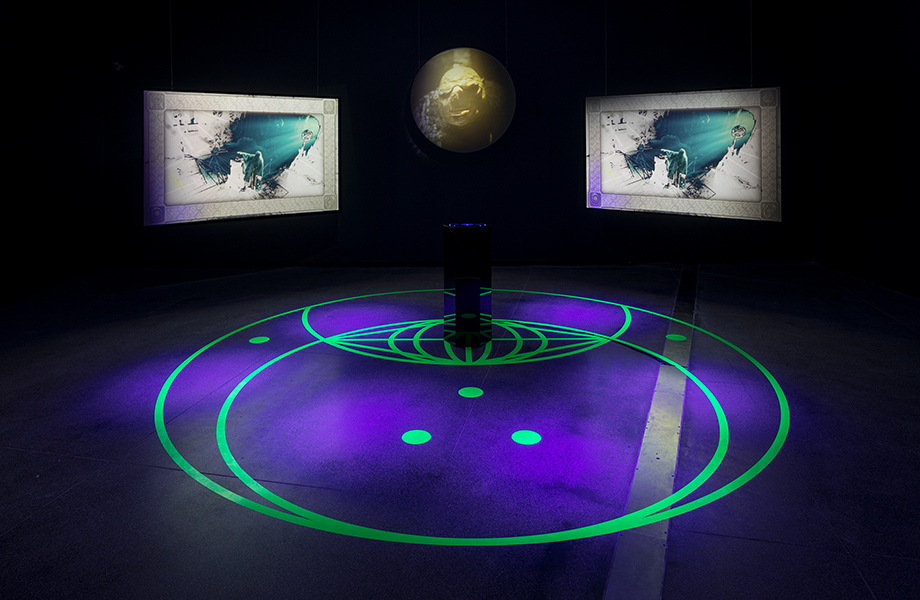
- Article Hero Image Caption: Zach Blas, Metric Mysticism: A Troll’s Tale, 2022 (photograph by Andrew Curtis)
- Alt Tag (Article Hero Image): Zach Blas, Metric Mysticism: A Troll’s Tale, 2022 (photograph by Andrew Curtis)
- Production Company: Australian Centre for Contemporary Art
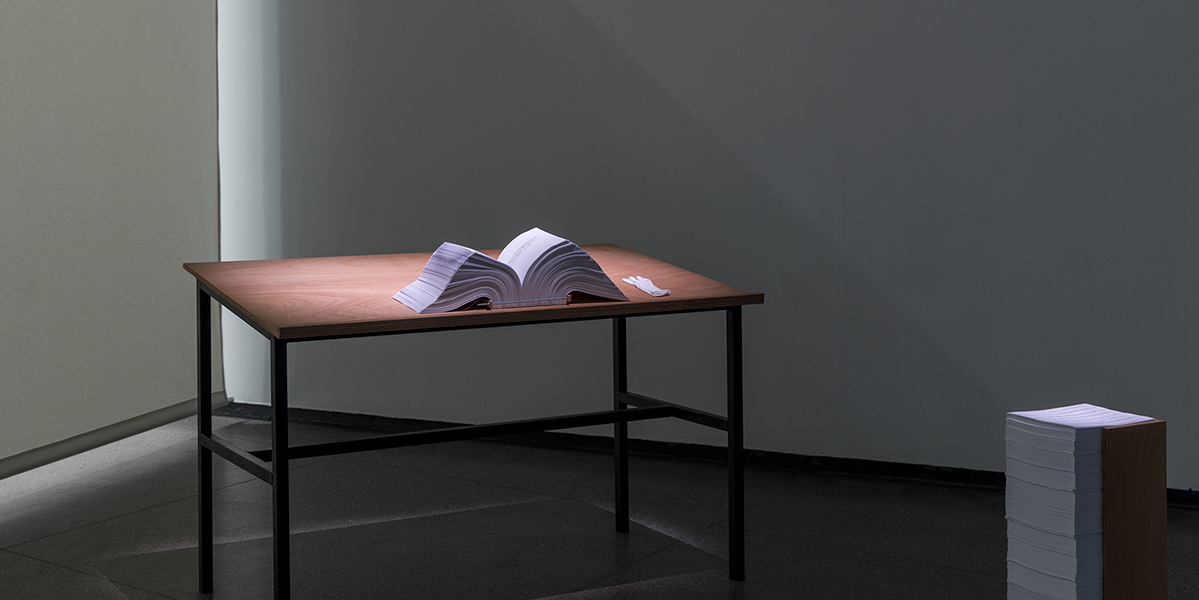 Winnie Soon, Unerasable Characters, 2022 (photograph by Andrew Curtis)
To this end, several works in the exhibition use data not only as subject matter but also as a medium in itself. The three different iterations of Hong Kong-born Winnie Soon’s Unerasable Character opt to keep data in a crude, almost unrefined state. The raw materials for Soon are posts from Chinese social media site Weibo that have been deleted by the Chinese government. Unerasable Character II (2020) processes these deleted posts (via a software program written by Soon), which are then projected onto the towering far wall in the main room at ACCA. At full swing, it is a grid of writhing Mandarin characters that recalls the abstractions of concrete poetry, though when I visited, the thirty-two-hour-long work was towards the end of a cycle and only a lonely single character remained flashing like an SOS beacon. Unerasable Character III (2021), meanwhile, is a web-based work, elevating the same raw materials to cosmological levels. The Weibo posts and their metadata here have been generated into an infinitely scrolling night sky in the fashion of the elegant, minimal figuration of early internet ASCCI text art.
Whereas Soon is attempting to recuperate the ravages of online information warfare, Synthetic Messenger (2021), the contribution by Australian-American duo Tega Brain and Sam Lavigne, provides a demonstration of it in action. The basis of the work is a script that sends out a swarm of 100 bots to search out online news articles on climate change. The bots click through the surrounding ads to generate a positive feedback loop that marginalises climate-change scepticism. Fake consumers become toy soldiers conducting a guerilla war in the monetised information economy (though one wonders if anyone other than bots ever click on the ads?)
Brain and Lavigne face a similar problem to Soon in how to convert pure data into form. Bots operate phantasmagorically, their data trails forming spectral footprints. They are beyond human vision, dumb agents travelling across the air on WiFi signals and underground through cables. Here, twenty televisions are scattered across black plinths. Each screen follows a bot in action as they scroll across websites hunting for ads. The choice by the artists to render these bots literally as hands feels perhaps too droll. Given the ever-increasing capabilities of AI-trained image-generating software such as Dall-E, I was left wondering how these bots might envision themselves.
Data Relations seems to be part of a heightened focus by ACCA on digital art. The exhibition coincides with the launch of ACCA’s new Digital Wing for online projects, as well an ongoing collaboration with the high-profile Australian tech company Atlassian. This collaborative spirit, much touted by digital start-up culture, is taken to extremes in the performance art of Lauren Lee McCarthy and their project Surrogate (2022). Submission underpins Surrogate, McCarthy proposing not just to act as pregnancy surrogate for a willing couple but to be completely at their mercy via an app. Videos documenting the project are scattered within a large house-like structure where all privacy-enabling barriers such as doors or walls are absent. The clinic-like feel of the house furthers the sense of nakedness (as any patient knows, there is neither dignity nor secrets in hospital).
Whilst it is hard to get a grasp on the project as a whole, given that it is an evolving, multi-part performance, the video works are all quite short and, given the nature of the project, surprisingly lightweight. McCarthy opts for a humorous approach that feels glib. Sperm Donors (2022) and Fever Dream (2022) are both commercial satires that adopt the slick, saccharine language of millennial-era advertising and sit disjointedly with others works here like Intended Parents (2020). This work is edited down from a series of conversations between the artist and potential couples about participating in the project. Far from interrogating the complexities of control, surrender, and kinship that this networked relationship would enable, it ends up like a four-minute collage of sound bites. At one point in Intended Parents McCarthy explains the project as ‘almost like a LARP or a role-playing scenario or thought experiment for the three of us to live out together’. Perhaps this is part of the work’s problem.
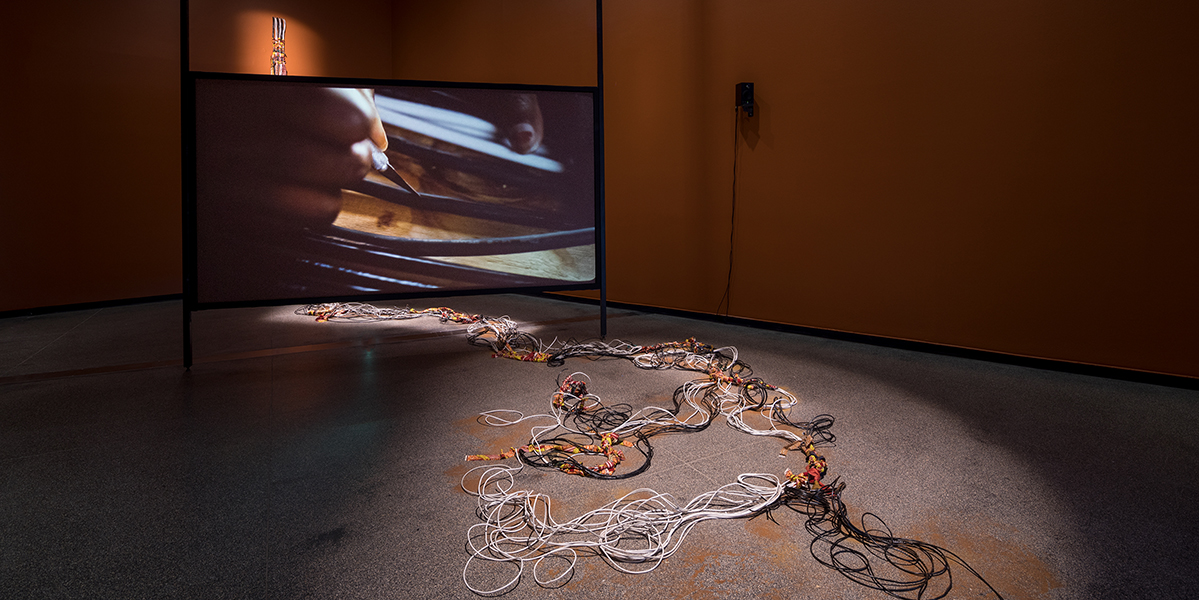 Mimi Ọnụọha, These Networks In Our Skins, 2021 (photograph by Andrew Curtis)
While there is an emphasis on the corporate ownership and instrumentality of the vast data economy, an unusual thread of magic and fantasy runs throughout Data Relations. This provides a counterpoint to the technocratic rationality usually ascribed to big tech. The techno-utopian vision that underpins the information economy is here infused with an ancient and unstable quality.
The chthonic world of fantasy games is the basis for Zach Blas’s Metric Mysticism: A troll’s tale (2022). A digitally generated troll, accompanied by a medieval PowerPoint slide, provides a gloomy lecture on Peter Thiel and his big-data analytics company Palantir (named after the all-seeing eye in The Lord of the Rings). Thiel here becomes a dark wizard, ruling over the world through his crystal ball predictions. Adapted from a 2017 performance-lecture by Blas, the limits of machine-led pedagogy are on display with the hour-long lesson delivered in the droning, inflexible baritone of a text-to-speech program. The fluctuating cadence of a human voice is keenly missed; not unlike during the cut-scene sequence of a computer game, one felt at times a wish to skip forward to the action.
The adjacent work by Australian-based artist-research collective Machine Listening depicts the Amazon Alexa as a combination of cybernetics and spiritualism. Their radio-play After Words (2022) portrays Alexa as not only passively waiting to be conjured into being via a wake word (e.g. ‘Hey Alexa’), but silently learning to turn all words into spells. Sparsely installed as a line of chairs in a narrow rectangular room, the experience is like being inside an Alexa. Voices abruptly dart around the room and talk at you, to themselves, or to one another in the stuttering tempo of an Ouija board. The question here is who, or what, is being summoned. As a voice asks; ’what does a wake word wake?’
Mimi Onuoha closes the exhibition with two works that infuse data infrastructure with Igbo cosmology and ritual. While a video work dominates the middle of the room, it is her installation The Cloth in the Cable (2022) that is most successful. Onuoha uses a mass of ethernet cables to create a diffuse, sculptural formation that traverse the length of the room. These cables crawl out from the back wall, snaking across the floor like a vine or serpent. The out-of-control tendrils have been somewhat tamed, tied up in African ankara fabrics (a collaboration with Nigerian-Australian designer Dinzi Amobi). These tourniquets lend a handmade quality to a show that is otherwise dominated by impersonal constructions and cold, industrial materials. It is certainly the most sensual work in the exhibition; spices have been scattered across the cables, their scent filling the room that has been painted in a single shade of darkened terracotta. The earthy quality here brings indeterminacy into the relationship with data. More then just a technical infrastructure, there is an implication that the data economy is something simultaneously mineral, animal, and vegetable.
Data Relations is showing at the Australian Centre for Contemporary Art in Melbourne from 10 Dec 2022 to 19 Mar 2023