


- Free Article: No
- Contents Category: Film
- Custom Article Title: Triangle of Sadness
- Review Article: Yes
- Article Title: Triangle of Sadness
- Article Subtitle: Ruben Östlund’s projectile extravaganza
- Online Only: No
- Custom Highlight Text: People’s taste in satire can be as acquired and specific as their taste in art overall; some favour scalpel-like precision (the television of Armando Iannucci), while others prefer more of a sledgehammer approach (the films of Adam McKay). Your appreciation for Ruben Östlund’s Triangle of Sadness will vary depending on your tolerance for sweeping observational class satire (and the on-screen depiction of bodily fluids)
- Article Hero Image (920px wide):
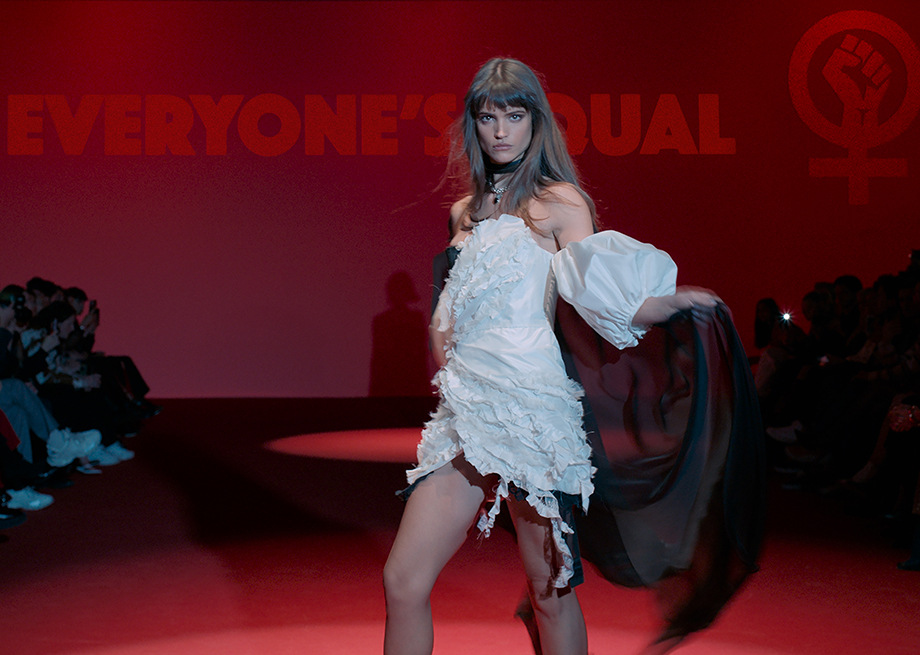
- Article Hero Image Caption: Charlbi Dean in Triangle of Sadness (photograph by Fredrik Wenzel)
- Alt Tag (Article Hero Image): Charlbi Dean in Triangle of Sadness (photograph by Fredrik Wenzel)
- Production Company: Sharmill Films
These targets include, but are not limited to: the fashion industry, influencer culture, gender politics, the wealthy élite, the military-industrial complex, neo-Marxism, modern-day imperialism, and the service industry, each dragged into the crosshairs by way of a large ensemble cast in a formally delineated triptych. In Part One, we meet Carl and Yaya (Harris Dickinson and Charlbi Dean), two self-obsessed models who appear to be together purely as a branding exercise, during a cringingly protracted argument over who should pick up the bill after an expensive dinner. In Part Two, we find them at sea on a luxury superyacht (paid for by Yaya’s Instagram cachet), where we meet the other players: a Russian oligarch (Zlatko Burić) who made his fortune literally ‘selling shit’ (fertiliser); a seemingly homely British couple (Oliver Ford Davies and Amanda Walker) who bemoan the UN’s prohibition on landmines putting a dent in their company’s profits; a lonely tech billionaire (Henrik Dorsin) who buys Rolexes for anyone who so much as smiles at him; the tanned, meticulous ship’s head of service, Paula (Vicki Berlin); and the reclusive, alcoholic captain (Woody Harrelson, loving every moment of his teasingly brief appearance).
Of course, there are more people on the ship, below deck – an invisible army of cooks, cleaners, engineers, and service workers, largely people of colour, who may as well not exist as far as the yacht’s wealthy clientèle are concerned. This includes Abigail (a sensational Dolly de Leon), the once-overlooked ‘toilet manager’, who quickly steals the show in Part Three after a spectacular disaster at sea leads to a Lord of the Flies-esque redistribution of status and wealth. This culminates in a beguiling closing sequence that, after my sold-out session at least, proved something of a Rorschach test as to whether or not you personally believe the omnidirectional flow of power can ever truly be reset.
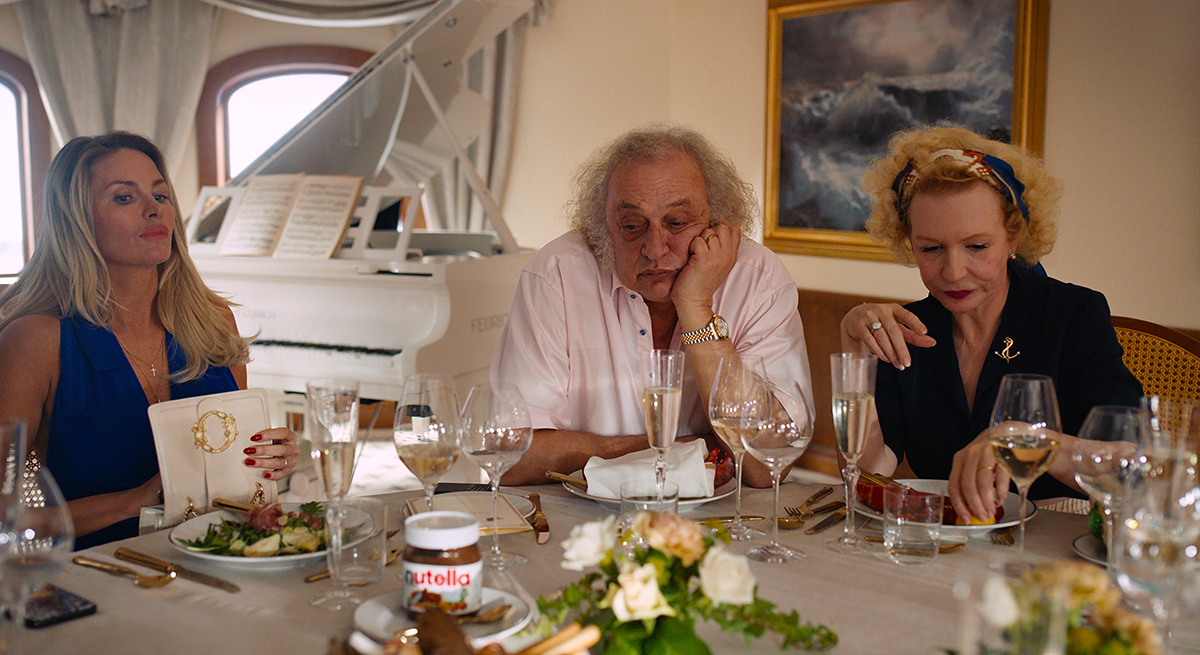 Carolina Gynning, Zlatko Burić and Sunnyi Melles in Triangle of Sadness (photograph by Fredrik Wenzel)
The film’s centrepiece, a nauseating, snowballing slapstick sequence set during a formal captain’s dinner, firmly cements Triangle of Sadness as both a significant technical achievement and a modern gross-out masterpiece. After Harrelson’s skipper insists on holding the event in the middle of a raging storm, the guests line up to shake his hand, air their petty grievances, then dine on an assortment of stomach-churning seafood dishes as the wind howls outside and the ship rocks violently. The floors tilt, chandeliers sway, wine bottles roll eerily across the carpeted floors, and before long the guests are trying to suppress their projectile vomiting by – what else? – quaffing more champagne. It is a transcendentally icky twenty-five minutes of Buñuelian cinema. Some modern take-downs of the rich and powerful, like HBO’s Succession, satirise their quarry while still relying on a certain level of vicarious wish fulfilment; we revile the characters even as we ogle their clothes, their cars, their mansions. Triangle of Sadness, in this sequence and throughout, reserves no such appreciation; it is a punishing, pitiless evisceration of the people who make our world an infinitely worse place.
Dolly Parton once said ‘It costs a lot of money to look this cheap’ – and not dissimilarly, it takes an enormous amount of skill to make something as devotedly silly as Triangle of Sadness. From Fredrik Wenzel’s razor-sharp cinematography to the hauntingly playful music curation by Mikkel Maltha and Leslie Ming, every technical aspect of the film functions at the highest level. The sound design – for instance, the ominous creaking of the storm-ravaged ship, or the grating squeak of a windscreen wiper underscoring Carl and Yaya’s opening argument – expertly ratchets up the tension throughout. For his part, Östlund’s camera placement and composition are endlessly inventive. The first glimpse we get of our luxury yacht, rather than a traditional aerial establishing shot, is a close-up of a waterproof suitcase in the lap of a helicopter passenger as the ship gradually comes into view down below. (The suitcase is an emergency airdrop of Nutella, naturally.)
All too much of the discourse around Triangle of Sadness, especially after its Palme d’Or win at Cannes earlier this year (Östlund’s second after The Square [2017]) has centred on whether the film’s insights are too obtuse, its characters too caricatured – but something in this vein of thinking smacks of the very same snobbery that Triangle of Sadness sets out to skewer. Here is a bold and sprawling comedy, by a fiercely intelligent filmmaker, featuring sociopolitical statements that could be grasped by a seventh grader; I see its obviousness as a feature, not a flaw. At a time when almost all public discourse has sunk to reprehensible new depths, why stymie our most brazen filmmakers with the burden of respectability? Good art ought to mirror our times. If Ruben Östlund’s films have grown increasingly broad and brutal, then surely that’s our problem, not the mirror’s.
Triangle of Sadness (Sharmill Films), 147 minutes, opens on 26 December 2022.