


- Free Article: No
- Contents Category: Film
- Custom Article Title: The Banshees of Inisherin
- Review Article: Yes
- Article Title: The Banshees of Inisherin
- Article Subtitle: The dark unknowability of other people
- Online Only: No
- Custom Highlight Text: When did nice become an insult, and simple such a burden? Pádraic Súilleabháin (Colin Farrell) is a nice man, leading a simple life on the fictional island of Inisherin, just off the coast of Ireland. The year is 1923. Even as a civil war rages across the water, for Pádraic all is well in the world so long as he gets to meet his lifelong friend, Colm Doherty (Brendan Gleeson), at the pub at 2 pm every day for a pint.
- Article Hero Image (920px wide):
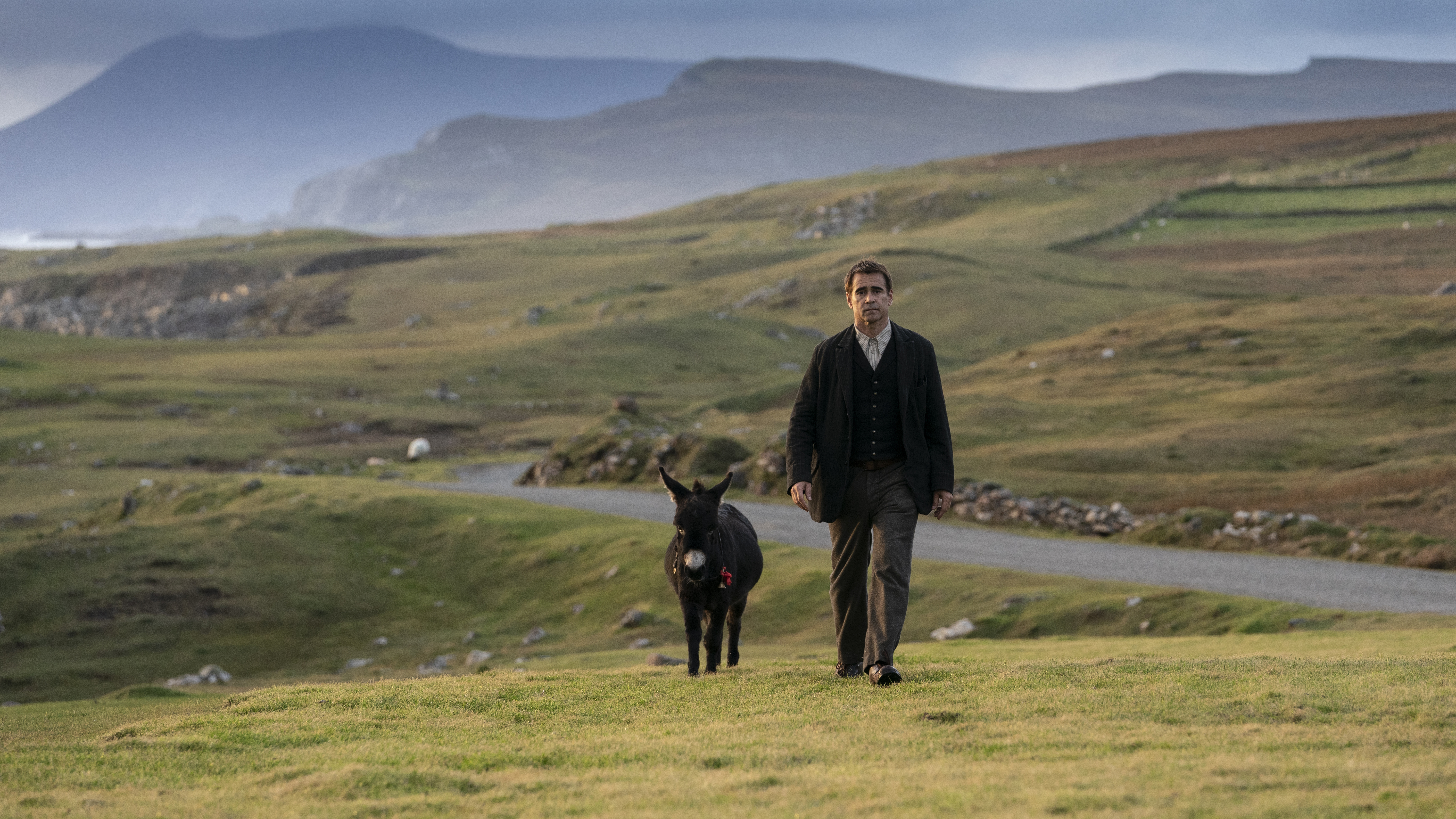
- Article Hero Image Caption: Colin Farrell in The Banshees of Inisherin (photograph by Jonathan Hession)
- Alt Tag (Article Hero Image): Colin Farrell in The Banshees of Inisherin (photograph by Jonathan Hession)
- Production Company: Searchlight Pictures
It is no great spoiler to reveal the thinking behind Colm’s decision: as an older man, he has been reflecting on his legacy, and has concluded that sitting in the pub while Pádraic discourses at length on the contents of his ‘donkey’s shite’ is not a noble or worthy pursuit. Instead, he intends to write music, in the hope of crafting something that might outlive him.
Here is the central conflict of Martin McDonagh’s masterful The Banshees of Inisherin, a graceful, shrewd, frequently hilarious film that tracks the fallout of the failed relationship between these two men; one doomed by stubborn ambition, the other doomed only by being too content with what he has.
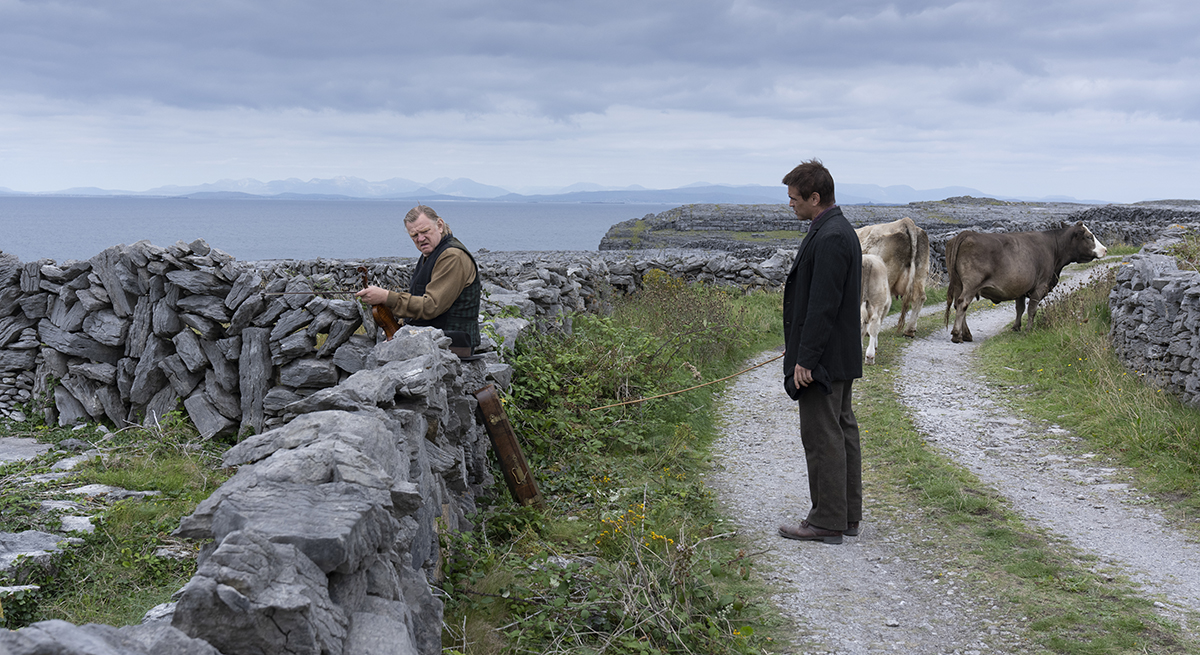 Brendan Gleeson and Colin Farrell in The Banshees of Inisherin (photo by Jonathan Hession)
Fifteen years after his spectacular film début, In Bruges, lauded playwright McDonagh reunites its stars, showcasing how time and age have refined all three men’s notable skills. Farrell gives a tragicomic performance for the ages as Pádraic, while Gleeson, in a smaller, somewhat quieter role, exudes stoic regret. They remain a stellar pairing – Farrell’s handsome clown and Gleeson’s wizened grouch – a perfect match both physically and intellectually, effortlessly trading verbal blows thanks to McDonagh’s loquacious yet incisive script.
The writer–director remains a wordsmith of the highest order, and this is his most theatrical screenplay yet, but at no point does it feel as though it might have been better suited to the stage; on stage, we might miss the imperceptible twitches of Farrell’s eyebrows, or the subtle shifts in Gleeson’s growling delivery. And on stage, we wouldn’t have the breathtaking Irish coastline, serving in almost every frame to underpin Pádraic’s contentment while spurning Colm’s dissatisfaction.
Joining Farrell and Gleeson is Kerry Condon, wonderfully fiery in her role as Pádraic’s sister, Siobhan, loathing the island’s insatiable need for gossip and her brother’s paltry row with Colm. Barry Keoghan, fast becoming the world’s most instantly recognisable character actor, plays a downtrodden village idiot of sorts, Dominic, to whom Pádraic defaults for conversation after Colm announces their uncoupling. Banshees also features an array of loveable animal performances, none more so than that of Jenny, a miniature donkey and Pádraic’s closest (non-human) companion. There are always animals around Pádraic, placidly observing the complicated ebbs and flows of human interaction. The fact that Farrell’s character relates more easily to them, with their simple needs and innate goodness, speaks silent volumes about his convictions.
Behind the camera, Ben Davis catches the real-life Aran Islands with a restrained but admiring eye, letting their unfettered natural beauty do most of the heavy lifting, while Mark Tildesley’s impeccable production design renders a range of stark yet homely interiors, all buttery hues and dark wood. Perhaps most notable on a technical level is the costume work by Eimer Ni Mhaoldomhnaigh, whose every lovingly crafted piece feels simultaneously fresh and nostalgic, conjuring up a specific time period and a tangible mood. The tactile beauty of The Banshees of Inisherin works cunningly hand-in-hand with its central themes; the more beautiful something is – be it a hand-stitched sweater or an ocean view – the more we’re forced to ask, via Colm’s new rationale: what use is it? What good will it be when we’re gone? Is it enough for these things to be pleasant, or is it pleasantness that robs us of our purpose?
It is notable that Banshees begins on the very day Colm acts on his decision to unfriend Pádraic; one can imagine a less confident screenplay that first shows us their final afternoon as friends, establishing their lived-in dynamic before Colm decides to blow it all up. This might have risked allowing us, the audience, to form too clear an opinion about whose side we’re on in the ensuing row. Maybe Pádraic is as exhaustingly dull as Colm insists. Maybe Colm is being as flippantly cruel as Pádraic says. We’ll never know, and nor will they. Banshees submerges us in the dark unknowability of other people – even people we have known our entire lives. For every thousand stories about the dissolution of a romantic relationship, there might only be a handful dedicated to exploring the unique and far-reaching ramifications of the death of a friendship – Banshees positions this loss as perhaps the greatest of all.
Much like Pádraic, The Banshees of Inisherin may appear superficially simple at its outset; a handful of seemingly ordinary characters on one small island, beset by seemingly ordinary problems – but this simplicity is deceptive, and McDonagh’s writing elevates it all to the level of Aristotelian tragedy. For this, it turns out he doesn’t need the life-or-death, heaven-and-hell stakes of In Bruges, or the Tarantino-esque hijinks of Seven Psychopaths, or the inflammatory politics of Three Billboards Outside Ebbing, Missouri. All he needs is a perfect pair of actors, a stretch of scenic coastline, and a pint.
The Banshees of Inisherin (Searchlight Pictures), 114 minutes, opens on 26 December 2022.