


- Free Article: No
- Contents Category: Theatre
- Review Article: Yes
- Article Title: The Tempest
- Article Subtitle: A lively production embroidered with other plays
- Online Only: No
- Custom Highlight Text: The Sydney Theatre Company’s staging of Shakespeare’s The Tempest, directed by Kip Williams, is centred around a large rock set on a revolving mechanism that assists with scene changes and helps to animate this rather static play about characters shipwrecked on a tropical island. The rock is reminiscent of the story of Prometheus, chained forever to a large rock by Zeus, but this is the ‘hard rock’ to which Caliban (the only character native to the island) is banished by the lordly Prospero, which reminds us that the island (and perhaps even the play) is Caliban’s domain.
- Article Hero Image (920px wide):
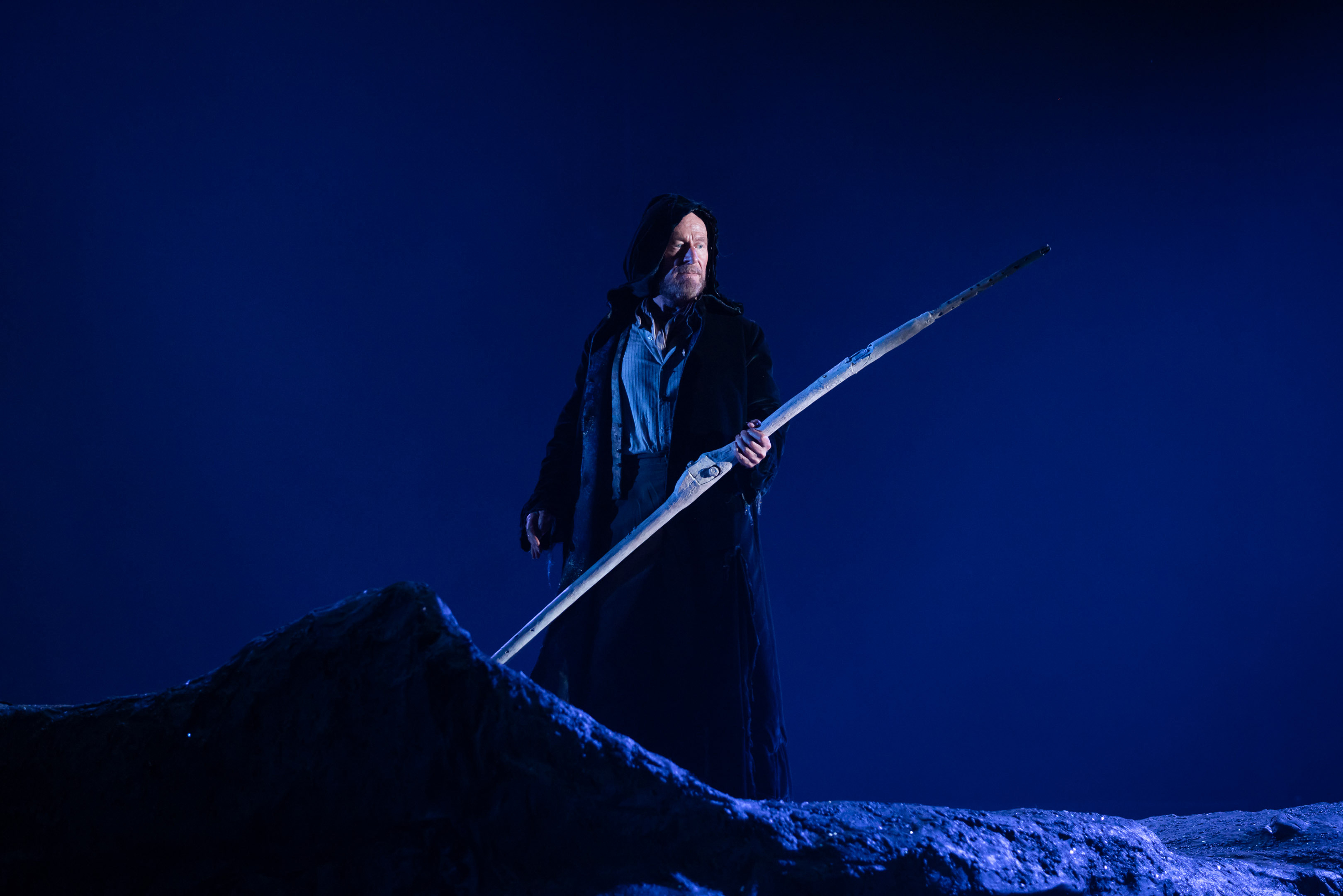
- Article Hero Image Caption: Richard Roxburgh as Prospero (photograph by Daniel Boud)
- Alt Tag (Article Hero Image): Richard Roxburgh as Prospero (photograph by Daniel Boud)
- Production Company: Sydney Theatre Company
Despite seeing several productions of The Tempest, I have never really enjoyed this play. But Roxburgh’s performance, and all the acting more generally, help us navigate the static plot with its swathes of storytelling, its conspicuous comic scenarios, its applications of occult magic, and the play’s feeble framing as a slow-motion political thriller (all de rigueur for commedia dell’arte – an influence on Shakespeare’s art).
Roxburgh drives diligently for the sense of Shakespeare’s text, and his lengthy exchanges with his daughter, Miranda (Claude Scott-Mitchell), draws out the logicality of Prospero’s lines to clarify the motives of the play. This attentive acting dares not rush, for fear of losing the audience, which is precisely what this play needs. Roxburgh builds character as the play builds tension, working beat by beat through monologues that could easily be lost if managed by lesser hands – he adds fatherly comic gestures that draw laughter not so much for their candour but for their warmth, such as the bemused pangs of a beleaguered parent home-schooling a teenage daughter who is cherished all the more for resisting her parent’s guidance. While there is a difference between an actor who can make a long speech sound good and an actor who can make good sense of why the speech is there in the first place, this Tempest shines because it has Roxburgh at its helm.
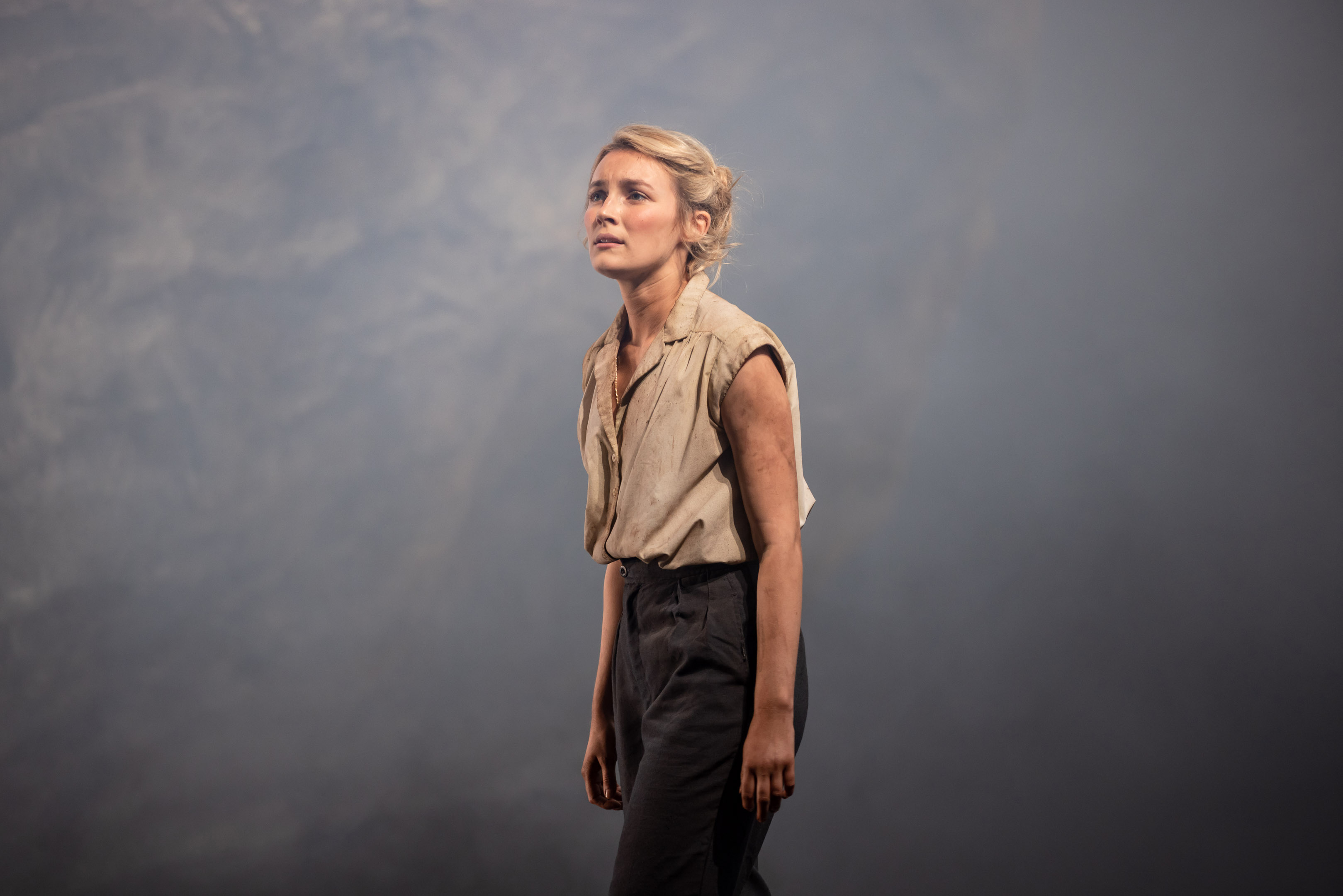 Claude Scott-Mitchell as Miranda (photograph by Daniel Boud)
As the teenage lovers (Scott-Mitchell and Shiv Palekar) balance sweetness with fumbling adolescent passion to affect the delightful coupling of Miranda and Ferdinand – the ‘bread-and-butter’ (or shall I say ‘fairy-bread’) of Shakespeare’s romantic interludes that become one of the many threads of Prospero’s magic puppeteering – the controversial character of Caliban is superbly acted by Guy Simon, a proud Birripi/Worimi man who brings great dignity to this role as the only character native to the island – that is, before Prospero and his infant daughter landed twelve years ago and enslaved him. Simon’s Caliban is judiciously wary of alcohol when he meets the shipwrecked Stephano and Trinculo, who seem to have an endless supply of liquor. It is these subtle choices, combined with Simon’s interpretation of a character who is both repressed and ignorant of the wider world of these invaders, that delivers a politically astute Caliban, one who realises that he must play the double agent and set invader against invader to help effect his own emancipation.
Peter Carroll, now almost eighty years old, is delightful as the aged spirit Ariel, appearing half-naked in a pair of rough charcoal trousers with long white hair a little reminiscent of Lucky in Waiting for Godot. This older sprite carries with his jaunty frame a sense of ‘deep history’ for a play that otherwise maintains the unities of time and place.
Megan Wilding brings welcome energy to the role of Gonzalo and draws regular laughs for her unscripted responses to the miraculous situations of the plot, enlivening the mobs of shipwrecked characters that, in a post-tempest fog, wander the isle (Chantelle Jamieson as Sebastian, Jason Chong as Antonio, Mandy McElhinney as Alonso, and Susie Youseff as Trinculo).
For me, though, the charismatic Aaron Tsindos steals the show as the drunken Stephano, played here as an esteemed, somewhat nineteenth-century cad, made nevertheless dashing by his drinking. This Stephano is a faux heroic swashbuckling wannabe switching between his truer nervousness and his artificial gallantry to milk surprising realism from a rambunctious comedic performance, injecting an energy into the show on par with all the dynamic special effects that also keep the show exciting. While not every character should go as ‘big’ as Tsindos, his energy benefits the production.
One choice that looked exciting in the program but did not work so well was the insertion of multiple text passages from other Shakespeare plays. In part responding to ‘a focus on sharing this story with audiences on Aboriginal land’, and in part a response to the many echoes of Shakespeare’s other plays inherent in The Tempest, the creative team – no doubt in consultation with the excellent Shari Sebbens as dramaturg (a proud Bardi, Jabirr person) – have embroidered the play with passages from Pericles, Romeo and Juliet, Macbeth, The Merchant of Venice, Hamlet, and Richard II. The reason why this doesn’t work is that whenever a line from another play is spoken it immediately jolts the audience to those other theatrical worlds, disengaging them from the world of The Tempest. When Miranda quotes Juliet to say to her lover Ferdinand, ‘Parting is such sweet sorrow / That I shall say good night till it be morrow’, we are transported to Juliet’s balcony in fair Verona. It sticks out like a sore thumb, jarring the moment and seasoning this sweet scene with a saccharine cleverness. Although Caliban says early that he was once ‘mine own king’, it still seems rhetorically indecorous when Caliban spouts whole passages from Hamlet and Richard II.
While these passages cleverly garner a range of material sourced from Shakespeare’s works that bespeak a connection to land and themes of sovereignty, is it really necessary to rewrite Shakespeare’s Elizabethan text to make it more fitting to our ‘brave new world’? The earlier line about Caliban’s violence towards Miranda is softened to suggest some violence against Prospero, and at the end of the play lines are inserted so that Prospero confesses to Caliban that he was ‘wrong’ – an apology. I think most audiences wish to see themes of reconciliation on the Australian stage, especially in new work, but must we rewrite Shakespeare to achieve this?
Shakespeare and his plays do not need to be decolonised, although his cultural legacy and the colonial violence that promoted that legacy do need decolonisation. Are not these processes better served by external creative responses and ‘adaptations’ that can write back to the centre more independently rather than trying to correct another author’s work and the times he lived in? Kylie Bracknell’s adoption of Hecate from Macbeth for an extended Yirra Yaakin production, and her translation of the sonnets into Noongar, spring to mind, along with Akala’s intellectualising of the links between hip-hop and Shakespeare’s sonnets. Would we rewrite Sarah Kane because she is confronting or Samuel Beckett because he is dull? I pity someone seeing the play for the first time, for they will not experience it as it was written, but this production remains a slick modern rendering with moments of striking costume and special effects that ensure that this is a Tempest to remember.
The Tempest (Sydney Theatre Company) continues at the Roslyn Packer Theatre until 21 December 2022. Performance attended: 3 December.