


- Free Article: Yes
- Contents Category: Art
- Review Article: Yes
- Article Title: Barbara Hepworth: In Equilibrium
- Article Subtitle: Turbulence, curvature, and flux
- Online Only: Yes
- Custom Highlight Text: ‘I do not want to make a stone horse that is trying to and cannot smell the air,’ quipped the British sculptor Barbara Hepworth in 1934. What Hepworth meant by this cryptic statement is that she did not wish to be an artist making figurative sculptures of recognisable subjects but instead to distil her deep sensitivity to the natural world into a language of living things that could themselves breathe, palpitating with a sense of their own inner vitality.
- Article Hero Image (920px wide):
- Article Hero Image Caption: Barbara Hepworth, Eidos 1947, National Gallery of Victoria
- Alt Tag (Article Hero Image): Barbara Hepworth, Eidos 1947, National Gallery of Victoria
- Production Company: Heide Museum of Modern Art
Before studying sculpture at the Leeds School of Art and the Royal College of Art in London in the early 1920s, Hepworth had grown up in West Riding in Yorkshire. She later recalled that her memories of this time were all of ‘forms and shapes and textures’, indicating the early formation of her artist’s eye. In 1939, she left London to live in St Ives, Cornwall, whose coastal terrain was to prove pivotal to the development of her aesthetic. Working in wood, alabaster, stone, and later bronze, Hepworth was an adherent of ‘direct carving’, a term used after World War I to refer to a method of hand carving in wood or stone without the assistance of machines or power tools. This technique allowed a sculptor to retain full manual control over the artwork, developing an intimate relationship with the material as it was hewn from start to finish.
Hepworth’s sculptures drank deeply from the natural environment, but her singular artistic vision operated as a powerful agent of transformation. Cast in bronze, Sea Form (Porthmeor) (1958) conjures the form of cresting ocean waves, its textured ribbons of metal an instantaneous capture of the ocean’s frenzied motion, while Curved Form (Wave II) (1959) appears as a schematic distillation of a wave form. Yet in both of these sculptures, Hepworth is not depicting the sea so much as sublimating it, summoning the ocean’s essence of turbulence, curvature, and flux.
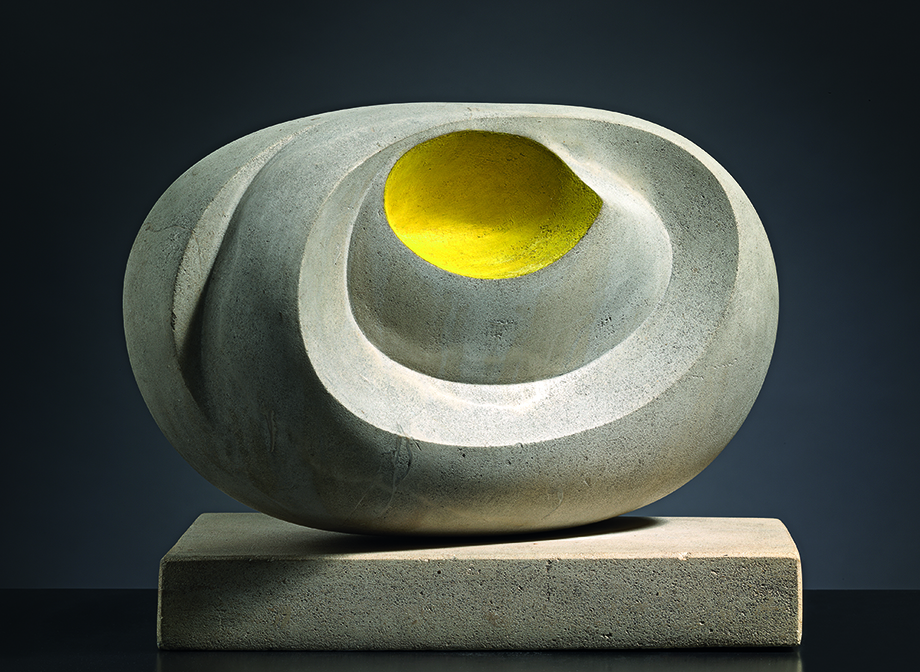
As she evolved, such real world sources were increasingly reimagined by Hepworth into a language of abstract forms. Her mature work is both powerfully architectonic and formally reductive. Certain structures became her hallmark; ovoid forms in wood, stone or bronze whose interiors were hewn away to leave enigmatic voids. The interior surfaces were then painted, often white although sometimes egg-yolk yellow, as in Eidos (1947), marking a strong contrast to the sculpture’s outer silhouette.
Hepworth also had notable dexterity in juxtaposing dissimilar materials in a single work, prompting visual relationships of beguiling variance. This is most apparent in the string works: sculptures fashioned from plaster, bronze, or brass, whose edges are punctured and threaded through with string, forming a mesh across the sculpture’s hollowed out interiors. In Sculpture with colour and strings (1939, 1961) and Sculpture with Colour, (Deep Blue and Red) (1940), the strings delineate lines of movement, accenting the internal space while directing the gaze around and through the object, as if looking itself is a form of threading.
With large-scale works, these excised interiors leave cavernous voids, reaching an apotheosis with Corinthos, (1954–55), a hulking behemoth carved from a massive cut log of ancient guarea wood, whose gouged inner cavity undulates in sweeping curvaceous arcs. Corinthos’s white-painted interior comes alive as the viewer walks around it, each position activating mutable casts of light and shadow.
 Barbara Hepworth, Corinthos 1954-55, Tate London
Too often, Hepworth has been seen in relation to her male artist peers: her one-time husband Ben Nicholson and the more famous British sculptor Henry Moore. It is to the Heide curators’ credit (Lesley Harding and Kendrah Morgan) that they dislodge Hepworth from these default associations to more clearly view her sculpture on its own terms. It is a commonplace opinion, for instance, that Moore pioneered a style of monumental stone sculpture (often reclining figures) with dramatic void spaces, but Hepworth’s tiny alabaster and slate sculpture Figure (1933), with its circular perforation, reveals that she was experimenting with mass and void before it became Moore’s artistic signature.
Hepworth understood how the physical environment surrounding her sculptures shaped their perception, and that different settings – from modernist architecture to sandy beaches – could modulate their elemental qualities. She railed against the constraints of exhibiting in galleries and museums, much preferring the outdoors for her sculptures. ‘I always envisage “perfect settings” for sculpture,’ she asserted, ‘and they are, of course, mostly envisaged outside and related to the landscape.’
The inclusion of the short documentary Figures in a Landscape (1952), directed by Dudley Shaw Ashton, makes this apparent. The primary focus is Hepworth’s sculpture, but as the camera roves across the rocky coast of St Ives, it shows not just the landscape as a source of inspiration but, through the physical placement of Hepworth’s works on the craggy cliffs and shore, the degree to which they were in direct dialogue with that landscape.
The importance of setting is implicitly understood by Heide curators through their invitation to the Melbourne-based architectural firm Studio Bright to undertake the exhibition design. Instead of the conventional white cube gallery backdrop, the architects have designed a subtle casing for Hepworth’s sculptures, with walls and plinths painted in muted tones reminiscent of wood, slate, and stone. This is most opulently realised in the display of Corinthos: set atop a slate-green plinth encircled with velvet curtains of the same hue, the sculpture’s red woodgrain almost glows. The sculptures are also installed so as to maximise their relation to Heide’s verdant surrounds. The hulking bronze pair, Two Forms in Echelon (1961), for example, sits afront the floor-to-ceiling window in the central gallery space, the sculpture’s internal voids filtering views of the garden vista beyond.
Hepworth revered the natural world, seeing it as a wellspring of rejuvenation and mystery, yet her sculptures were never subordinated to it. Attuned to the elemental qualities of each material, her tectonic imagination used these sources as a springboard for the creation of sculptures whose oscillation between inner void and outer contour imbue them with an inexhaustible and compelling aesthetic tension, making an oeuvre of elegant and vital potency.
Barbara Hepworth: In Equilibrium is showing at the Heide Museum of Modern Art in Melbourne from 5 November 2022 to 13 March 2023. The catalogue, Barbara Hepworth In Equilibrium, is available priced at $45.