


- Free Article: No
- Review Article: Yes
- Online Only: No
- Article Hero Image (920px wide):
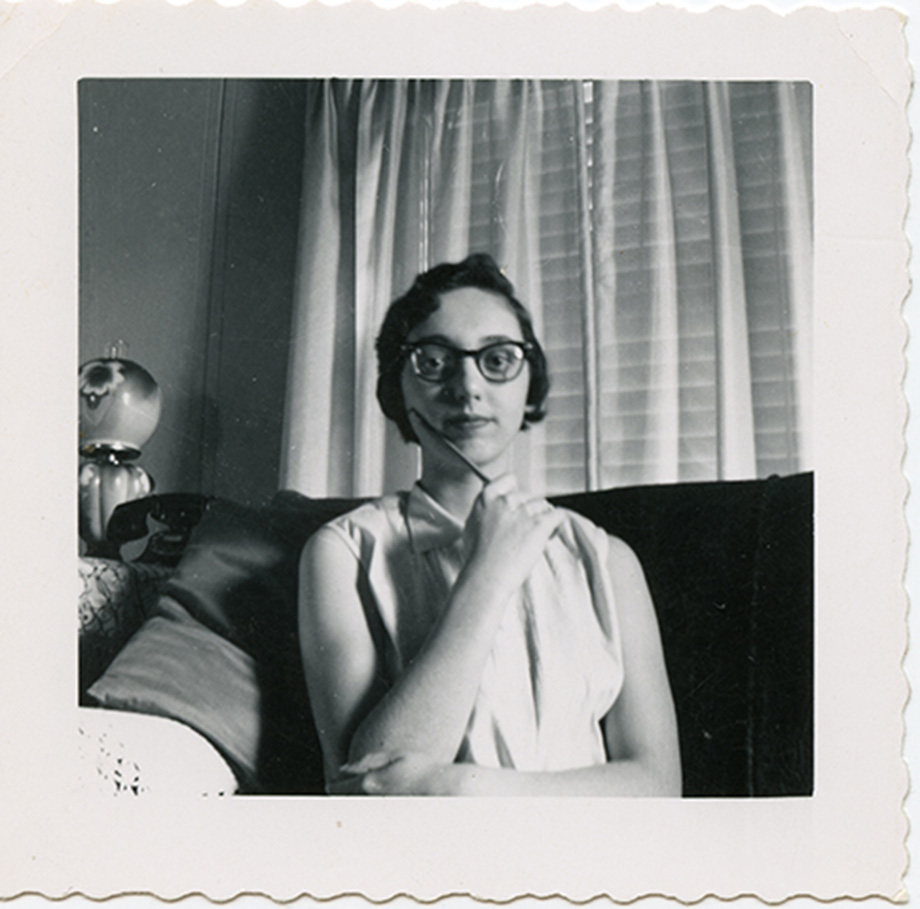
- Article Hero Image Caption: Joyce Carol Oates (photograph provided by Syracuse University)
- Alt Tag (Article Hero Image): Joyce Carol Oates (photograph provided by Syracuse University)
- Production Company: Jewish International Film Festival
There is nothing obviously cinematic about Joyce Carol Oates’s existence. The documentary makes a point of this from the opening shot. A cumbersome microphone occupies the foreground; we hear footsteps as a blurry figure approaches, then comes into focus as Oates in extreme close-up, not sure where to look. Is she nervous, Björkman asks? Of course she is: she is ‘not a film person […] not an actress’.
It is unusual to see such a camera-shy subject, so fraught with nervous energy, blown up onscreen at such length. She is uncertain, untrained – eyes moist, darting, downcast, or flicking glimpses at the camera, the way we’re told not to do.
Oates is no Marina Abramovic, but the artist’s presence is intense (expect many close-ups in hard focus with low depth of field). In black and white photographs, she is in the line of Poe and Kafka – all haunting eyes and gothic pallor – but on screen she is no spectre but warm-blooded, her thin, round-shouldered frame charged with excessive vitality. Her sunless skin has acquired a crimpled softness rather than lines.
Shot almost entirely by day at Oates’s spacious home outside Princeton, New Jersey, in a sober natural light, the new footage has a cool clarity which contrasts starkly with clips from older studio interviews, creating an illusion of full access. In her unpretentious study, the camera dwells on details of her person and surrounds. We see her cats, her small clean hands, her slightly grimy laptop and desk. A nazar amulet hangs in the window, gazing back at the viewer as we watch Oates at work from behind. We pan across long-hand drafts or notes, and proofs with emendations and (sometimes) doodles. She is surrounded by books, family photographs, and what appear to be small painted portraits of herself. We spy not one but two copies of her picturebook Naughty Chérie (2008), which was marketed as ‘a purrrfect bedtime story’.
Intermittent exterior shots are framed so the edges of the housefront (an austere, penitentiary grey) exceed our sight, with Oates installed at the upstairs window: the ghost, the watcher, an inmate, an empty effigy?
As the Guardian noted in 2004, nearly every review of an Oates book begins with an attempt to tally her works (she herself long since lost count). She seems to have published around sixty novels. Björkman dispatches the mixed blessing of this staggering hypergraphia upfront, via clips from numerous television interviews. He addresses her politics in a similarly indirect manner, via her Twitter attacks on the man she calls ‘T***p’. Early sequences establish the documentary’s characteristic devices: the use of intertitles with Oates quotes; lightly animated headlines, tweets, and emails appearing onscreen; novel excerpts read by Laura Derne over archival footage, beginning with the 1967 Detroit Rebellion, the subject of Oates’s National Book Award-winning novel them (1969).
 Joyce Carol Oates (photograph by Bernard Gotfryd)
A visual subplot involves a journey through decades of fashion. In 1960s interviews, the big-haired, doe-eyed Oates looks luminously young and improbably chic; she might be Lisa Minnelli’s shy, studious cousin. In some of the new footage, she sports a determinedly gothic black straw hat, while her pencilled eyebrows – drawn the same way over decades – might be inspired by Edith Piaf. Meanwhile, Oates’s manner and habits of speech remain remarkably consistent.
Like many of Oates’s many novels, the film has a loosely associative structure, although broadly there are two acts: the first examining her literary career in different historical contexts; the second delving into more personal matters, her marriages, family history. For the first half, Oates’s second husband, Charles, remains in the background with the cats (we glimpse him packing the dishwasher), but he comes to the fore midway through to reveal a dry sense of humour beneath his slightly unkempt exterior. Meanwhile, Oates nervously giggles and writhes, coming alive as a very different woman: blushing, tender, flustered. That Charles died in 2019 (after filming ended) makes their scenes together more poignant. One of the most moving readings comes from Oates’s raw memoir A Widow’s Story (2011) concerning the loss of her first husband, Raymond J. Smith, telling us not to seek analogies for grief in ‘elevated’ places, but to ‘[t]hink of walking on crude gravel […] splotched mirrors in public lavatories […] towel dispensers when they have broken and there is nothing to wipe your hands on’.
While Björkman largely keeps out of the way, he explains in an early voiceover that he was drawn to Oates’s work after reading Blonde (2000), her massive novel about Marilyn Monroe, the subject of a recent, controversial Netflix adaptation, which features a talking foetus. He speaks about the difficulty of winning her over to the project, which commenced in 2017 and opened in Australia this month as part of the Jewish International Film Festival. But who is Björkman’s target demographic? Why should we care about Oates, and why now?
Besides the relentless relevance of her work’s themes, from campus sexual assault and political conspiracy to corporate greed and environmental disaster, there is its prestige and sheer volume. In addition to the novels, Oates – a five-time finalist for the Pulitzer Prize – has published many hundreds of short stories, as well as poems, plays, memoir, essays, and copious criticism. Depending on which book of hers you are reading, Oates could be described as a realist, a political writer and social critic, a master of gothic horror, an impressionist, a satirist, an experimentalist. She writes of urban and rural settings, rich and poor, past and present, public and private life, the fantastic and the mundane. She published four books in 2021 alone, aged eighty-two, following hard upon her novel Night. Sleep. Death. The Stars (2020), which runs to more than 900 pages. With such quantity, it can’t all be quality – but who has the time to check? I assume that Björkman had no hand in the billing of the film as a ‘comprehensive examination of [Oates’] life and art’.

Oates and Björkman are roughly coeval, but Björkman’s output is relatively modest. His bibliography includes books of interviews with more famous directors: Ingmar Bergman, Woody Allen, Lars von Trier. His documentary Ingrid Bergman: In Her Own Words received a special mention for the 2015 Cannes Film Festival L’Œil d’or. His other films include the satirical short To Australia With ... Love, a response to the banning of Björkman’s film I Love, You Love from the 1969 Melbourne Film Festival.
As for ‘comprehensive’ coverage of Oates’s art, Björkman’s documentary is surprisingly uninterested in literary questions of genre or prose style, process and craft. Ask her about the diagrams, the sketches! I wanted to shout. Perhaps he did: perhaps the answers weren’t interesting, or weren’t forthcoming. I also kept wondering when and how the documentary would deal with the characteristic violence of her fiction, which is arguably getting nastier in its graphic depictions of extreme sadism, sexual predation, and so on. It didn’t – perhaps because Oates is weary of answering questions on this front, having maintained over decades that her novels are violent because life, not least American life, is violent. But if you found your way into Oates through novels like Zombie (1995) and Babysitter (2022), the omission is striking: you would never know from this documentary that the woman onscreen has penned such lines as ‘I could EAT YOUR HEART & asshole and you’d never know it’ (Zombie) or proposed the serial killer as analogue for the writer’s imagination, with its ‘caprices and amorality’.
Oates is a fearless writer, in any medium (she has apparently never heard the old adage that the internet is forever, claiming that ‘twitter is very ephemeral’ when challenged over an insensitive tweet about gender-neutral pronouns). She has no fear of the blank page, and no topic is out of bounds. But this is not a fearless documentary. It is respectful, up close but never too personally invasive (there is no mention of Oates’s estranged, institutionalised sister). What Oates voices is all voluntary memory, although her body language betrays currents of alarming strength running below. As often as she is eloquent, the author is hesitant or even halting, answering questions with eyes trained inwards, far from fully present. Trying to describe her rural upbringing in upstate New York, she keeps snagging on the word ‘primitive’.
But how much of all this is performance? I think back to one of her journal entries from 1976, where she describes consciously projecting a ‘girlish’ persona, concealing her ‘calculating’ self behind this ‘naïve’ front; another from 1978 complaining that people see her as ‘big-eyed and shy and tremulous’, scorning one reporter who saw ‘fear’ whereas she felt ‘hostility’. Björkman touches on this issue of public and private personae via Blonde, which, like Oates’s published journals, is deeply interested in the gaps between different ‘selves’, between image and lived experience. There is clever editing: a journal quote in which Oates contemplates her ‘twin’ identities is laid over shots of Oates in her car’s rear mirror, so we see her much as she would see herself.
 Stig Björkman (photograph by Stina Gardell)
Although excerpts from Oates’s novels are often paired with her response to questions on points of her own life, the film is never heavy-handed in suggesting biographical parallels. Oates herself supplies some of the connections, openly describing the 2007 novel I’ll Take You There (from which the documentary takes its title) as being based on her college experience, and explaining how the novel The Gravedigger’s Daughter (2007) was inspired by her beloved paternal grandmother, whose gravedigger father committed suicide following the attempted murder of his wife and child. (If you’ve been wondering, the JIFF connection is via this paternal grandmother, whose German Jewish identity Oates discovered long after her death).
The film starts to lose momentum in the final quarter, where the director seems at a loss as to what visuals to provide to accompany readings (one irrelevant shot of train tracks seemed to repeat), and begins to push the limit with talking heads. I could have closed my eyes for a minute during a long clip of Oates at a Jerusalem Prize ceremony without missing much, although the cut to archival footage of workmen erecting a gigantic cut-out of Marilyn Monroe made for a purposeful juxtaposition.
In a 1976 interview for The Paris Review, Oates suggested that ‘[t]he average review is a quickly written piece not meant to be definitive’. During the time I wrote this review, Oates has doubtless written far more (she has certainly been tweeting to her 224,000 followers, mostly about her cats and Elon Musk). The film itself is certainly not meant to be definitive: the inexhaustible Oates is an inexhaustible subject. At its end, she remains an enigma. For a woman who has long queried whether she even has a personality, this is surely inevitable.
Joyce Carol Oates: A Body in the Service of Mind is screening in Sydney and Melbourne as part of the Jewish International Film Festival.