


- Free Article: No
- Contents Category: Art
- Review Article: Yes
- Article Title: Fred Williams: The London Drawings
- Article Subtitle: A rich sense of living the moment
- Online Only: No
- Custom Highlight Text:
How rare an experience it is to be in an exhibition where you feel you are in the presence of the artist at work. It is as if you are watching the artist’s hand and eye moving swiftly in perfect unison as he outlines the object of his intense looking, repeating contours, making corrections, starting afresh, appearing to breathe life into his subjects, and thinking all the while.
- Article Hero Image (920px wide):
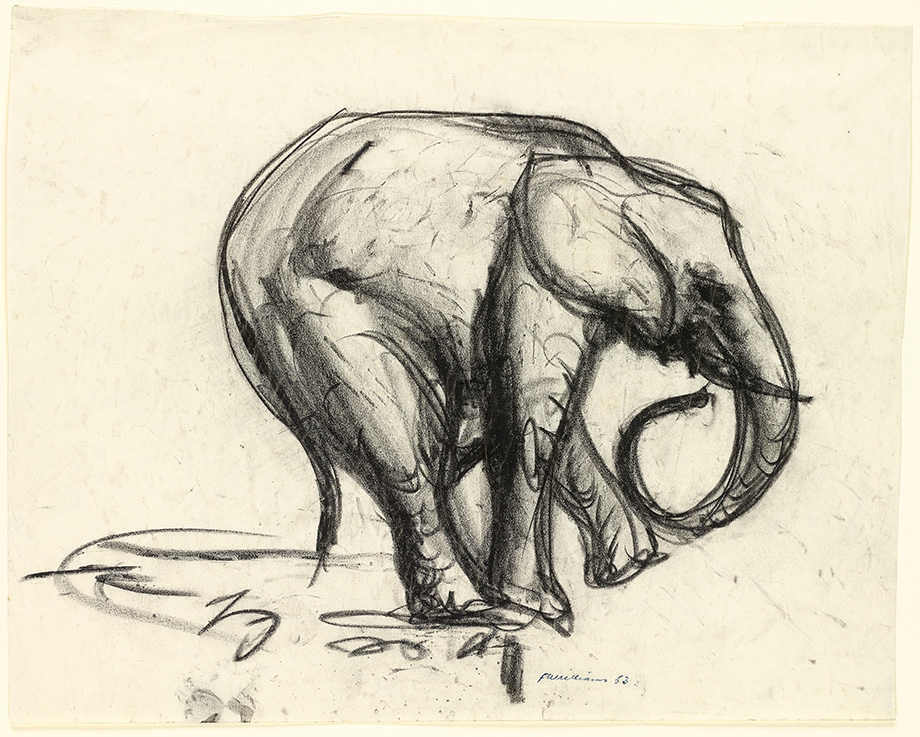
- Article Hero Image Caption: Fred Williams, Elephant, 1953 (National Gallery of Victoria, Melbourne Presented by the Art Foundation of Victoria by Mrs Lyn Williams, Founder Benefactor, 1988 © Estate of Fred Williams)
- Alt Tag (Article Hero Image): Fred Williams, Elephant, 1953 (National Gallery of Victoria, Melbourne Presented by the Art Foundation of Victoria by Mrs Lyn Williams, Founder Benefactor, 1988 © Estate of Fred Williams)
Williams had completed his formal art training at the National Gallery of Victoria (NGV) Art School before he left for London at the end of 1951. He was twenty-four years old. An appetite for work and study had also taken him to George Bell’s school and to regular drawing outdoors. Even before his departure for England, he was known for his determined, indeed frenetic pace of work. His friend, the artist Ian Armstrong described him at the Gallery School discarding one sheet after another in ‘clouds of charcoal dust’. He won a drawing prize at the Victorian Artists’ Society in 1947; two years later, the NGV purchased one of his drawings. Despite this early recognition, Williams was self-aware enough to be in no hurry to finish his education. He went to London to deepen his artistic knowledge, as both a practising artist and as one who wished to familiarise himself with the great art in the museum collections there. Having little money, he had to support himself and so found work at a framing establishment while enrolling at the School of Art of the Chelsea Polytechnic, where he attended evening life-drawing classes, a practice he continued throughout his five years in London. The drawings from the nude that he made there, and the fellow students and others he observed, form the first of four thematic groupings in the exhibition, the others being animal studies, views around London and the countryside, and the music hall drawings.
 Fred Williams, Performer and audience, 1952–56 (National Gallery of Victoria, Melbourne, Gift of Lyn Williams AM and Family through the Australian Government’s Cultural Gifts Program, 2022© Estate of Fred Williams)
In many of the nude studies, one can see the process by which the drawing was created, beginning with traces of an initial armature, followed by the application of vigorous and repeated contours and then shading with the flat end of the drawing implement – usually red conté crayon – to depict tonally the physical bulk of the human body. More drawing might follow, sometimes in a different medium or colour, as adjustments were made and emphases applied. Although these stages may be separated and analysed, the pictorial result is wholly organic and fluent, while adding a temporal dimension to the work. The naked body is a challenging form to draw, and in London Williams returned to it repeatedly as an essential activity in keeping his drawing and observational skills exercised. He was well aware of the fundamental place of drawing in the training and practice of artists in the European tradition. ‘[D]rawing exposes all,’ he wrote later in his diary. To make the statement more emphatic and personal, he added ‘[It’s] certainly true of me.’
The animals at Regent’s Park Zoo, which he would visit on weekends with Francis Lymburner, provided Williams with yet more complex forms and frequently moving subjects. A swift drawing of a squatting gibbon captures the fleeting moment of eye contact between species. Other sketches show a panoply of African animals including cheetahs, tigers and lions, a sharp-eyed secretary bird, and several of an elephant. The elephant drawings culminate in a large, finished work in black conté in which the animal is shown in profile, teetering on the edge of a raised ground, presumably the barrier in the animal’s enclosure visible in photographs from the 1950s. (Elephants are no longer kept at London Zoo.) There are echoes here of Rembrandt’s drawings of lions and elephants, and of Goya’s etched elephant in one of the plates of the Disparates, but Williams’s depictions are spontaneous and by no means imitative.
 Fred Williams, Drawing for Cheetah, c.1953 (National Gallery of Victoria, Melbourne Gift of Lyn Williams AM and Family through the Australian Government’s Cultural Gifts Program, 2022© Estate of Fred Williams)
The scenes of London depict glimpses of people going about their daily life. It is in this section of the exhibition that we get a sense of London at a particular period of history. A summary sketch of a one-legged pedlar on a crutch balancing his wares on his head, and night-time views of unlit streets, remind us that London was still recovering from a catastrophic war that had ended barely six years before Williams arrived. The landscapes – of canals, thatched buildings, and open fields – are drawn mostly in pen and ink, but there are also fine examples of Williams’s skilful and spontaneous use of brush and wash. The example of Rembrandt’s drawn and etched landscapes lies behind many of the English scenes, and seeing them grouped together here serves to emphasise the radical nature of Williams’s break with the European pictorial mode of representing landscape after his return to Australia in 1956.
Williams’s drawing, at its most exuberant, appears in the music hall subjects in which his attention shifts in turns from performers to audience. The performers’ actions are captured mid-movement; they juggle, somersault, dance, play music and sing as the drawn line moves swiftly, arresting the scene on paper, while retaining its spirit and sense of movement – even, seemingly, its sound. Williams can also capture moments of silent introspection: female performers quietly waiting their turn in the wings are the subject of two of the drawings. The audience is shown interacting in groups or individually reacting to the action on stage. Some writers have detected an undercurrent of sadness in Williams’s music hall subjects, yet the effect of this display is overwhelmingly one of liveliness. This is due to the linear vivacity of the drawings, the artist’s all-consuming attention to his subject matter, and to the sheer number of sketches that he made.
The exhibition is selected from a magnificent gift of drawings recently made to the NGV by Lyn Williams, the artist’s widow, and the Williams family. It is appropriate and timely that an exhibition drawn from this gift should be held, accompanied by a fine and fully illustrated (though, in some respects, eccentrically designed) catalogue published to acknowledge the generosity of the donors. Cathy Leahy, Senior Curator of Prints and Drawings at the NGV, is the curator of the exhibition and editor of the catalogue to which she has contributed the introductory essay on Williams’s London years. Deanna Petherbridge has written on aspects of the graphic imperative of Williams as draughtsman. Chris Stephens provides an overview of the English art scene in the 1950s. Fiona Gruber gives a brief history of the music hall, which provided Williams with theatrical subject matter, especially for his drawings and prints, not to mention a warm environment in winter. Louise Wilson has provided a technical analysis of Williams’s drawing materials. Lyn Williams, who met her husband in 1960, has contributed a brief personal account of what she knew from Williams of his years in London.
The NGV has been systematically building its collection of Fred Williams drawings and prints over many decades, by purchase and especially by gift. However, this latest donation is in a class of its own and is rightly being celebrated in this show.
The exhibition is elegantly installed with wide ledges placed along some walls for the horizontal display of related material, mostly photographs of Fred Williams in England, but also many etchings and gouaches. Chairs are helpfully provided. The labels with short explanatory texts are excellent and help viewers to better understand the work in question.
This exhibition is free of charge and is not to be missed.
Fred Williams – The London Drawings is at The Ian Potter Centre: NGV Australia from 21 October 2022 to 29 January 2023.