


- Free Article: Yes
- Contents Category: Music
- Review Article: Yes
- Article Title: Melbourne International Jazz Festival
- Article Subtitle: The state of jazz in Australia
- Online Only: No
- Custom Highlight Text:
The pandemic was always destined to cast a long shadow, leaving promoters and festivals twitchy when it came to long-term planning. The Melbourne International Jazz Festival (MIJF), like so many other events, swallowed a bitter pill in 2021, as the city went into its sixth lockdown just weeks out, scuttling months of preparation. A quick scramble saw a scaled-back, hastily assembled program of exclusively local acts rolled out over a weekend in December, a temporary marker signalling that the MIJF was down but far from out.
- Article Hero Image (920px wide):
- Article Hero Image Caption: Mike Nock Trio (Photography by Duncographic)
- Alt Tag (Article Hero Image): Mike Nock Trio (Photography by Duncographic)
- Production Company: Melbourne International Jazz Festival
Fast forward a year, and the landscape has changed dramatically. Yet there remains an undeniable note of caution at heart of the MIJF 2022 program. Gone for now are the high-profile international drawcards like Herbie Hancock or Charles Lloyd, who graced previous festivals, and whose guaranteed presence requires extended lead times. In their place, the MIJF came up with a program that focused on the state of jazz in this country, highlighting award-winning newcomers such as Flora Carbo and Chloe Kim, alongside late-career masters like Mike Nock. Instead of playing second fiddle, Australian musicians were very much front and centre. If the number of sold-out events is any indicator, few were put off by this state of play.
That is not to imply that the MIJF failed to live up to its ‘international’ tag. Those international acts scheduled tended to fall into two camps. On one side were popular artists whose work operates on the fringes of jazz, such as R&B singer Lalah Hathaway, who performed a concert featuring the music of her father, Donny Hathaway. Ditto, New Zealand funksters Fat Freddy’s Drop, who graced the Sidney Myer Music Bowl, along with the Bamboos, Emma Donovan, and Harry James Angus, as part of the Festival’s Big Saturday, a seven-hour extravaganza that attracted a crowd of nine thousand attendees.
The other camp comprised a series of artists – Italian drummer Francesca Remigi, Finnish pianist and harpist Iro Haarla, and powerhouse US drummer Pheeroan akLaff – whose performances all involved collaborations with local musicians. These concerts, which took place in the more intimate space of the Jazzlab in Brunswick, proved far more adventurous outings, reflecting a strong desire by the MIJF to stay relevant.
New York-based Remigi demonstrated her affinity with her home town’s avant-garde roots, exemplified by artists such as John Zorn, Marc Ribot, and Tim Berne. Her quintet performance, featuring Italian compatriot Federico Calcagno, alongside the distinctive talents of Melbourne musicians Niran Dasika, Andrew Saragossi, and Helen Svoboda, was fast-clipped and furious, full of jump cuts and bravura soloing. Calcagno’s deep, woody bass clarinet cast a lyrical base over which trumpeter Dasika and saxophonist Saragossi forged their ferocious flights, often playing in tandem. Svoboda’s frenetic bass tirelessly generated complex figures, driven by Remigi’s animated percussion. Her compositions, such as ‘Gomorrah’, directly inspired by Roberto Savinio’s book, were brimming with spiky dissonance, interspersed with occasional lyrical respites and pounding grooves.
Pheeroan akLaff’s Sunday night performance at Jazzlab saw the leader using every tool in his arsenal – snare, bass, toms – to generate a massive wall of sound. At the same time, he proved capable of sculpting spacious intervals, forged by delicate brushwork, that created openings for Sunny Kim’s experimental voicework. Sydney saxophonist Peter Farrar’s contribution was a standout, his searing tone slicing through the bustling musical melange, while Mike Nock’s pianistic contributions, subtle throughout, provided a rich seam of lyrical content. Pheeroan akLaff’s long career has seen him play and record with the giants of free jazz and improvised music, including Cecil Taylor, Anthony Braxton, Oliver Lake, and Wadada Leo Smith. His performance paid homage to that great legacy.
On the Tuesday night, Finnish artist Iro Haarla leant her cool, melodic sound – on both piano and harp – to Sydney bassist Jonathan Zwartz’s new work ‘Suite Suomi’, a near ninety-minute composition scored for sextet. A prominent ECM recording artist, Haarla’s work is inspired by nature, drawing sustenance from the austere white-tipped landscapes of her Nordic homeland. ‘Suite Suomi’, composed by Zwartz especially for Haarla, was designed to explore their shared love of the natural world, from the atmospheric dance of the Northern Lights to the harsh aridity of the Australian interior. Zwartz’s suite can best be described as slow music, steadfastly minimalist, awash with a delicate sheen. Haarla’s harp fashioned gentle waves of sound, providing a luxuriant backdrop for Julien Wilson’s slow-burn forays on tenor sax, his sound floating freely, as if untethered to its surrounds. Zwartz’s bass was ever-present, full of reverb, earth to Phil Slater’s soaring trumpet. The composition, framed as a continuous and extended journey, unfurled ever so gently, habitually morphing and shifting register, building incrementally toward its rousing and cacophonous finale.
Several large-scale projects by Australian composers were given their Melbourne première, including works by Flora Carbo and Jeremy Rose. On opening night, saxophonist Carbo unveiled her new project Ecosystem, a product of the 2022 Take Note Commission. Now in its fourth year, the Commission represents a major initiative by MIJF, designed to address gender inequality in jazz by focusing attention upon future women and gender-diverse leaders. Following on from previous commissions by Claire Cross, Holly Moore, and Ellie Lamb, Carbo’s contribution reveals a deeply committed artist who, in the space of a few brief years, has risen to the forefront of the Australian jazz scene. Flora Carbo (Photograph by Will Hamilton-Coates)
Carbo’s sixty-minute suite, scored for an unconventional sextet made up of three alto saxophonists and three voices, touched on contemporary themes of environmentalism and place, drawing on field recordings Carbo made during Melbourne’s lockdowns. The very act of walking – an activity that loomed large for many of us during that time – has, in her hands, been transformed into a sustained rhythmic pulse, her tempos switching from amble to stride to run. As the piece progressed, saxophonists Bernard Alexander and Zac O’Connell dabbled in extended techniques, mimicking the wordless vocalising and harmonising of the singers. Full of repetitive phrasing and occasional spoken work, Carbo’s choir-like music summoned the delicate in-out of breathing, the elemental pulse of a heartbeat. In the absence of conventional rhythmic instruments – drums, bass, piano – Carbo’s ensemble manifested an other-worldly spirituality, her rising chorus of sax and voice recalling the eccentric vocal chamber work of Meredith Monk. A bold and adventurous composition that weaves a rich tapestry from everyday sounds, Ecosystem provides ample evidence of Carbo’s dramatic maturity as an artist.
Sydney saxophonist Jeremy Rose’s large-scale composition Disruption! The Voice of Drums, ranks as a milestone in his career to date. Composed collaboratively with Sydney drummers Simon Barker and Chloe Kim, and augmented by the Earshift Orchestra, the extended performance, intense and visceral, commemorates the ceremonial ritual of drumming as a force for protest, dialogue, and healing. Inspired by recent global turmoils – from environmental disasters to Black Lives Matter – Rose’s turbulent score serves as a strident and urgent call to arms. Barker and Kim’s drum kits were atypically situated at the forefront of the Recital Centre stage, providing a theatrical framework, their combined sound forming a relentless barrage of percussive communication. Behind the drummers, guitarist Hilary Geddes generated electronic squalls, trumpeter Tom Avgenicos twisted and bent his notes into tortured shapes, while Jeremy Rose’s bass clarinet persisted as a brooding presence. The performance was enhanced by use of a triple screen displaying the work of video artists Rachel Peachey and Paul Mosig, whose powerful images collaged scenes of protest with desolate landscapes and an unending cosmos. At its heart, Disruption! is a paean to the astounding abilities of Barker and Kim, whose ear-splitting intensity summoned an earlier masterwork of percussive provocation: Max Roach’s We Insist! Freedom Now Suite.
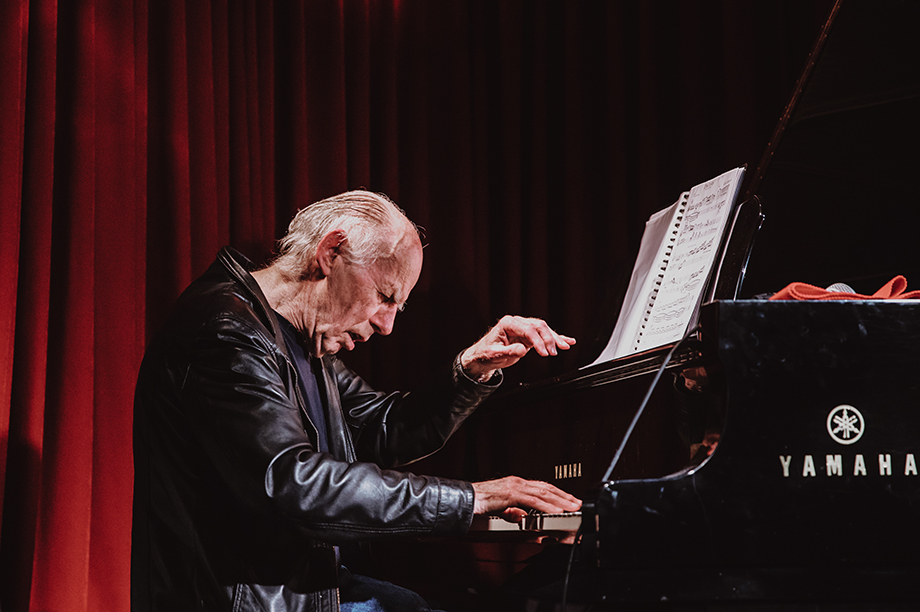
New Zealand-born pianist Mike Nock, now in his ninth decade, shows no signs of slowing down. For his MIJF performance, he revisited his 1982 trio album Ondas, accompanied by bassist Jacques Emery and drummer Chloe Kim. Recorded for Manfred Eicher’s ECM label – a rare honour – the recording featured bassist Eddie Gomez, who famously honed his playing style with Bill Evans, and Norwegian drummer Jon Christensen. Ondas represented a watershed in Nock’s career, an album that perfectly wedded his lyrical proclivity with poetic flights of improvisation. Forty years on, there is no diminution in its power. Forgoing a spoken introduction, Nock proceeded to perform the album’s five tracks, beginning with the extended reverie ‘Forgotten Love’, as a single piece flow, teasing out the work’s clear-eyed narrative. Throughout, Nock’s compositional lyricism was to the fore, as the trio engaged in a meditative three-way conversation exploring tonal variations of light and shade, seamlessly blending space with clean lines and elegant phrasing, steadfastly reaching for beauty.
This year’s MIJF placed a strong emphasis on Sydney musicians, a welcome reminder that most had not set foot in Melbourne since pre-pandemic times. Piano trio Brekky Boy brought their cranked-up, high-energy vamps to Chapel off Chapel, mining a similar groove to artists such as Robert Glasper and the Bad Plus. Beginning with spacy, prog-rock effects, the trio proceeded to discharge volley after volley of punchy hooks, awash with hypnotic repetitions, thundering bass lines, and incessant hip-hop beats.
Sydney guitarist Hilary Geddes, awarded the prestigious Freedman Jazz Fellowship in 2021, demonstrated a stylistic affinity with guitarists such as John Scofield and Pat Metheny, along with post-rock bands such as Tortoise and Mogwai, during her quartet set at Jazzlab. Her final suite ‘Pine Vale / Silos / 102’, inspired by her home town of Griffith, was a standout, a restless, moody soundscape evoking western panoramas, high plains, and drifters.
The Jazzlab resembled a laboratory when Sydney-based quartet Tangents took to the stage to perform an unbroken eighty-minute improvisation, hemmed in by laptops, electronic pedals, and endlessly snaking cable cords. Peter Hollo’s electrified cello loosened waves of swirling dark figures, while Ollie Brown, twiddling computer knobs, inserted a flurry of chirrups and electrical feed into the mix. Adrian Lim-Klumpes, on piano and Rhodes, produced dense layers of white noise, the various computerized elements welded together by Evan Dorrian’s ceaselessly inventive drumming. Like the Necks, Tangents build vast slabs of sonic architecture. In mashing genres such as drone, ambient, trance and minimalism, they question the very boundaries of jazz.
On the penultimate night, trumpeter Paul Williamson brought his latest project, the What Ifs, to Jazzlab to launch his new album Keep It Simple. Williamson is a stalwart of the Melbourne jazz scene, with a dozen recordings under his belt. His new band is arguably one of his finest to date. Surrounding himself with mostly younger players, Williamson appeared egged on to stretch himself, débuting new compositions that were demonstratively pliant and supple in nature, with themes constantly snaking and turning. Miro Lauritz’s vibes were key to the quintet’s sound, a plush scene-setter for Scott McConnachie’s scorching solos on alto and soprano saxophone. McConnachie comes across as a force of nature, his darting and angular incursions, freely hovering above the melody, propelling this music to dizzying heights.
 Brenda Gifford, Joe Brown McLeod and the Australian Art Orchestra (Photography by Duncographic)
The final night of MIJF saw the première of an important new work by composer Brenda Gifford, developed in partnership with MIJF and the Australian Art Orchestra as part of its First Nations Residency Program. Saxophonist, composer, and proud Yuin woman, Gifford – with her nephew Joe Brown McLeod and a sextet of musicians from the AAO – performed her extended composition Moriyana, incorporating Dhurga language, field recordings, and improvisation. Introduced by McLeod’s didjeridoo, clapsticks, and solo voice, Gifford’s experimental work drew inspiration from whales, and their place in the creation stories of her Country. Aviva Endean’s clarinets and Reuben Lewis’s trumpet mimicked whale song, but equally their instruments conjured wind through trees, or vast expanses of water and land, connecting this music to place and spirituality. Helen Svoboda’s bass bowing, Andrea Keller’s piano, and Maria Moles’s percussion added a rich dimension to Gifford’s sporadic saxophone cries, her brief spoken recitation, each of these elements mingling to form a powerful musical journey that slowly cycled back to its beginnings, closing with McLeod’s unaccompanied, haunting voice.
With more than eighty-five performances on offer over ten days, some inevitably fell by the wayside, including US pianist Dan Tepfer’s computer-generated music, projected as visual imagery upon the Melbourne Planetarium’s domed ceiling; Phillip Johnston’s quirky score played as live accompaniment to the silent films of Georges Méliès; and award-winning and Chilean saxophonist Melissa Aldana. The fact that most performances were well attended, with many sold out, says much about Melbourne’s post-pandemic craving for live music. It also suggests that MIJF got the mix right, balancing the popular with the adventurous and challenging. Most tellingly, this MIJF cemented the exceptional talents of a new generation of young Australian female and gender diverse artists – Flora Carbo, Helen Svoboda, Chloe Kim, Hilary Geddes – delivering their music to a wide audience. Their rise points to the rapidly changing landscape of Australian jazz, surely a cause for celebration.
The Melbourne International Jazz Festival took place at multiple venues from 14–23 October 2022.