


- Free Article: No
- Contents Category: Music
- Review Article: Yes
- Article Title: Awakening Shadow
- Article Subtitle: The indefatigable Sydney Chamber Opera
- Online Only: No
- Custom Highlight Text:
Understandably, the focal point of musical interest in Sydney in recent months has been Bennelong Point, more specifically the newly revamped Concert Hall at the Opera House. Central here has been the Sydney Symphony Orchestra under the new leadership of Simone Young, offering a series of wide-ranging and exhilarating concerts. But there has been other music making. Sydney’s indefatigable Sydney Chamber Opera has not been idle, and Friday saw the première of Awakening Shadow, an intriguing new/old work by Australian expatriate composer, Luke Styles, It comprises a melding of original music by Styles that enfolds the five Canticles of Benjamin Britten (1913–76).
- Article Hero Image (920px wide):
- Article Hero Image Caption: Tenor Brenton Spiteri (photo by Zan Wimberley)
- Alt Tag (Article Hero Image): Tenor Brenton Spiteri in Awakening Shadow
- Production Company: Sydney Chamber Opera
Britten’s five Canticles are interspersed throughout his substantial mature output from 1947 to 1974, and in many ways chart, in miniature, the development and blossoming of his musical, dramatic, and philosophical ideas. These five works are difficult to categorise as they contain elements of art song, sacred cantata, and opera, all synthesised into a distinctive form of chamber music. What is also striking are the links between each Canticle and an opera that preceded or followed its composition. Britten saw the Canticles as a new form, but acknowledged their origins in the Divine Hymns of Purcell.
The first Canticle, My Beloved is Mine, written for Peter Pears, is a tribute to Dick Sheppard (1880–1937), Dean of Canterbury, Christian minister and broadcaster, pacifist and founder of the Peace Pledge Union, and a renowned pacifist (like Britten himself). It uses text by Francis Quarles (1592–1644) who wrote almost exclusively religious poetry, reminiscent of John Donne. My Beloved is Mine is a meditation on the religious ecstasy of man’s relationship to God. Some commentators see this work as a quasi-epitaph to Britten’s opera Albert Herring (1947). Britten biographer Humphrey Carpenter asserts: ‘Canticle I seems to be, as no other work had yet been, a happy celebration of the composer’s relationship with Pears.’
Canticle II, Abraham and Isaac, a setting of a scene from the medieval Chester Miracle Plays, was premièred in 1952. Britten wrote the Canticle for Pears and Kathleen Ferrier. There is a strong thematic link with the opera Billy Budd (1951). It pits the alto and tenor voices against each other, and is operatic in its exploration of changing emotions. The voice of God is suggested by the combination of the two voices, singing not quite in unison, which creates an eerie, almost otherworldly atmosphere. The work is a fusion of play, cantata, and operatic scena. Britten would use some of this music in his War Requiem (1962). There is a much more operatic sensibility at work here than in the first Canticle.
Canticle III: Still falls the Rain – The Raids, 1940, Night and Dawn, from 1954, signals a turning point in Britten’s music due to its engagement with dodecaphony (it is based on a theme that uses all twelve chromatic pitches). It was written as a tribute to Noel Mewton-Wood, a brilliant young Australian pianist who had worked closely with Britten and Pears, but who committed suicide at the age of thirty-one. The work is scored for tenor, horn, and piano, and is a setting of the hard-hitting text by Edith Sitwell, confronting the horrors of World War II. Britten himself wrote that ‘at last one could get away from the immediate impacts of the war and write about it’. The Canticle reflects the tortured world of its operatic predecessor, The Turn of the Screw (1954), particularly in its deployment of theme and variations. It is the most disturbing of the Canticles. Again, the voice of God is heard, this time with a combination of tenor and horn. In the final section, a spoken outburst, ‘O Ile leape up to my God; who pulles me doune’, is Doctor Faustus’s anguished cry from Christopher Marlowe’s play, leading to redemption against all the odds.
Canticle IV, The Journey of the Magi (1971), changes the vocal forces to counter tenor (mezzo), tenor, and baritone (Melchior, Balthazar, and Casper). As in the final Canticle, the words are by T.S. Eliot; they explore the doubts and frustrations suffered by the three kings in search of the child Christ, as recalled by one of them years afterwards, including uncertainty about the significance of their journey and what they had really seen. The work immediately preceded Death in Venice (1973), and the musical conception has a similar sense of unease and foreboding.
Canticle V, The Death of Saint Narcissus, one of Britten’s last works, was the first music he wrote on his recovery from heart surgery. He dedicated the work to the memory of South African writer William Plomer, the librettist of Gloriana (1953) and the three Church Parables. The use of a harp as accompaniment creates an atmosphere of exoticism – an echo of the sound world of Death in Venice, which had its première immediately before the Canticle’s composition. As in so many of Britten’s works, the theme of lost innocence is explored. The music is spare and economical, typical of Britten’s final period.
Luke Styles now enjoys a successful and prolific career as composer since journeying to the United Kingdom to pursue his musical education. He was the first Glyndebourne Young Composer in Residence (2011–14), and has composed a wide range of works for that company, the Royal Opera Covent Garden, the London Sinfonietta, the London Philharmonic Orchestra, the Britten Sinfonia, the Philharmonia Orchestra, and the Sydney Symphony Orchestra. His operas range from Macbeth to Ned Kelly.
Styles’s music frames and provides interludes between the Canticles. To the alto, tenor, and baritone, a soprano is added who plays a crucial role, particularly in the ‘Nova Stella’ section. The work opens with wordless, often non-pitched sounds, which explore the idea of the emergence of language that precedes the Old Testament elements of the Canticles. In addition, Styles draws on Johannes Kepler’s discovery of a new star, a link to the Journey of the Magi, as well as poetry by Lord Byron and Percy Shelley.
Styles’s second interlude has the soprano and baritone struggling to articulate the they eventually manage to utter. In broad terms, what might seem at first to be an unrelated combination of musical elements gradually lends musical coherence through the use of fragments of harmony, melody, and rhythmic figures from the Canticles, and serves as important linking elements within Britten’s works and providing a sense of overall structure. Awakening Shadow closes with all four voices together – the tenor had sung only in the Canticles – with text from Shelley’s ‘Mutability’. The final sounds are all four voices in harmony singing Shelley’s line, ‘Nought may endure but Mutability’, which indicates the musical arc of the work being completed.
 Sydney Chamber Opera's Awakening Shadow (Zan Wimberley)
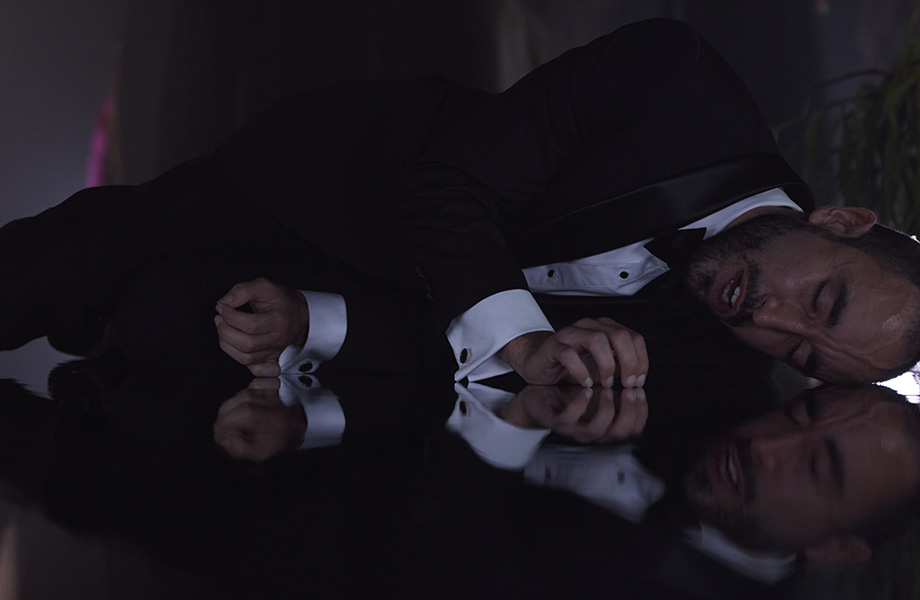
The performance is dominated by tenor Brenton Spiteri, who delivers a vocal tour de force. Spiteri had a great success with SCO in Elliott Gyger’s Fly Away Peter (2015) and Oscar and Lucinda (2019), among other operas. The Britten is a marathon for the tenor, but Spiteri met all the challenges with aplomb. His voice has excellent focus, is richly hued, and deployed with great musicality, sensitivity, and rhythmic surety, as well as outstanding intonation. The widely ranging emotional landscape of the Britten drew from Spiteri a full spectrum of dynamics and tonal variety underpinned by crisp diction. Although Spiteri does not have a typical ‘English tenor’ sound, he sings Britten as to the manner born, with his ‘Italianate’ heft adding substantially to the dramatic essence of the Britten work.
While the mezzo and baritone are used sparingly in the Canticles, Styles deploys them, with the soprano, extensively in his sections of the work. Mezzo Emily Edmonds is establishing an important career in Europe, and although hers is a very different instrument from Kathleen Ferrier’s, she has a beautiful, creamy tone and her contribution in both the Britten and the Styles was impressive.
Soprano Jane Sheldon and baritone Simon Lobelson are SCO stalwarts and have shone in a wide variety of music. Sheldon has a pure and clean sound, and a musicality that is always apparent. The most extreme vocal demands and extended techniques, of which there are several in Styles’s music, were dispatched with elan. Lobelson’s warm baritone provided a rock-solid foundation in the ensembles, while his singing in The Journey of the Magi was most moving. All three contributed substantially to the success of the performance.
Jack Symonds, artistic director of SCO, oversaw the performance from the piano. Both Britten’s Canticles and Styles’s music make great demands on the pianist, but Symonds is one of those performers who seemingly can play, and sight-read, anything, so these challenges held no terrors for him, controlling the disparate forces with assurance. Rowan Phemister (harp), Carla Backwood (horn), and Emma Jardine (violin) added significantly to the success of the show, providing much aural and textural variety.
Staging was directed by Imara Savage, with set and costume design by Elizabeth Gadsby, video by Mike Daly, and lighting by Alexander Berlage. While the performance is essentially static, the use of the space was imaginative and the costumes, lighting effects and video projections created much interest. The staging is a visual exploration of the male body using the filmic technique of photogrammetry, in which images of a dancer’s body seemingly become memorialised, transforming into fluidly moving statues. The playing space becomes a place of reflection and memorial, with the striking flower sculptures suggesting a site of worship, whether religious or pagan.
The issue of genre sometimes emerges in the offerings premièred by Sydney Chamber Opera, and Awakening Shadow is such a piece. Is it opera, music theatre, dramatic cantata, or something else? A ‘traditional’ opera audience might have difficulty in accepting the contested term ‘opera’ in this context, but it is probably not wise to go down the genre rabbit hole – that way madness lies! It is a shame that preconceptions could preclude potential audiences from attending an intelligent, fascinating, and excellently performed piece. SCO have added to its rich repertoire of thought-provoking and important theatre works. Long may this continue.
Awakening Shadow (Sydney Chamber Opera) is on at Carriageworks until 7 October 2022. Performance attended: 30 September 2022.