


- Free Article: Yes
- Contents Category: Theatre
- Review Article: Yes
- Article Title: Cyrano
- Article Subtitle: A new adaptation of Edmond Rostand’s classic
- Online Only: No
- Custom Highlight Text:
In Italian playwright Luigi Pirandello’s Six Characters in Search of an Author (1921), a handful of people enter a stage during a rehearsal and begin to break down the very structures of theatre itself. They question not just the verisimilitude of acting but the essentialism of character, the idea that we are ever any one thing fixed in time. It is a concept that animates Virginia Gay’s free adaptation of Edmond Rostand’s Cyrano de Bergerac (1897): this is a tragic hero who pushes at the confines of their assigned role, daring to imagine not just an alternate ending but an entirely new way of being Cyrano.
- Article Hero Image (920px wide):
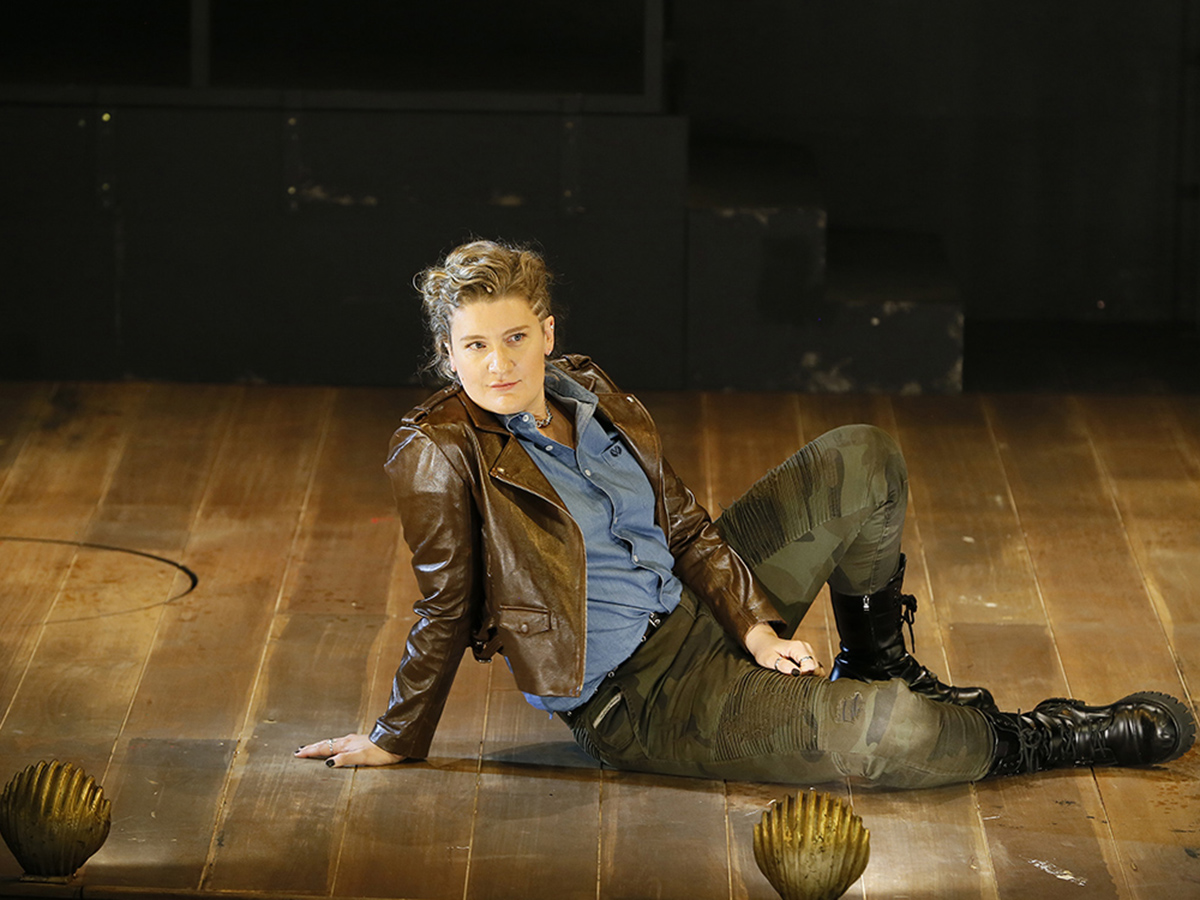
- Article Hero Image Caption: Virginia Gay as Cyrano (Jeff Busby)
- Alt Tag (Article Hero Image): Virginia Gay as Cyrano in MTC Cyrano
- Production Company: Melbourne Theatre Company
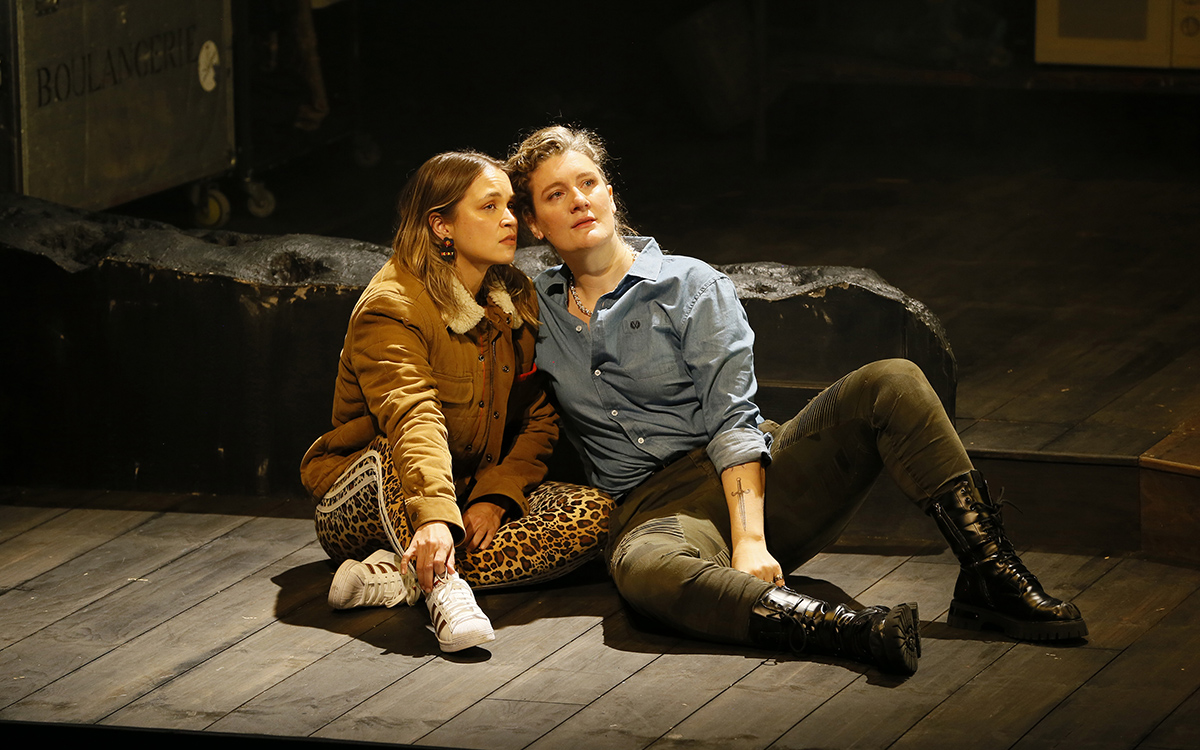 Tuuli Narkle as Roxanne and Virgina Gay as Cyrano (Jeff Busby)
Another major change to, and certainly a vast improvement on, the original is the character of Roxanne (Tuuli Narkle), who is here transposed from the bland ‘maiden in a tower’ to a feisty, sexually adventurous fellow wordsmith. Not only is she a match for Cyrano’s wit, she pushes back hard on the story’s tendency to strip her of agency and self-determinism. This makes the central love story equally weighted, and therefore more touching. Rostand’s love affair is really between Cyrano and his own panache; Gay’s version is a genuine meeting of minds.
Apart from these central lovers, the only other named character in this production is Yan (Claude Jabbour), the dunderheaded jock on whom Roxanne is fixated, and who Cyrano helps in a misguided attempt to seduce the woman she feels she doesn’t deserve in her own right. Jabbour has a lovely dim-witted charm, and folds neatly into the chorus when not tripping over his own clumsiness. The chorus themselves are a delight, gentle clowns of meta-theatre who bring a lovely musicality and charisma.
Director Sarah Goodes wrangles the material admirably, even if she lets some of the cast’s energy dissipate and the play’s focus to wander. Gay’s script is very light on actual plot – it has a sometimes frustrating tendency to tell us rather than show us the story, constantly stepping out of the frame to comment on the action – and Goodes fills this dramatic void with some unnecessary stage business. When it works, it feels like a travelling troupe cobbling their art together; when it doesn’t, as in an extended comic dancing scene, it feels dangerously close to rehearsal warm-up games.
Described as a ‘play with songs’, Cyrano is filled rather with plenty of incidental music and not a lot of fully realised composition. What is there (under the musical direction of Xani Kolac) is lovely, folk-inflected, and whimsical, and it is all beautifully performed by the ensemble. Milo Hartill in particular has a supple and trilling voice, and Holly Austin is wonderfully versatile on a number of instruments.
The design (sets by Elizabeth Gadsby and costumes by Jo Briscoe) is elementary and effective, with a punched-through brick wall opening to a bare stage lined with prop boxes and costume racks. Lit warmly by Paul Jackson, it feels comfortably bohemian, a utilitarian theatre-making space primed for simple joys.
Cyrano, in all its many iterations, is a showpiece for an actor, and it is clear why Virginia Gay was attracted to it. She is a performer of bounding vitality and magnetism, but she is also capable of profound sadness, even bitterness. Her Cyrano is a force of nature, of the chivalric longing that defines the part, but of anger too; there is a rage of otherness, of marginalisation underpinning her performance that is atypical and fascinating to watch. As a writer, she tends to lean into her ambivalence about the telling of old stories to the detriment of the drama, so that the result is less an adaptation of Rostand’s play than a self-aware exegesis on the play’s legacy, a demolition of its assumptions and world view. She has turned Cyrano from a tragic hero into a queer romantic heroine. Some will argue this is a falling off; others will see it as proof of the power of the spoken word. If Rostand himself might turn in his grave, Pirandello would be proud.
Cyrano (MTC) continues at the Sumner Theatre until 29 October 2022. Performance attended: 29 September.