


- Free Article: No
- Contents Category: Opera
- Review Article: Yes
- Article Title: The Human Voice and The Call
- Article Subtitle: Reflecting an Australian contemporary cultural identity
- Online Only: Yes
- Custom Highlight Text:
Opera Queensland’s third mainstage production of the year, presented in partnership with Brisbane Festival and in association with Fluxus, is a double bill of two one-woman operas where a single phone call changes the course of each character’s life. First came Francis Poulenc’s The Human Voice, followed by the world première of The Call.
- Article Hero Image (920px wide):
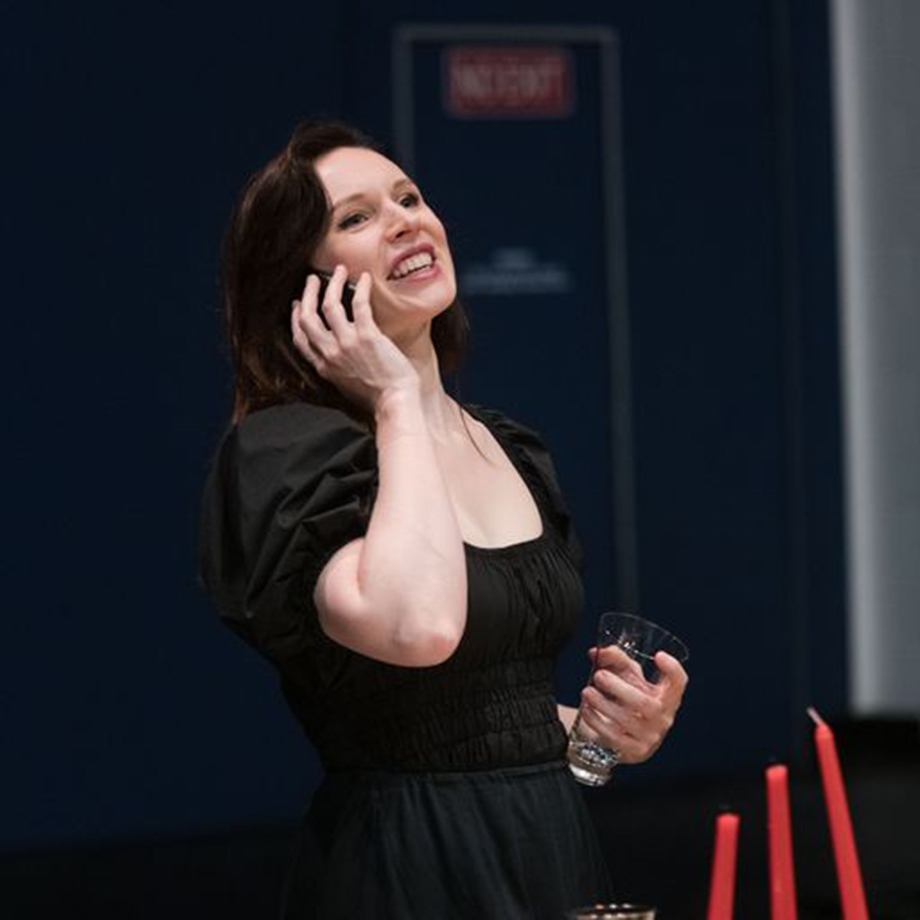
- Article Hero Image Caption: Alexandra Flood in The Call (Opera Queensland)
- Production Company: Opera Queensland
Performing in Europe since her début at the Salzburg Festival in 2014, Australian soprano Alexandra Flood made her mainstage début for Opera Queensland as Elle. Flood’s luscious, warm, and effortless soprano was a highlight of the evening, and was delivered in beautiful French. She empowered Elle with a refreshing complexity and depth, and her refined performance softened a sharp edge in the intermittent and repetitive score. The role did not provide opportunity for her full coloratura, but demonstrated exciting lyric potential. Let us hope that Australia will see more of this artist in future.
The Call was conceived by soprano Ali McGregor when she heard a true story on the podcast The Moth told by Auburn Sheaffer, who then approved its adaptation into an opera. A carefully curated publicity campaign maintained mystery around the plot, creating a palpable anticipation in the theatre when it was revealed who was on the other end of the call. McGregor assembled a team of Meanjin-based creatives to develop the fifty-five-minute opera, including composer Connor d’Netto, co-librettists Kate Miller-Heidke and Keir Nuttall, and director Patrick Nolan.
Composer Connor d’Netto is known for his integration of neoclassical, post-minimal, and pop influences with a delicate use of electronic instruments. In The Call, we are immediately drawn into his compelling contemporary sound world. The audience is taken on an epic aural and emotional ride through d’Netto’s score, which is vibrant with layered textures, vertical rhythms, lyricism and starkness, as well as sweeping movement. Although The Call is d’Netto’s first opera, there is a maturity in his opera composing. He has a knowledge of vocal writing through his own experience as a singer, and the score has an excellently paced dramatic approach. His orchestration cut the QSO back to nine string players with a solo part each, percussion and two bass clarinets, with added piano and two electric guitars. Percussion was a soloist on its own, with rich and intelligent use of the colours and a drum kit providing hypnotic rhythm and unsettling dramatic tension. An electric guitar solo confidently rounded out the aesthetic and showed that opera can reflect an Australian contemporary cultural identity.
Written as a monologue, the libretto is a skilful adaptation of Shaeffer’s story by Kate Miller-Heidke and Keir Nuttall, whose experience in song-writing brings excellent suitability for the sung voice as well as simplicity, clarity, and charm.
Soprano Ali McGregor gave a charismatic performance that employed the full capacity of her cabaret and operatic vocal technique, as well as spoken lines delivered with the finesse of a theatre actor. D’Netto’s vocal writing was a vehicle for McGregor to deliver full-bodied operatic singing, semi-sung lines with crystal clear clarity of diction and – impressively – sustained stratospheric whistle register sounds, like a breathtaking, otherworldly cry.
Greek international orchestral conductor Zoe Zeniodi’s background as a collaborative pianist enables generous connection to the singers. She maintains a sensitive balance between singer and orchestra. The QSO met the challenge of Poulenc’s score with an impressive ensemble and remarkable ease. The orchestra committed to d’Netto’s score so convincingly that it was disappointing that they were invisible in the pit.
Patrick Nolan’s collaborative approach to direction is evident through the nuanced performances of both sopranos. With set and costume designer Marg Horwell and lighting designer Bernie Tan-Hayes, the design team created a contemporary aesthetic, which maintained their fresh lens to the form. An elegant English surtitle translation for The Human Voice was poetically crafted to resonate with a modern audience.
The QPAC Concert Hall was transformed into a theatre-like space with the installation of lighting rigs and theatre walls. The orchestra pit, usually hidden, was exposed. One advantage of this space was the ideal acoustic for orchestra and the classical voice.
In The Call, an excellently executed live video feed was integrated with the surtitles, using cameras on stage and from above. This provided proximity and intimacy for a one-woman show in a large space. Seeing McGregor’s face up close revealed nuance in the libretto and enhanced the emotional experience. Live feed was not present in The Human Voice. While a dramaturgically detailed lighting design was evident, and surtitles were projected attractively onto the set, these elements came at the expense of sufficient lighting on Flood’s face, which meant that, overall, the detail and layers of her performance were not able to be appreciated in the same way as The Call.
A standing ovation ended the evening. Phone calls can indeed change the course of lives, yet the voices of Flood and McGregor and the birth of an important new Australian opera reminded us that there is nothing like the in-person experience of human connection.
The Human Voice and The Call (Opera Queensland and Brisbane Festival in association with Fluxus) were performed at QPAC Concert Hall from 20-24 September 2022. Performance attended: 20 September.