


- Free Article: No
- Contents Category: Television
- Review Article: Yes
- Article Title: The Australian Wars
- Article Subtitle: Places etched in the memory
- Online Only: No
- Custom Highlight Text:
At a pivotal moment in the new SBS miniseries The Australian Wars, director and presenter Rachel Perkins takes us to a place she says is ‘etched in the memory of my family. A place called Blackfellas Bones.’ Perkins turns to talk directly to camera: ‘You know, we turn away from things that we don’t want to see. We all do it. And I admit that I actually didn’t really want to make this documentary series because I knew that I’d have to spend years going through the horror of it. But … making this film has led me to this place … a place where many members of my family were killed. But my great grandmother survived to tell the story.’
- Article Hero Image (920px wide):
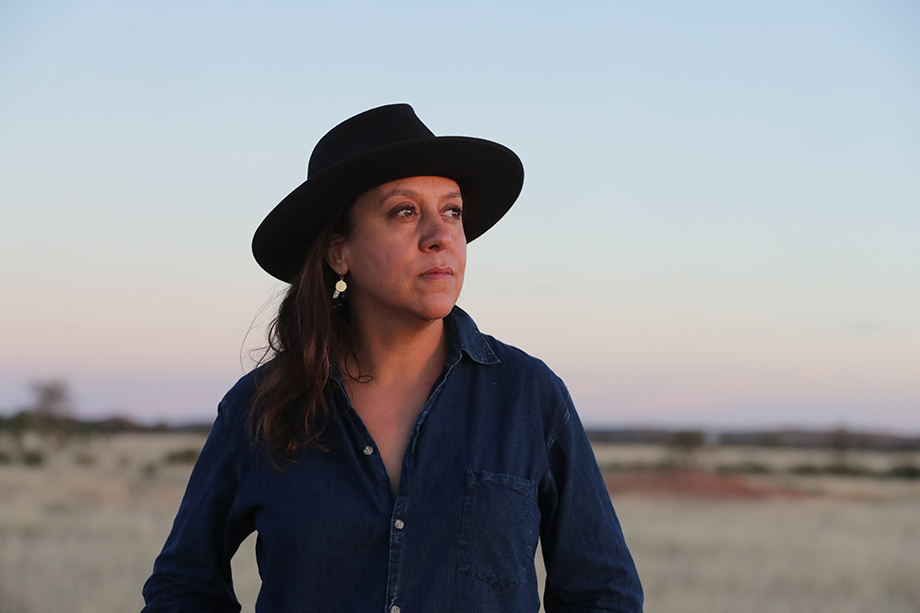
- Article Hero Image Caption: Rachel Perkins (photograph by Dylan River)
- Production Company: SBS
At this moment, Perkins shifts from the role of a documentarist collating the well-researched evidence of experts and witnessing the testimony of others. She steps into the role of a participant in this history struggling to look face-on at the massacre of members of her own Arrernte and Kalkadoon families. This moment clinches a key premise of the series: that ‘this history is still alive in those descendants who carry the stories’. The emotional openness of the direct address has the potential to build a powerful rapport with viewers as it brings what is often considered the historical past into connection with its reverberations in the present.
The documentary series is framed around some key questions. Why is the extreme violence of the frontier not recognised as war? In a country ‘obsessed with war and commemoration’, why is the death of an estimated 100,000 people on the frontier, both black and white, not acknowledged and memorialised? When the number of people killed on the frontier roughly equals the combined total of all Australians killed in all foreign wars to date, why does the Australian War Memorial, tasked to honour and commemorate those who died in Australia’s wars, explicitly exclude those who died in the fledgling nation’s first war: the war for sovereignty of this land?
When Perkins challenges the director of the Australian War Memorial, Matt Anderson, about this exclusion, his response is that there is ‘no evidence of military forces raised in Australia engaged in the frontier violence’. War was never officially declared; the implication is that this was not war because war is combat fought between armies. But, as Perkins emphasises, what took place was guerrilla war – and not just one war but a series of small ones that lasted for over a hundred years, spreading across the country as the frontier extended into new territories. While the colonial governors did deploy soldiers, and the Queensland Native Police was set up as a paramilitary force notorious for its ferocious efficacy, the fierce Aboriginal resistance was mostly waged by small bands of warriors. The conflict was often staged between warriors using guerrilla tactics and individual settlers or small sorties of squatters and vigilantes setting out to ‘clear’ any impediment to their occupation of the land.
Over three episodes, the series traces the extension of the frontier in a rolling wave of violence across the mainland and Tasmania. As Perkins states, this series is ‘hopelessly inadequate to tell the scale of the violence’ on the frontier; of necessity it focuses on key sites of conflict as exemplars. The first episode follows the establishment of the Sydney colony, the first known organised resistance of the Sydney clans, led by Pemulwuy, as the settlers encroached across the Parramatta Plain, and the ongoing conflict that erupted around the land grab on the Cumberland Plain, around the Hawkesbury and the free-for-all over the mountains into the vast pasturelands of the Bathurst Plains.
The second episode tells in chilling detail the story of the Tasmanian colony and the terror experienced by both sides as the colonists sought to exterminate the Aboriginal inhabitants and as the guerrilla war escalated. The series follows this acceleration of warfare into Victoria, up through Queensland and into Central Australia and the Top End, and across Western Australia into the Kimberley. The account moves from the early days when Aboriginal people had the distinct advantage of numbers and home terrain, to conflicts that were more evenly matched on to the tipping of the scales when horses were introduced to the frontier in the 1830s and finally to the introduction in the 1880s of the repeater rifle, against which Aboriginal people ‘didn’t stand a chance’.
With the 1997 ABC TV series Frontier (Bruce Belsham, Victoria Pitt), Australian audiences first confronted on television the meticulously researched historical evidence that the frontier advanced in ‘a line of blood’. Many viewers responded with shock, distress, and outrage that they had not known this history. Determined to fend off sceptical viewers who would deny this history, Frontier relied strictly on verifiable historical documents; in its devotion to rigorous historical accuracy, it presented only what was in the written records of the time.
Twenty-five years later, the brutality of colonial settlement is much more widely known, and the claims that ‘it didn’t happen’ have become more muted. A more common defensive reaction now, aiming to quell discussion of this confronting history, is to say: ‘That was all a long time ago. Move on.’ In this contemporary context, The Australian Wars has a brief to explore the legacy of this history in the present – both what is and isn’t officially acknowledged, and what is carried by the descendants of the warring parties as family story, oral history, and long-held secrets. The new series features contemporary survivors and their attempts to process, in the present day, this complex and traumatic legacy.
The research of historian Henry Reynolds provided much of the source material for Frontier; Reynolds and anthropologist Marcia Langton were consultants on the program. Frontier was a stark, depersonalised presentation of historical facts, presented in the traditional style of a BBC documentary: a disembodied narrator, archival accounts voiced by actors, illustrations from the time.
The Australian Wars is not just about historical facts; it is also a story of people and the grief they bear. The new series is also thoroughly researched. It draws on letters and reports from colonial governors and contemporaneous newspaper accounts. Both Reynolds and Langton are interviewed in the documentary. Their accounts are boosted by the research of a host of other experts: historians, archaeologists, lawyers, archivists and educators – including many from First Nations – and numerous prominent members of Aboriginal communities (‘descendants of those they didn’t kill’), whose testimony brings to the fore the ongoing impact of the atrocities perpetrated on their ancestors.
Traditionally, testimony passed down from Aboriginal survivors has been questioned by historians because it is oral history – there is no written evidence on the Aboriginal side – but new forensic methods are now corroborating these stories passed down through the generations. As Langton states in The Australian Wars, we can never know how many people died because of the way bodies were piled up and burnt, but the documentary reveals the research work of archaeologists whose forensic examination of bone fragments found at the site of a reported massacre provides convincing evidence of fires that were tended and maintained with fuel at extremely high temperatures – 800 degrees – for up to six days in the attempt to destroy evidence. Methods of forensic science honed in the investigation of war crimes in other arenas of conflict are furnishing proof of the veracity of the oral histories.
Although the series spares viewers some of the more horrific details of the frontier violence, which are extremely traumatic to hear, the personal accounts of descendants are complemented by dramatisations that emphasise the intensity of the conflict, the terror that pervaded the frontier, and a sense of the atrocities committed. These wars were waged at close range between people engaged in a struggle for their lives: on one side backed by the weight and resources of empire, fuelled by ideas of racial superiority and spurred on by hunger for the wealth the land could provide; on the other, armed with an intimate knowledge of the land, ease of mobility, skills in spearmanship and commitment to defend kin, law, and country. The series is adamant in pointing out that this is not ‘just Aboriginal history’.
The comparison between Frontier and The Australian Wars, produced a quarter of a century apart, demonstrates how the presentational mode of a documentary positions us as viewers in relation to historical events and their implications in the present. The audio-visual sparseness of Frontier was praised by some viewers for its ‘measured and temperate’ approach, but this did not seem to engage many younger viewers. The richer audio-visual palette and more personal dimension in the new series brings this history much closer than the detached documentary techniques of Frontier allowed. The more traditional, ‘objective’ modes of documentary can distance us from events and people, establishing the ‘pastness’ of history and insulating viewers from any implication in the legacy of those events. The more hybrid form of The Australian Wars, combining historical research, legal commentary, and scientific evidence with the very personal accounts of descendants of survivors, foregrounds the way this history lives on in the present and fuels what Langton describes as ‘the burning desire for justice’ among Aboriginal people.
How we deal with this legacy has ramifications across Australian life. On a recent visit to Swan Hill, I took a trip on a paddle steamer along a tributary of the Murray. The historical commentary on the cruise began with settlement of the town and proceeded to list key figures in the town’s development. When I asked why there was no mention of the Aboriginal history of the area, the attendant replied, ‘Everybody knows they were here. There’s no need to mention it.’ So pervasive and normalised is this erasure and the practice of referring to Aboriginal people only in the past tense that the more you encounter it, the more glaring it becomes. This ongoing deference in everyday life to ‘the great Australian silence’, despite the rhetoric of recognition at the level of government, is a symptom of how entrenched is the selective amnesia.
The imperative to have this history acknowledged drives The Australian Wars. At the close of the series, after Perkins has revealed atrocities committed against her own great-grandmother and her kin, she lights a small fire in the spinifex, damps it down, and bathes herself in the smoke. This ritual cleansing can never erase the horror of what happened here and is no substitute for the repatriation and proper burial of human remains dispersed across the globe, but it does bring home the importance of according the proper rites to the dead. The Australian Wars demands that these rites be honoured for the victims of the frontier wars. As Perkins says, ‘Until it is recognised as a war and memorialised as a war it will never be entirely over.’
Episode 2 of The Australian Wars screens on SBS on 28 September. The series is streaming on SBS On Demand.