


- Free Article: Yes
- Contents Category: Opera
- Review Article: Yes
- Article Title: Elektra
- Article Subtitle: A tutti blaze of good old C major
- Online Only: No
- Custom Highlight Text:
There are not too many parallels to be drawn between the House of Atreus and the House of Windsor, especially in these mournful times. But I could not help noticing one (admittedly tenuous) connection of memory and circumstance triggered by Victorian Opera’s powerful, almost magisterial one-off performance of Elektra and, later on at home, watching the procession of the Queen’s coffin down the Mall, from Buckingham Palace to Westminster Hall.
- Article Hero Image (920px wide):
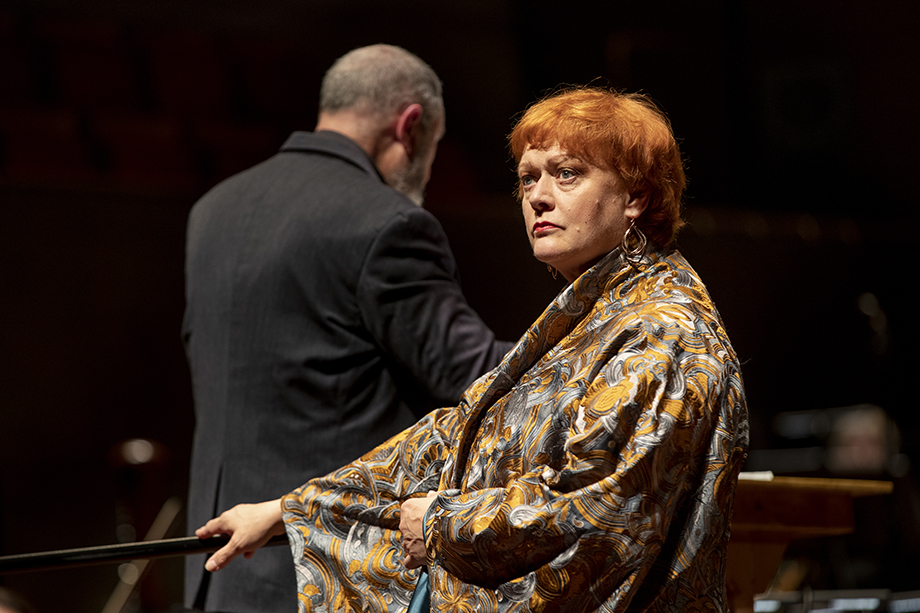
- Article Hero Image Caption: Catherine Foster as Elektra (Charlie Kinross/Victorian Opera)
- Production Company: Victorian Opera
In 1910, at the same time as Elektra received its UK première at Covent Garden, the band of the Grenadier Guards played a potpourri of music from the opera in the courtyard of Buckingham Palace. A note was dispatched, via George V’s equerry, to the Bandmaster: ‘His Majesty does not know what the Band has just played, but it is never to be played again.’
Well, one king’s disappointment notwithstanding, 122 years later, Elektra, undeniably a masterpiece, belongs in any opera company’s repertoire, along with its earlier stablemate, Salome (1905). Although it is tempting to place these two one-acters into the same chalice – both have mad heroines who die at the end – they are markedly different in style and execution. Strauss himself, one of the great painters of music, defined Salome as ‘purple and violet’, and Elektra as ‘night and light, or black and bright’.
For Strauss, Elektra represented the furthest he would go, or was willing to go, in terms of modernism (his next project, with his librettist, Hugo von Hofmannsthal, would be Der Rosenkavalier). Although Elektra ends in a tutti blaze of good old C major, it contains more than its share of harmonic dissonances, jagged, unnerving rhythms, and mood shifts. Also ambitiously, Strauss deployed an enormous orchestra of around 110 players, specifying multiple clarinets and horns, swaths of strings and percussion – and let’s not forget the heckelphone (a sort of bastard son of the oboe and alpenhorn, with a preternaturally deep voice).
Crammed on to the Hamer Hall platform on Wednesday were ninety-four players on this occasion: Orchestra Victoria, led by Sulki Yu, augmented with twenty-two musicians from the Australian National Academy of Music. Richard Mills, Victorian Opera’s artistic director, was the auspicious conductor. His account, while necessarily focused and driven, maintained the utmost respect for this gargantuan score, which unfolded with natural grace and a clarity in which even the smallest, but most significant, references could be heard.
The performance was billed as ‘a semi-staged concert’, which essentially it was. It helped greatly that the cast sang from memory. No heads buried in music stands here; instead, an instant dramatic rapport with the audience. It also helped having the singers ranged in front of the orchestra – with merely a narrow alleyway in which to perform. As distinct from a conventional staged performance, and having to hurl their voices through the orchestra, they could project straight into the auditorium, to maximum effect.
The English dramatic soprano Catherine Foster was exactly in her element as Elektra. Her strong, never-tiring voice coped magnificently with this long, almost impossible role (she deserved every sip of that glass of water beside her chair). While Foster does not have the icy clarity of a Birgit Nilsson (who has?), she is just as deeply involved with the part, not merely in the monologues, but in her relationship with the other performers.
Just as compelling was the exemplary Chrysothemis of Anna-Louise Cole, in a fearless, white-heat performance that made so much more of this often underrated character. Cole, who sings Brünnhilde in Opera Australia’s Ring next year in Brisbane, is well on the way to tackling Chrysothemis’ elder sister.
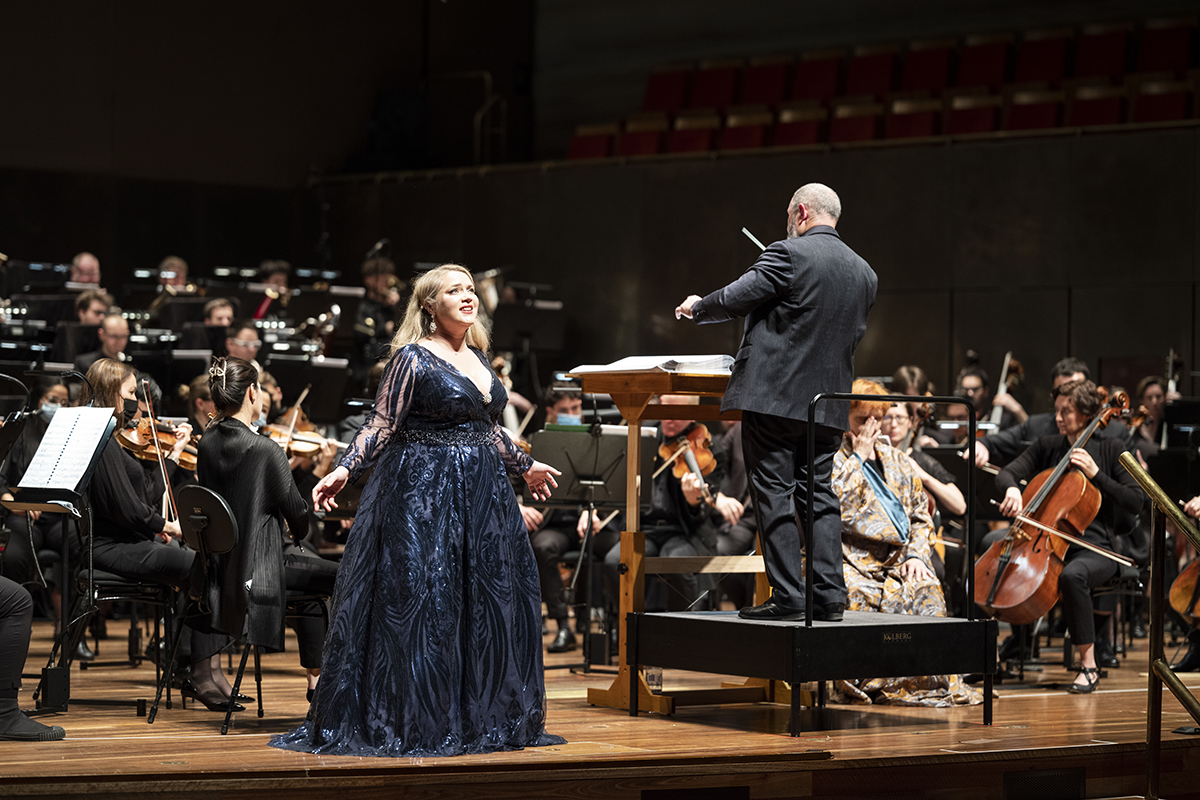 Anna-Louise Cole as Chrysothemis (Charlie Kinross/Victorian Opera)
Deborah Humble’s Klytemnästra, clothed in deepest red to match the blood she would soon enough be shedding, was marvellously neurasthenic, yet never a caricature. She is, after all, a queen, if a murderous one. Klytemnästra’s long scene with Elektra is the pivotal point of the opera, and Humble and Foster made their confrontation as gripping as a Wimbledon final.
Elektra is dominated by its three key women performers. Indeed, we don’t hear a male voice until more than halfway through, when a young servant and an old servant (well sung by Paul Biencourt and Stephen Marsh) have a brief exchange. Apart from the absent Agamemnon, whose theme permeates the score, the main male performer is Orest, Elektra’s missing-presumed-dead brother, who returns to exact revenge. Derek Welton was physically and vocally tremendous in the part, his heroic voice shaking the very walls of Mycaenae. The Recognition Scene was as profoundly moving as I have ever heard it. James Egglestone was excellent as the hapless, doomed Aegisth. Simon Meadows was notable as the Guardian of Orest.
The Five Maids and their Overseer – Dimity Shepherd, Shakira Dugan, Sally-Anne Russell, Olivia Cranwell, Rebecca Rashleigh and Kathryn Radcliffe – made the most of their brief, but fiendishly difficult exchanges. Cranwell doubled as Queen’s Confidante, and Radcliffe also sang the Trainbearer (Schlepperträge). It has to be said that all servants dressed well above their pay grades.
By the end, as, in the upper reaches of the hall, twenty-five members of the Victorian Opera Chorus dutifully acclaimed ‘Orest!’ the specified twenty-seven times, Elektra went into her dancing spasm, and died. Before we knew it, and as happens with any great performance of Elektra, it was all over. A justifiably huge ovation ensued. I suspect even George V might have approved.
Elektra (Victorian Opera) was performed in concert at Hamer Hall, Arts Centre Melbourne on 14 September 2022.