


- Free Article: No
- Contents Category: Music
- Review Article: Yes
- Article Title: Australian World Orchestra
- Article Subtitle: A combination of telepathy, instinct, and love
- Online Only: No
- Custom Highlight Text:
To place the Australian World Orchestra (AWO) in a truly global context, and before I deal with Wednesday night’s triumphant concert in Hamer Hall, I must briefly expand my terms of reference.
- Article Hero Image (920px wide):
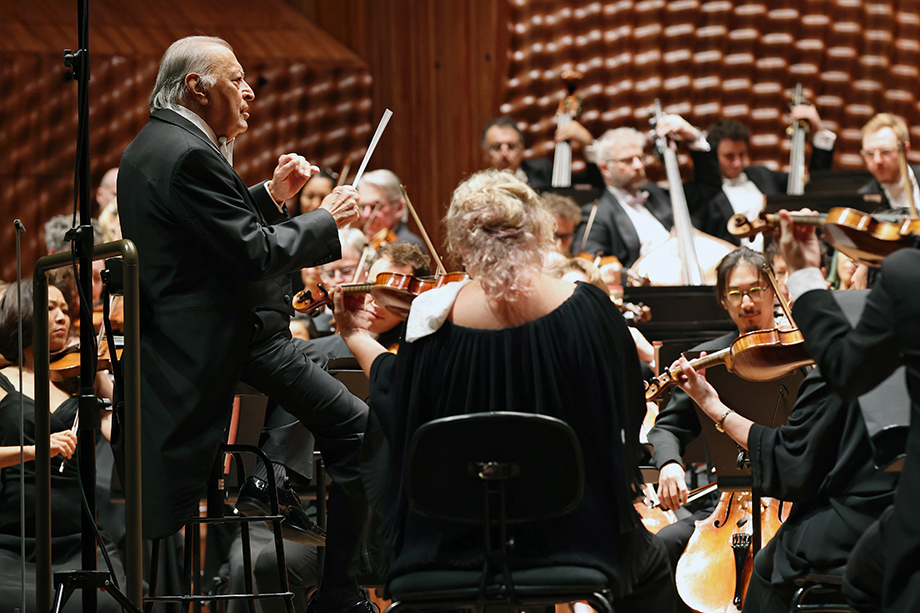
- Article Hero Image Caption: Australian World Orchestra (photograph by Prudence Upton)
- Production Company: Australian World Orchestra
Reviewing the Prom, The Observer’s critic, Fiona Maddocks, said this ‘diaspora’ orchestra has ‘the energy of a festival ensemble. That they will only have come together to rehearse last week added to the sense of adventure’.
Adventurous was exactly the right word. So, too, was another recent description of the AWO as a grown-up youth orchestra – an appropriate remark, since many of the AWO are alumni of the Australian Youth Orchestra. There is always something irresistibly fresh about the AWO’s playing – scholarship allied with experience and derring-do. I always feel that it is at once looking inward, to the music it is playing, as well as outward, in its brilliance of attack and extraordinary cohesion, as if all 105 players are actually listening to one another.
The day after the Prom, the AWO (well, almost all of them) and their maestro were on flights to Melbourne. By the weekend, they began rehearsals for an all-new program of three of Richard Strauss’s tone poems: Don Juan (1888–89); Till Eulenspiegels lustige Streiche (1895); and Ein Heldenleben (1899). Any one of these works on its own would be fiendish enough, as befits Strauss’s ambitious orchestral requirements (just think of the eight horns, bass and tenor tubas, two harps and battery of percussion among the mêlée of musicians jammed on to the platform in Heldenleben). But to have all three? Surely this could have been indigestible: the symphonic equivalent of La Grande Bouffe.
It is a joy and a privilege to report that this was nothing of the sort. Before even a note was sounded, from the moment the orchestra made its way on to the platform, acclaimed by the capacity audience, you just knew this was going to be something special and treasurable. The already thunderous reception only increased as Zubin Mehta, hesitantly and with the aid of two sticks (one for walking; the other for conducting), made his way to the podium. He eased himself on to his stool, gave a downbeat, and the years fell away.
Strauss’s Don Juan, written when he was twenty-four, was described by the critic Eduard Hanslick as ‘sound effect’ in which ‘colour is everything, musical thought nothing’. How wrong can you be? This orchestral showpiece may be boisterous at times, but at heart it is also tender, almost romantic. Mehta exercised restraint, ensuring grace, clarity and even mellowness in the work’s subdued ending.
Till Eulenspiegel’s Merry Pranks, a more substantial and intricate work, is the most programmatic of the three on display. Strauss famously derided the need for ‘a kind of handhold for the listener’, adding that ‘anyone who really knows how to listen to music probably doesn't need it anyway’. This conveniently ignores the fact that Strauss’s deployment of programmatic structure was second-to-none, especially with Till Eulenspiegel. Its roguish central character is portrayed by a famous horn call, which consistently appears in ever-changing forms, and on an array of instruments. Eulenspiegel, a beloved impish character of German storybook tradition, manages to prod and provoke his perplexing way through just on twenty minutes of music, until finally (mercifully, to some) being tried and executed.
Here, Mehta and orchestra again proved that by letting the music speak for itself, the greater the overall benefits. It had a transparency, too, through which one could discern every change of mood and every last inflexion – right down to Till’s impudent raspberry blurting forth from the bass clarinet (here played by Alexander Morris). A word, too, for the agile solos from the first-half concertmaster, Rebecca Chan.
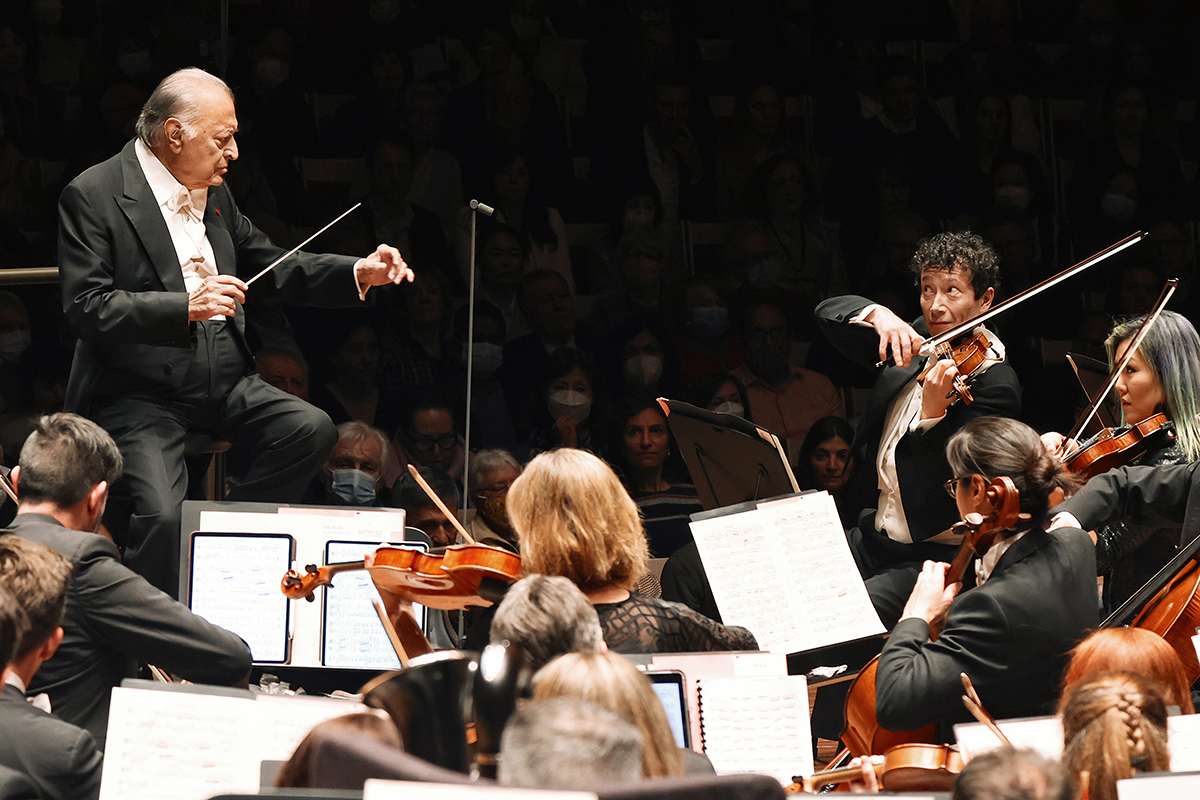 Zubin Mehta conducts the Australian World Orchestra at the Sydney Opera House (photograph by Prudence Upton)
The triumph of the night, however, was Ein Heldenleben (A Hero’s Life). This utterly heroic piece, in creation and performance, not only deploys enormous forces but contains a long, sustained, and elaborate role for solo violin, played by the second-half concertmaster, Daniel Dodds. This is worth special mention, as Dodds’s fluent and glorious playing followed to the letter all of Strauss’s precise instructions, set down in his score: ‘Flippant, tender, a little sentimental, exuberantly playful, gracious, emotional, angry, nagging, loving.’ The part, of course, was modelled on Strauss’s wife, the notoriously peppery Pauline. Dodds well deserved the rapturous reception from the audience and the embrace from Zubin Mehta.
In fact, Heldenleben is, more or less, a concerto for orchestra. The AWO, among whose ranks are at least twelve concertmasters, plus an assortment of orchestral players, freelances, soloists, chamber players, and teachers, served to make this one of the most musically beautiful and burnished performances of Heldenleben you could hope to hear. Even in the more bellicose sections (‘The Hero’s deeds of war’), you never lost sight of the dignity that imbues the work as a whole. Underlying this was the masterly playing of Strauss’s opulent and plangent horn settings and the warmly subterranean rumbles from the nine double basses, placed behind the cellos to the left of the platform.
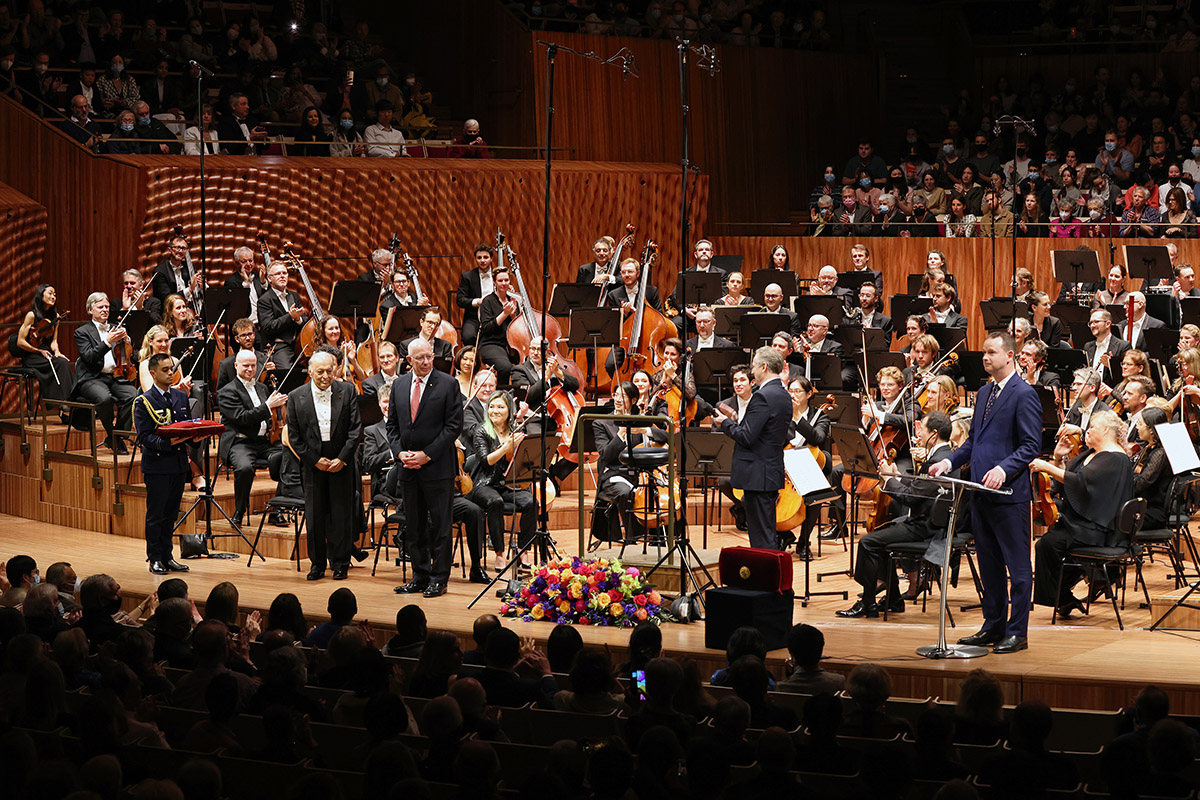 Zubin Mehta receives his AC from Governor General David Hurley onstage in front of the Australian World Orchestra at the Sydney Opera House (photograph by Prudence Upton)
The final section, ‘The Hero’s retirement from the world’, was elegiac and tranquil, but never lingering. Occasionally, in more indulgent performances, there can be the feeling that the hero has outstayed his welcome. Not in this case. Instead, Mehta, with his now restricted but always clear beat, was persuasive rather than commanding, bringing the work to a close with gentle strength and then, a few seconds of precious silence before an eruption from the audience.
Mehta’s association with the AWO has been (and, I hope against hope, continues to be) as exemplary as it is profound. The orchestra has been lucky to have also worked with the likes of Riccardo Muti, Simon Rattle, and, of course, its own artistic director and visionary, Alexander Briger. But its association with Mehta is something which, like the art of conducting, is a mystical combination of telepathy, instinct and love. All these qualities were evident on Wednesday. It was a concert I will long hold in my head and my heart.
The Australian World Orchestra at Hamer Hall, Arts Centre Melbourne on 31 August 2022.