


- Free Article: Yes
- Contents Category: Opera
- Review Article: Yes
- Article Title: Lucrezia Borgia
- Article Subtitle: A lively performance of a Donizetti rarity
- Online Only: No
- Custom Highlight Text:
Few opera composers were more prolific than Gaetano Donizetti, and 1833 proved to be no exception in his relatively short career, with four separate premières in as many cities, culminating in Lucrezia Borgia, first heard at La Scala on 26 December. That season ran for thirty-three performances. The opera went on to become a popular vehicle for prima donnas (some nearing the end of their careers). Melbourne Opera’s reliably good program informs us that Lucrezia had its Australian première at Melbourne’s Theatre Royal in 1855 and remained popular for forty years, becoming Donizetti’s most performed opera in Victoria after Lucia di Lammermoor.
- Article Hero Image (920px wide):
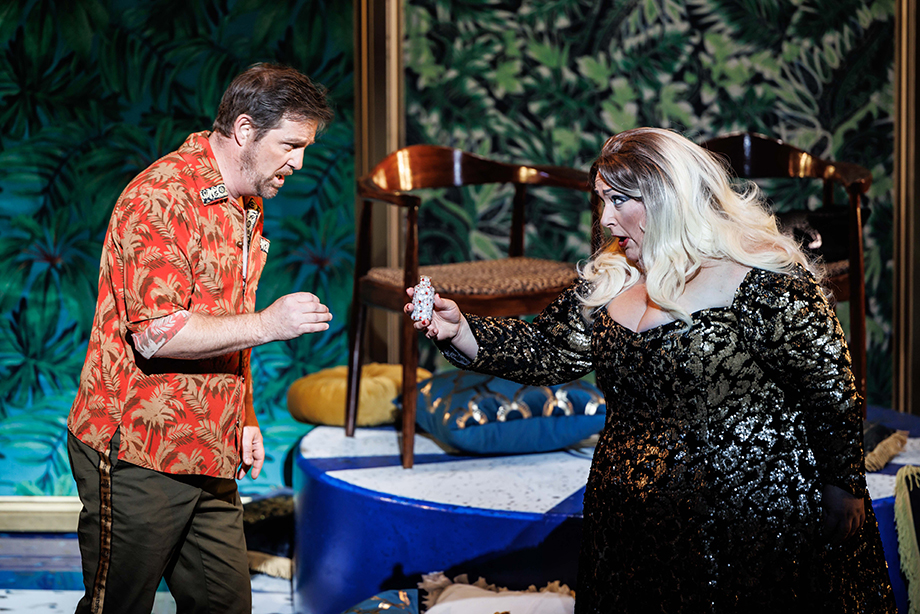
- Article Hero Image Caption: Helena Dix (Lucrezia Borgia) and James Egglestone (Gennaro) (Photograph by Robin Halls/Melbourne Opera)
- Production Company: Melbourne Opera
Felice Romani’s libretto is based on Victor Hugo’s play Lucrèce Borgia (1833). Hugo said it formed a ‘bilogy’ with his play Le Roi s’amuse, the source of Verdi’s opera Rigoletto. Hugo’s heroine is even more lurid than the notorious, oft-married historical figure (1480–1519), a Spanish-Italian aristocrat who was the daughter of Pope Alexander VI.
Lucrezia contains an abundance of rousing music. The score, according to Andrew Porter, ‘consists of one good number after another; the listener is carried forward on a powerful tide of melodic and dramatic invention’.
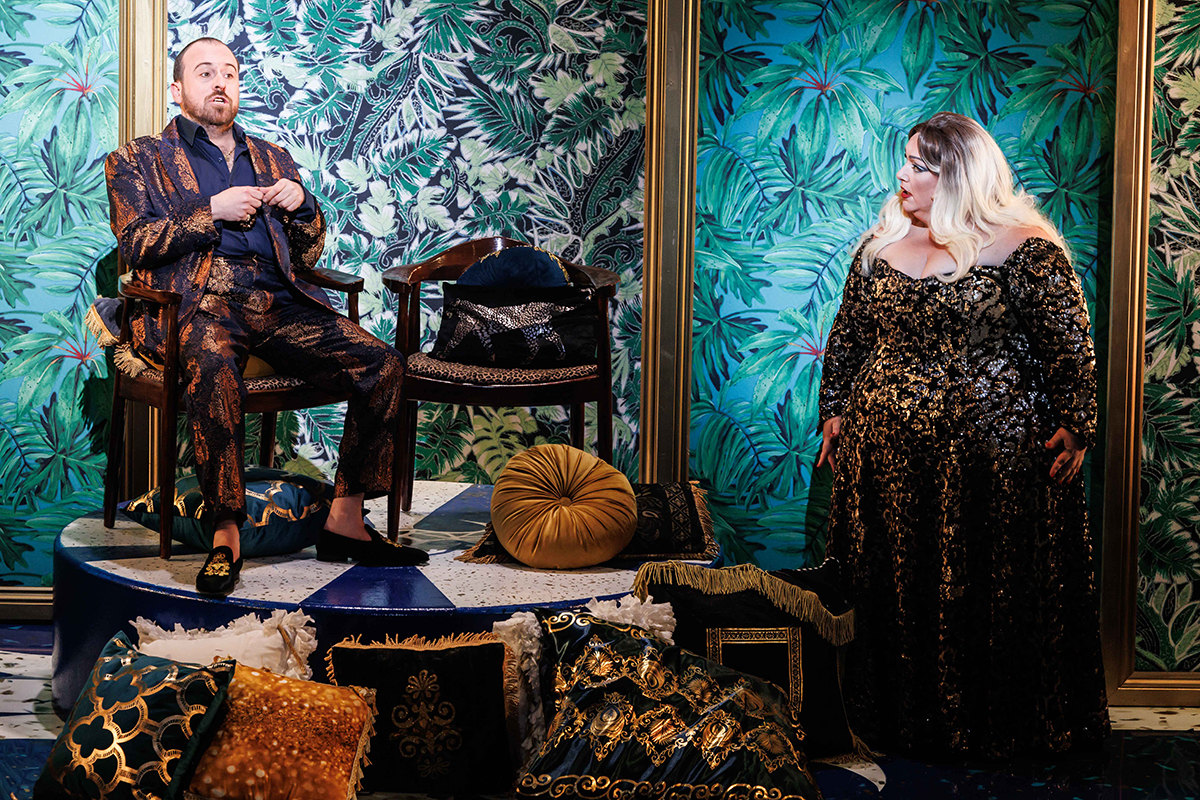 Helena Dix (Lucrezia Borgia) and Christopher Hillier (Don Alfonso) (Robin Halls/Melbourne Opera)
Unusually, there is no conventional love interest. The principal attraction, if that’s the right word, is between Lucrezia – now menacingly on to her fourth husband, Alfonso d’Este, the Duke of Ferrara – and her clueless son Gennaro, whom she abandoned after being raped (as Hugo has it) by her brother. Lucrezia, fondly missing her son, follows Gennaro to Venice and rhapsodises about the sleeping youth in the cavatina ‘Com’è bello’. Predictably, on waking, Gennaro falls in love with the masked beauty, only to be disabused by his companions, who point out that she is the poisonous Borgia.
The other erotic attraction – neatly conveyed here – is between Maffio Orsini (a trouser role for mezzo-soprano or contralto) and Gennaro, who are old friends. Their ‘friendship duet’ in Act II is one of the highlights of the score. Here, indeed, Orsini became quite friendly.
The opera – presented in a lengthy Prologue and two acts – is dramatically shapeless. There are two poisonings but only one antidote, and directors must make the most of this repetitive and melodramatic scenario. Played too regally, portentously, it might well be a long night in the theatre, notwithstanding the sustaining trills and some of Donizetti’s most inspired tunes.
Gary Abrahams (directing his first opera production) and the cast and chorus approach the task with brio and an admirable sense of play – from the rompish outset. Abrahams writes about it in the program. Irritated by ‘academics, aficionados and educated snobs’, he finds Donizetti’s music ‘playful and full of humour’:
Even though the story is ostensibly a tragedy, the music is often light and many scenes lend themselves to a comedic touch. I think Donizetti understood the dramaturgy of storytelling well. You need to soften an audience up by making them laugh and enjoy themselves before you can attempt to move them and make them cry.
Duly softened up, and keen (especially at a matinee) not to seem academic or, worse, snobbish, we find ourselves enjoying the romp that follows. We arrive in ‘a world of power, corruption, debauchery and excess’ very like any wealthy suburb near you. Abrahams writes: ‘A euro-trash fashionista aesthetic offered a contemporary reference point for the brand of “Borgia”, and felt like a wonderful playground in which to place Lucrezia.’ The sets are bright, florid, comic. Harriet Oxley’s excellent costumes are straight out of a Versace catalogue, and mafia tropes help us to make sense of ‘the gangs and political machinations of the story’. Lucrezia, blonde as the historical character, is draped in gold and covered in bling.
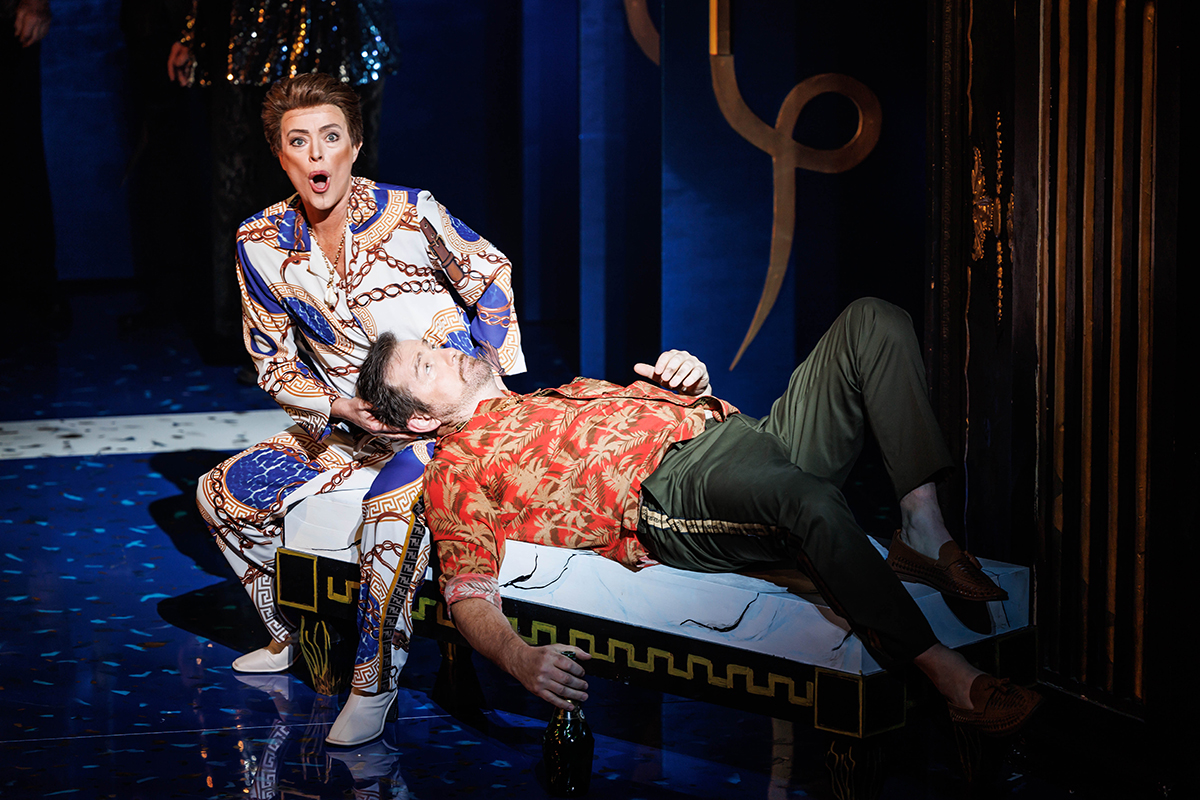 Dimity Shepherd (Maffio Orsini) and James Egglestone (Gennaro) (Robin Halls/Melbourne Opera)
The cast was uniformly good. What fun they seem to be having; how well they gel.
Dimity Shepherd, a veteran of this company, is sensational as Orsini. Moving wonderfully and utterly exuberant, she is at ease with the text and the music. Vocally, she becomes even more audacious, with some brilliant interpolations in the Brindisi in Act II, the most famous aria in the opera.
Christopher Hillier brings the requisite volume and flexibility to the role Don Alfonso, Lucrezia’s suspicious and rightly worried spouse. Hillier sings memorably in the Act I aria ‘Vieni, la mia vendetta’ and matches the opulently voiced Helena Dix in the thrilling duet that follows.
When he revived the role, Donizetti expanded the role of Gennaro. His final aria, ‘Madre, se ognor lontano’, was added in 1840. It was Richard Bonynge who found the Act II romance ‘T’amo qual dama un angelo’ lurking in the Morgan Library in New York and restored it to the opera.
It’s a challenging role for any tenor, but James Egglestone was impressive throughout and every bit as adventurous in his vocal ornamentations as the other principals. He sang beautifully in the Act I trio with the warring couple – fine legato singing in one of Donizetti’s sweetest ensembles.
Gennaro’s cronies were impressive – Adrian Tamburini (Gazella) and Louis Hurley (Vitellozzo) especially so. Rustighello, a servant of Don Alfonso, has some interesting music in this rampantly songful opera. Alastair Cooper-Golec grew in the role, interpolating and sustaining a bold high note at one point and acting the part nicely – a young tenor to watch.
Helena Dix tackles the central role at a much younger age than most Lucrezias. In this form she will be singing it for years to come. Dix has brought considerable lustre to the company, but this was perhaps her finest performance – certainly her most daring in terms of the coloratura (she writes her own ornamentations). The beauty and rare evenness of her tone were apparent in ‘Com’è bello’, and she sailed above the other singers during the septet that follows, when Gennaro’s friends outline her perfidious history. Nor is Dix reluctant to let the harshness, the sarcasm, the sheer baleful lowness of the woman come through at times.
Finally, Gennaro, poisoned yet again, succumbs, having refused the antidote that Lucrezia, newly revealed as his mother, exhorts him to swallow. Donizetti had intended to end the opera here, but his first Lucrezia, Henriette Méric-Lalande, was insistent and so he wrote ‘Era desso’. Abrahams (or possibly Dix) prefers to go straight from Gennaro’s death to ‘Era desso’, thus delaying the Duke’s arrival for a few minutes. The contraction works dramatically, and Dix is at her most flamboyant and colourful.
The chorus has almost as much fun as the principals. At times the men’s patter reminds us of the Duke’s courtiers in Rigoletto. How deeply Verdi drew on Donizetti during his early to middle years; the pre-echoes are frequent.
The orchestra, conducted by Raymond Lawrence, was alert, rhythmic, and zesty, notwithstanding the odd lapse from the horns. The trumpet work was notable from the start.
It’s hard to think of a better way to introduce someone to bel canto opera, and you would travel a long way to hear a more ebullient cast. It was another fine performance from this spirited local company.
Well worth watching on YouTube is a 2014 production from the San Francisco Opera, with Renée Fleming and Michael Fabiano in fine form as Lucrezia and Gennaro. There are two Sutherland DVDs (Sydney in 1977, and London in 1980, opposite the great Alfredo Kraus), and there’s a late YouTube rarity from the end of her career (Barcelona, 1989), seventeen years after she began singing the role. Devotees should not miss Montserrat Caballé’s famous New York début in 1965 (YouTube, audio only) .
Lucrezia Borgia (Melbourne Opera) continues at the Athenaeum Theatre, Melbourne on 30 August and 1 and 6 September 2022. Performance attended: 28 August.