


- Free Article: No
- Contents Category: Music
- Review Article: Yes
- Article Title: War Requiem
- Article Subtitle: The promissory note of art
- Online Only: No
- Custom Highlight Text:
Benjamin Britten’s War Requiem was written for the consecration of the new Coventry Cathedral in 1962, after the old cathedral had been destroyed by German bombing raids in 1940. He dedicated the work to four friends, three of whom were killed while on active service during World War II, and the fourth of whom survived the war but later committed suicide. As an avowed pacificist who had been a conscientious objector during the war, Britten took the opportunity to compose a work combining the traditional Latin Requiem Mass with the anti-war poetry of Wilfred Owen: a fellow pacificist (and fellow gay man) who had served as a lieutenant in World War I and who was killed on the Western Front one week before the Armistice was declared in 1918.
- Article Hero Image (920px wide):
 - Hero image crop.jpg)
- Article Hero Image Caption: Britten's War Requiem performed by WASO (photograph by Linda Dunjey)
- Production Company: WASO
Like Mozart (whose lifelong influence he acknowledged), Britten was a great musical dramatist, who gave his ‘voice’ to the words of others in order to express something both masked and deeply personal. There is a Mozartian ambiguity in all Britten’s music that flickers between lightness and darkness, public and private, the mask and what it conceals. This sense of drama and ambiguity reflects unresolved tensions that lie at the heart of the War Requiem. These tensions include the antagonism in language between the Requiem Mass and Owen’s poetry, the differences between the two world wars (as well as the Cold War and Vietnam War, both underway in 1962), and the contradictions inherent in Britten’s pacifism, as well as his relationship with Christianity. Musically, this sense of inner conflict is expressed by the tritone, an inherently sinister interval (proscribed by medieval religious authorities as ‘the devil in music’) that provides a structural building-block for the entire score.
The Western Australian Symphony Orchestra’s performance of the work under Asher Fisch on 19 August – in collaboration with musicians from the Australian National Academy of Music, the WASO Chorus, the Tasmanian Symphony Orchestra Chorus, the Aquinas College Schola Cantorum, and three distinguished soloists – seemed a little under-realised, for all its array of forces. This is in no way to impugn the musicianship of those involved; it was the work’s sense of drama and complexity that was lacking.
In part this can be attributed to extra-musical factors: most noticeably, the fact that all the choristers wore masks, unlike the soloists, most of the orchestra, and most of the audience. Notwithstanding the health and safety reasons for this decision, it had the effect of muffling their faces and voices, especially in the articulation of consonants, which diminished some of Britten’s most effective choral passages of hushed pianissimo or fortissimo attack. It also obscured the dramatic role of the adult chorus, who express and embody a shared humanity that encompasses soldiers and civilians, victims and survivors of war alike.
As for the boys’ choir, instead of singing from a distance (say in the upper gallery) and being accompanied by a smaller instrument, as prescribed by the score, they were placed alongside the adult chorus in the choir stalls and accompanied by the fixed concert-hall organ. This likewise obscured the role of the boys’ choir as a disembodied host of angels interceding with God from afar on behalf of humanity.
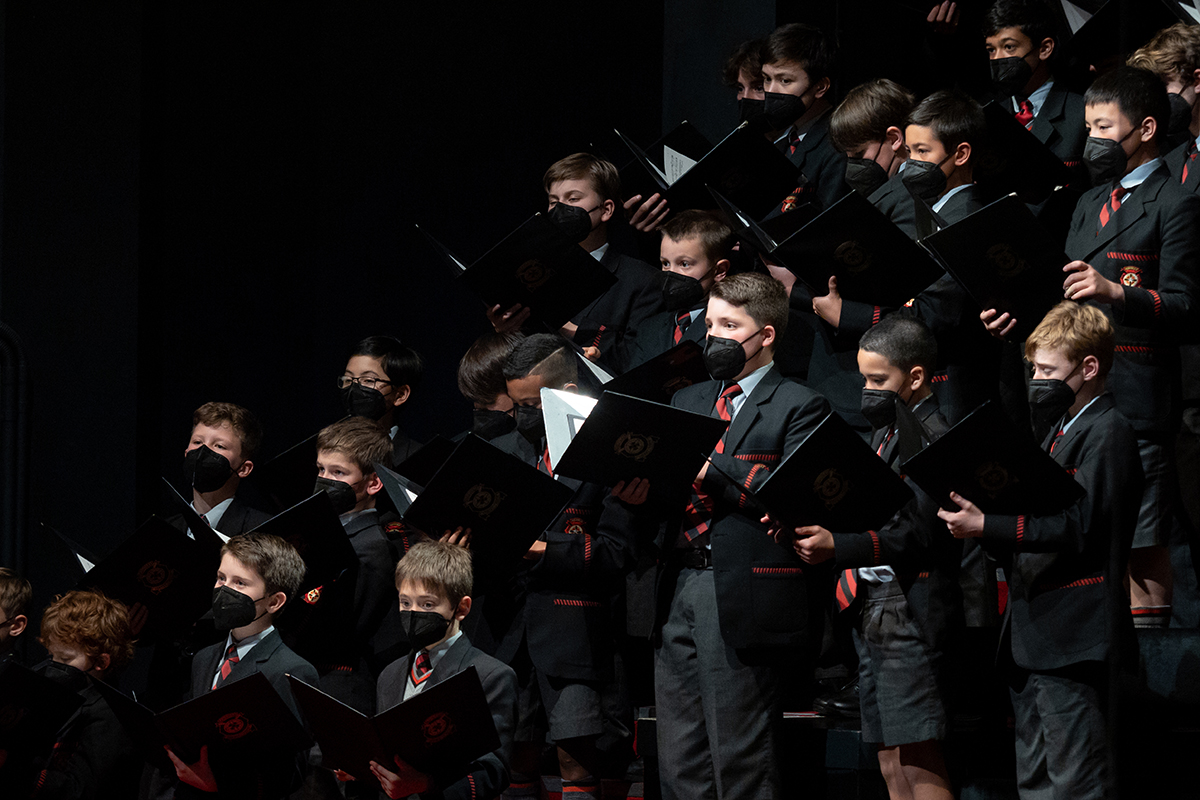 Britten's War Requiem (photograph by Linda Dunjey)
There was also a lack of visual, spatial, or aural distinction between the orchestra (which accompanies the adult chorus and soprano in the Latin Requiem passages) and the chamber ensemble (which accompanies the tenor and baritone for the Owen poems). Instead of being a separate group of instrumentalists, the latter were simply members of the orchestra who had in a sense been ‘hollowed out’ from within it and as such were scarcely distinguishable from their colleagues. Perhaps there were practical reasons for all these decisions, but they had the cumulative effect of reducing the musical and dramatic impact of the work and obscuring Britten’s intentions.
As for the all-important contributions of the soloists, conductor, and orchestra: I felt a certain lack of engagement on their part with the work’s intensity. The exception was soprano Elena Perroni, whose soaring and swooping vocal attack matched her role as an apocalyptic angel of judgement; she even looked the part with her fierce demeanour and the long white bridal train that extended from her gown. However, given her musical and dramatic function, I would have positioned her up in the choir stalls with the chorus rather than down on the forestage with the other two (all-too-human) soldier-poet soloist-protagonists.
For their parts, tenor Paul O’Neill and baritone David Greco sang with great artistry and sensitivity, though I rarely sensed any deep emotional connection with what they were singing. Similarly, I missed the energy and clarity that Fisch usually brings to his interpretations. WASO scarcely sounded like the same orchestra that only a few weeks ago delivered a shattering account of Dmitri Shostakovich’s Eleventh Symphony under the baton of guest conductor Vasily Petrenko.
Britten was never more impassioned than in the War Requiem, and no one can listen to Owen’s poetry without feeling its sense of agony and rage as well as its pity and sorrow, especially when cruelly juxtaposed with the words of the Requiem Mass. The title page of the score quotes the poet’s draft preface for his projected volume of war poems (which was published posthumously): ‘All a poet can do today is warn.’ Those words have never been timelier than they are now, in a new era of militarism, jingoism, ideological tribalism, and religious hypocrisy. I applaud WASO for its ambitious programming of works such as the War Requiem, the Eleventh Symphony, and the forthcoming Eumeralla: A Requiem for Peace by First Nations composer and soprano Deborah Cheetham. Such works require immense commitment on the part of companies, venues, artists, and audiences in order to deliver on their promise – which is also the promissory note of all art.
Britten’s War Requiem was performed by WASO at Perth Concert Hall on 19 and 20 August 2022. Performance attended: 19 August.