


- Free Article: Yes
- Contents Category: Theatre
- Review Article: Yes
- Article Title: Anna K
- Article Subtitle: An insipid new play from Suzie Miller
- Online Only: No
- Custom Highlight Text:
Australian playwright Suzie Miller, a mainstay of independent stages both in Australia and overseas, is having something of a breakthrough year. Two of Miller’s play are having their mainstage premières – Anna K and RBG, Miller’s ode to American jurist Ruth Bader Ginsberg (Sydney Theatre Company, October–December) – and her Griffin-award-winning play Prima Facie (2019) has been a sell-out smash in London’s West End and broadcast around the world as part of the prestigious NT Live initiative of Britain’s National Theatre.
- Article Hero Image (920px wide):
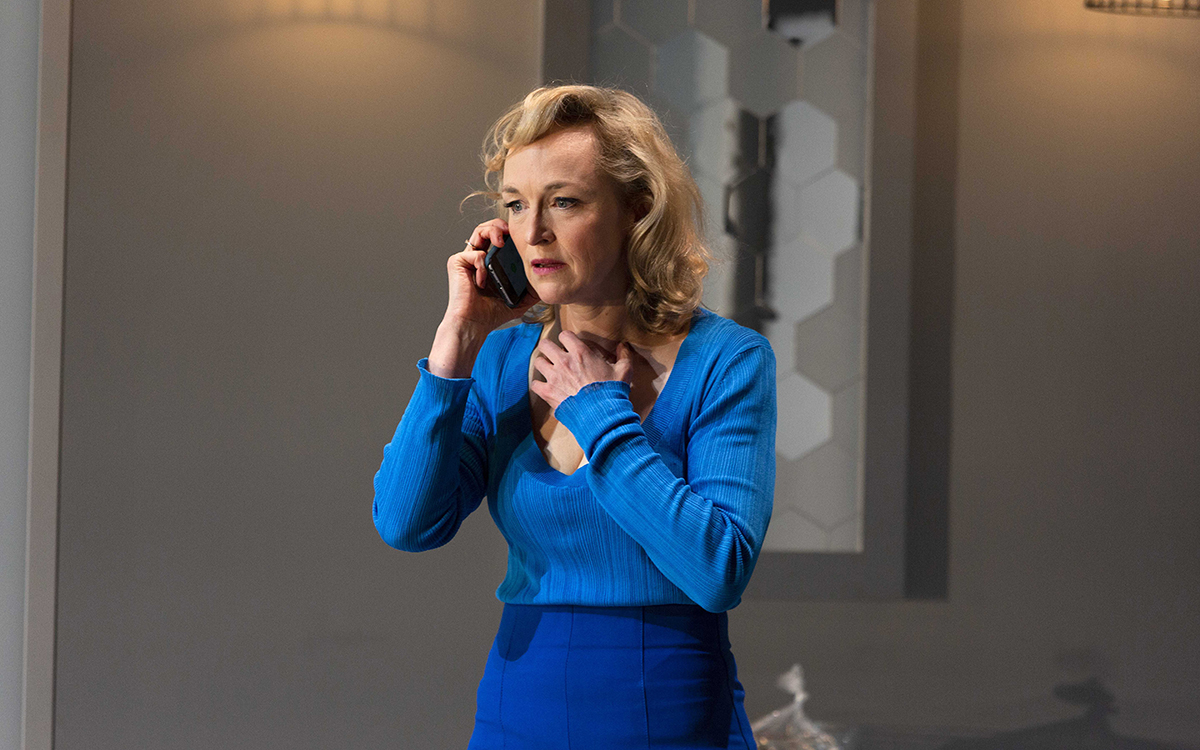
- Article Hero Image Caption: Caroline Craig in <em>Anna K</em> (photo credit: Pia Johnson)
By comparison, Anna K is an insipid and somewhat dispiriting affair. As its title suggests, Anna K takes as its template Leo Tolstoy’s classic novel of desire, family, and faith, Anna Karenina (1878). Anna (Caroline Craig) is an investigative journalist, renowned for her pursuit of truth at all costs. One of her recent stories involved élite SAS soldier Lexi (Callan Colley), who has exposed the brutal beating of a young recruit by a superior officer. Despite their seventeen-year age difference, Anna and Lexi are now having an affair. Anna has decided to leave her husband and, for the time being at least, her ten-year-old son, to be with her lover. Secreted away in a hotel room, they plan a future together.
Their idyll is shattered when they wake to discover a press pack outside the hotel and the internet in overdrive reporting news of their affair. Anna just wants to get to work – she is putting together an exposé on sexual harassment in the banking industry – but she decides she needs to wait until the street is clear of paparazzi and the feeding frenzy has died down. She waits alone in the hotel room while Lexi heads out to pursue the connections that might land him a new job and a means of supporting Anna and her son. When she says that her job brings in enough to support them both, he tells her he won’t be a kept man.
Anna’s affair – and the tabloid representation of that affair as the selfish abandonment of her son and a repudiation of family values – subjects her to a tsunami of online abuse. Miller’s focus here is not so much the whys-and-wherefores of the hatred and vitriol that spew forth on social media, nor why women are more viciously targeted than men (for Miller it’s sufficient to blame misogyny and move on). Rather, Miller concerns herself with the impact this invective has on Anna and whether or not she will break under its burden.
No one expects Miller to recreate the complexity of Tolstoy’s work within the confines of a ninety-minute play. However, in mapping her own play against the principal checkpoints in Tolstoy’s plot – the unhappy marriage, the handsome soldier, the aggrieved husband, the lost child, the jealousy, the loss of faith in the lover, the emotional breakdown, and even the train (here rattling past the hotel every few minutes) – Miller both limits how responsive she can be to the social and moral context of twenty-first-century characters (are we really so affronted by extramarital affairs and divorce?) and creates a situation where Anna is lurching from one emotional state to another, the transitions between them far from credible. Not only does this leave the audience with the near-impossible task of joining the dots, but it also requires an unflinching performance from Craig to imbue Anna with at least a modicum of plausibility.
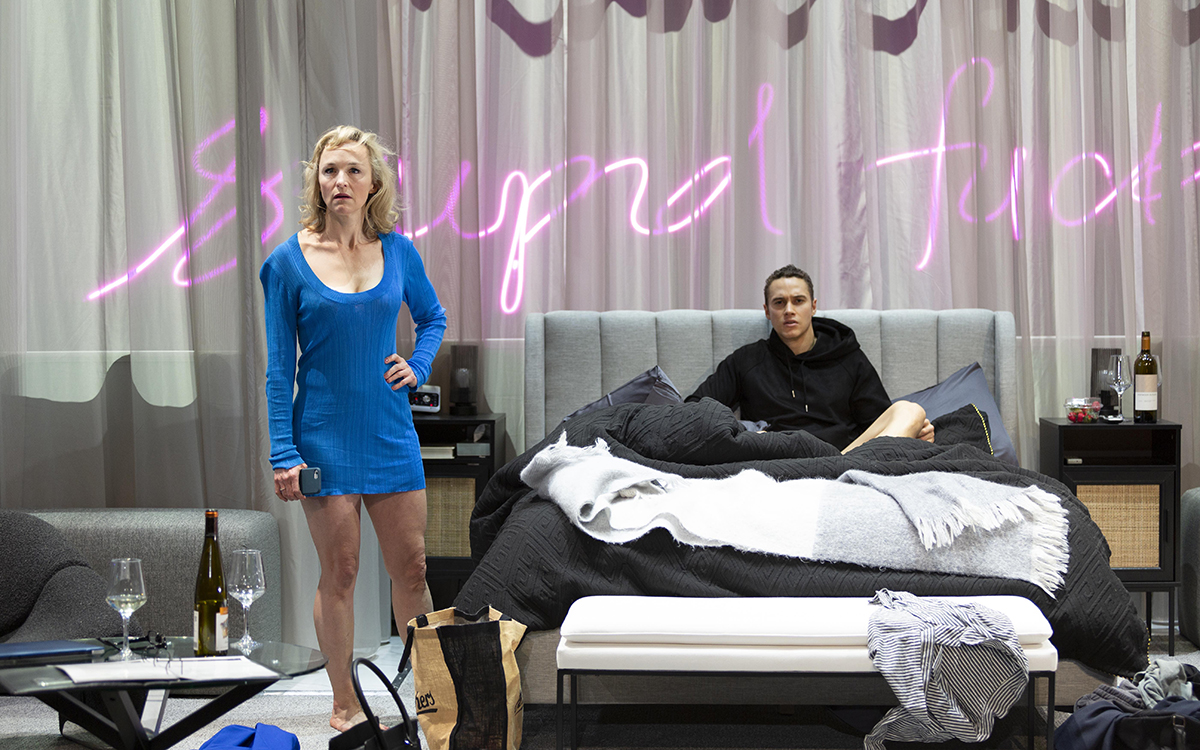 Caroline Craig and Callan Colley in Anna K (photo credit: Pia Johnson)
That it’s possible for even the most successful of women to fall prey to despair under such circumstances is not in doubt, yet Miller offers little to explain Anna’s particular descent into hopelessness. Why would a woman with Anna’s professional reputation wilt so quickly, foregoing all agency, in the face of a bombardment of paparazzi and tweets? Has she not been the subject of online trolling before? Can she find no women to support her apart from a sister-in-law and a colleague (both played by Louisa Mignone), who counsel her to toe the line and return to her husband? Are we meant to believe that there are no sympathetic voices in the public sphere coming to Anna’s defence?
By failing to even suggest answers to questions such as these, the play is without the scaffolding to support the two most powerful moments in the play: Lexi’s articulation of the brutality he witnessed while with the SAS; and Anna’s last-minute assertion of her own worth, her selfhood. Anna’s monologue here operates more as a deus ex machina than the culmination of any sort of dramatic arc. Even so, it’s of sufficient force and emotional texture to make you wonder how much more effective this play might have been had Miller structured it, like Prima Facie, as a monologue.
Fundamentally, Anna K is inhibited by its own dramaturgy (the play was developed with director Carissa Licciardello). Restricting the action within a grand hotel room (set design by Anna Cordingley) captures Anna’s feeling of entrapment and her escalating obsession with what’s being said about her. But it also forces much of the dramatic action – Anna’s increasingly fraught phone conversations, the clamour of the journalists, and the barrage of social media abuse – off-stage, thus choking any tension before it has a chance to breathe. Compounding this is the fact that the two supporting actors have no discernible function apart from implausibly exacerbating Anna’s plight, giving neither Colley nor Mignone much to work with. It’s hard to believe some of the laughs that Mignone’s characters elicit are deliberate. That there is not even a hint of sexual attraction or passion between Anna and Lexi – in either the performance or the rather bland assertions of lust in the script – only adds to the play’s credibility problems (are we really meant to believe Anna would jeopardise her career and her relationship with her son for such a damp squib of an affair?).
What ultimately undermines Anna K, however, is the superficial nature of Miller’s treatment of the subjects of slut-shaming, online trolling, and misogyny. In this, it is little more than an Op-Ed piece, one that relies largely on stereotypes and preaches to the converted. Miller makes no attempt to introduce ambiguity – ambiguity that might have perhaps been drawn from Anna’s work, her dedication to journalistic truth, her own contribution to the media milieu that is now feeding on her – to make us question our outrage or complicate our certainties.
American playwright Tony Kushner has written that when we experience theatre it’s not enough to be among those who share our faith: we need to be among those who share our doubts. It’s this sense of doubt – of scepticism and interrogation – that’s missing from Anna K. Compelling theatre forces us to ask questions not just about society but about ourselves. Those questions may bring us to the same conclusions, but if a play such as Anna K doesn’t at least attempt to expose something of the perspectives and prejudices that shape our certainties, it becomes difficult to see its point.
Anna K (Malthouse Theatre) continues at the Merlyn Theatre until 4 September 2022. Performance attended: 17 August.