


- Free Article: No
- Contents Category: Theatre
- Review Article: Yes
- Article Title: Strange Case of Dr Jekyll and Mr Hyde
- Article Subtitle: Getting beyond the binary
- Online Only: No
- Custom Highlight Text:
This month Sydney is host to two productions inspired by Robert Louis Stevenson’s novella Strange Case of Dr Jekyll and Mr Hyde (1888). The first, from Sydney Theatre Company, signals director Kip Williams’s return to the Roslyn Packer Theatre following the success of his 2019 production, The Picture of Dorian Gray. The second, from director Hayden Tee, offers a subversive revival of the much-maligned 1990 ‘gothic thriller musical’ Jekyll and Hyde by Frank Wildhorn and Leslie Bricusse at Hayes Theatre Co. ‘Man is not one but two’, Stevenson famously writes ...
- Article Hero Image (920px wide):
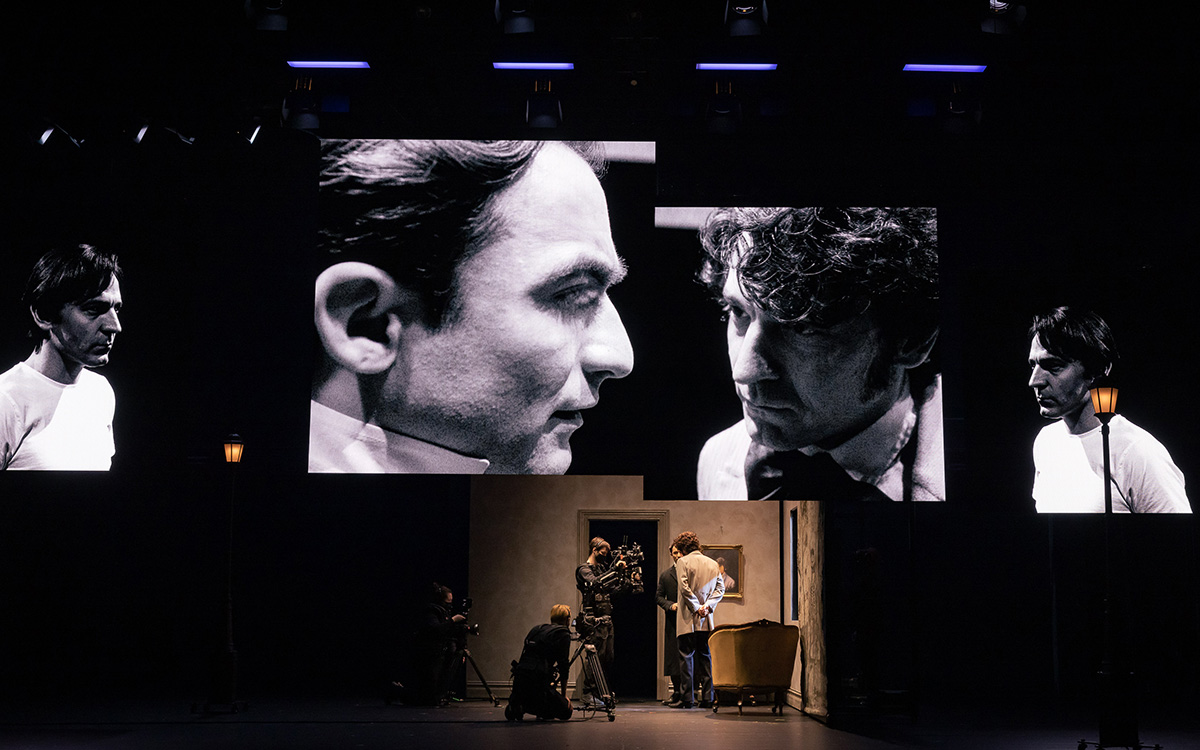
- Article Hero Image Caption: Ewen Leslie and Matthew Backer in <em>Strange Case of Dr Jekyll and Mr Hyde</em> (photo: Daniel Boud ©)
- Alt Tag (Article Hero Image): Ewen Leslie and Matthew Backer in <em>Strange Case of Dr Jekyll and Mr Hyde</em> (photo: Daniel Boud ©)
Meanwhile, David Bergman’s video design, paired with Susie Henderson’s video editing, revels in the cinematic traditions that have cemented the text’s cultural shorthand. After all, it was a 1908 film adaptation of the novella, since lost, that was considered the first American horror film. Filmed largely in black and white, the show’s video components recall the melodrama of early horror cinema. The camera zooms in on blood-curdling screams and violence is implied with fast cuts and jarring angles. A tilted shot of a shadowy staircase is taken right out of Alfred Hitchock’s Vertigo, and Clemence Williams’s string-heavy compositions recall a Hitchockian version of the ornate scores of 1960s Hammer horror. Hyde is a combination of matted curls, jet-black eyes and a stylised voice that would be right at home beside Vincent Price. Some may find this stylised transformation ironically too minimalistic in the wake of CGI-heavy adaptations and the more overt monstrousness advanced by adaptations like Wildhorn and Bricusse’s 1990s musical. Others may consider the show’s slow pacing a jarring contrast to Williams’s more bombastic Dorian Gray. But, as in Stevenson’s novella, there is cumulative benefit to Williams’s minimalism that rewards our patience.
Dorian Gray was a choreographed dance as much as a play. Eryn Jean Norvill’s Broadway-bound performance showcased physicality in a way complementary to Wilde’s interest in ideas of self-posturing and self-presentation, strutting across the stage or exaggerating the gait of a myriad of supporting characters. Strange Case of Dr Jekyll and Mr Hyde, though also tightly choreographed, places the face at its centre. Double exposures blend faces together, filters – used with confident restraint – distort expressions, and the overhanging screens that soar above the stage vivisect these expressions into their constitutive parts. A nose, a furrowed brow, a trembling lip are all separated from the actors that express them to become characters in their own right. This detachment is key to the production’s appeal, as the two worlds – cinematic and theatrical - at times exist independently of each other before uniting, with the audience often forced to consider each mode separately. The conceptual appeal of this split-focus is clear: the increasing fractures of Dr Jekyll’s mind complemented by our fractured gaze; the intimacy afforded by extreme close-ups an apt representation of an internalised, private conflict that the outward-facing nature of theatrical performance externalises, makes public. Such a dichotomy is complemented by the contrast that also exists between the crowd of technicians that move inconspicuously across the stage and the lonely profiles of terrified faces that loom overhead. These are the public and private spheres that begin to bleed together as the show continues: ‘the monsters without’ as well as the ‘monster within’, as Williams writes in his program notes.
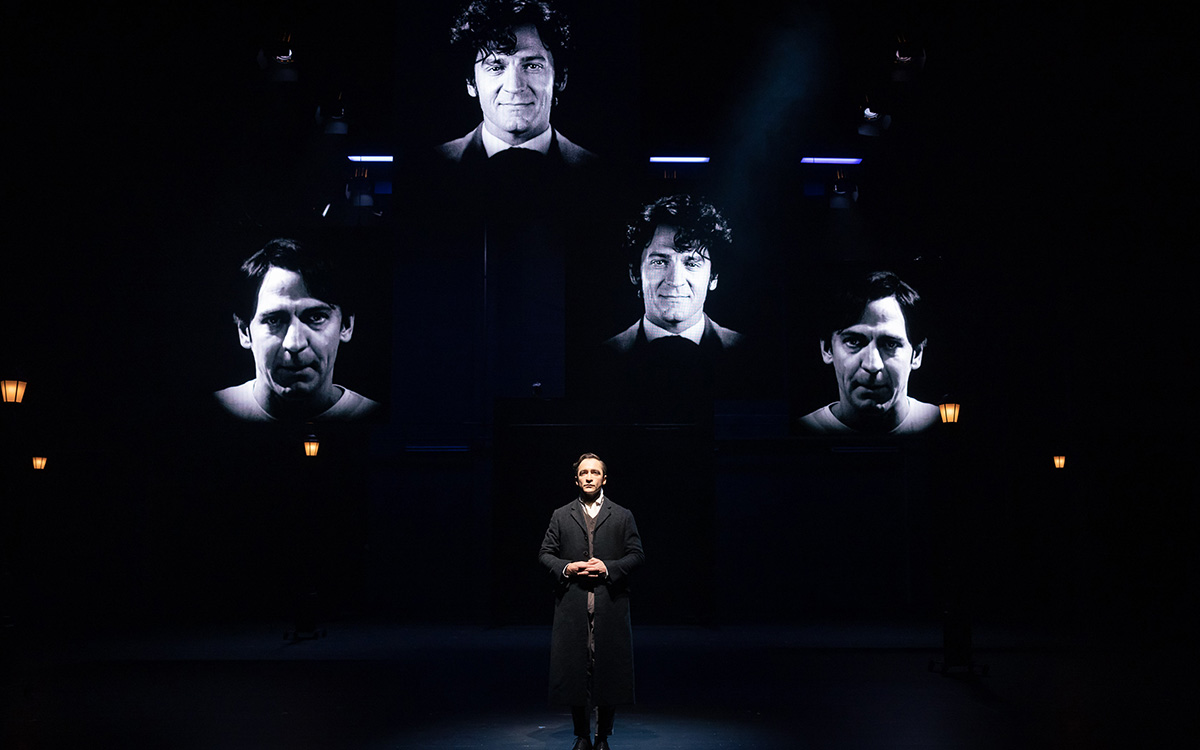 Ewen Leslie and Matthew Backer in Strange Case of Dr Jekyll and Mr Hyde (Photo: Daniel Boud ©)
To navigate both modes takes incredible skill. Thankfully, actors Ewen Leslie and Matthew Backer rise to the challenge with ease. Leslie’s malleable expressions transform from the stoic menace of Mr Hyde to the warm-natured Dr Jekyll with impressive speed. As Hyde’s monstrous nature infects Dr Jekyll, we see Leslie display Jekyll’s increasingly pained appearance with tragic effectiveness. Matthew Backer breathes new life into the character of Mr Utterson, the often neglected counterpart to Dr Jekyll. We map the emotional arc of the story onto his expressions as they move from the calmly stoic to the horror struck.
Initially, like the split between cinematic and theatrical modes, Jekyll and Utterson seem separate from one another. The third person that dominates much of the novella, and so the show’s dialogue, creates a sense of distance between them. Likewise, the overhanging screens emphasise their separateness. A conversation between the two is mostly recounted to a camera and sightlines are at times frustratingly obscured by set pieces, forbidding us from viewing their interactions on stage.
As we turn to the novella’s final chapter and so to first-person narration, Williams throws the pair together with glittering fanfare, dropping us suddenly into cinematic technicolour. Dressed as Dorothy and the Cowardly Lion, Utterson and Jekyll dance a feather-bound Can-Can that matches the minimalism of the show’s beginning with overt maximalism. For some, this sudden stylism will seem a poor attempt to recall Dorian Gray’s brash aesthetic. But there is a menace beneath the bedazzled surface here, a sort of parasitic consummation between the two figures signalled by a droning club beat that reflects Utterson’s temptation to join Mr Hyde. It is here that I was reminded of Hayden Tee’s nearby musical revival, which emphasises the queer undercurrents of Stevenson’s writing as a way to stylise the presumed ‘monstrosity’ of Dr Jekyll’s alter ego. Such homosocial connotations are by now an unshakeable feature of the novella’s legacy and Williams toys with this reading to stress connection between Utterson and Jekyll, pairing it with the queer resonances of camp aesthetics for good measure.
But as the show builds to its conclusion it intentionally muddies this interpretation. If Hyde represents a queer awakening of sorts then it is one limited to a personal, private experience. Another doubling illusion onscreen paired with a gory nod to the production’s interest in countenance shows Dr Jekyll in passionate throes with himself. Utterson, with an unreadable expression, watches on. In this, Williams seems to continue his commitment to the play between public and private spheres. Are we watching Utterson’s psyche fracture in an attempt to deny the temptation of Hyde’s unbridled hedonism? Or has Utterson shed the cultivated public persona required of the Victorian gentleman and joined him in the glittering freedom of a Soho club? Williams smartly refuses to restrict the text’s characteristic interest in duality to a stark choice between the two, instead concluding with a multiplicity of possible interpretations aided by a similarly plural combination of formal traditions. Where we began watching a black and white horror film, we conclude as witnesses to a theatrical spectacle that brings together the psychological depths of an Ingmar Bergman film, the camp stylings of Joel Schumacher, and the high stakes dramatics of Tennessee Williams. The show effectively ends by opening up Stevenson’s text beyond the aesthetic traditions and reductive interpretations that have confined it over the years.
Sydney Theatre Company’s Strange Case of Dr Jekyll and Mr Hyde offers a tour of the myriad interpretations, mediums, and contexts that are now embedded in Stevenson’s hundred-year-old tale. It is, as Williams writes, a ‘rebuke to those binaries … so often used to relegate us’ and Stevenson’s story to purely simple dichotomies and, relatedly, simple formal interpretations of these dichotomies. By the show’s conclusion, Mr Hyde is not a monster to fear and Williams’s interest in challenging the dogmatism that has relegated him to monstrosity alone is on full display. We conclude with Dr Jekyll – or someone that resembles him – sitting across from Utterson in a posture of quiet attention. But where is Hyde? All possible answers take one deeper into the conceptual and formal traditions that make up Williams’s production, contributing to the conversation around the mythology of Stevenson’s text with a rasping voice that masks the tickle of something monstrous in the throat.
Strange Case of Dr Jekyll and Mr Hyde (Sydney Theatre Company) is running at The Rosyln Packer Theatre until 3 September 2022. Performance attended: 12 August.