


- Free Article: No
- Contents Category: Film
- Review Article: Yes
- Article Title: Nope
- Article Subtitle: Muddled allegories redeemed by spectacle
- Online Only: No
- Custom Highlight Text:
It’s easy to forget that it has only been only six years since Jordan Peele’s directorial début. Get Out (2017) was both a strikingly confident addition to the horror genre and a remarkably influential step-forward for black representation on film, instantly making Peele a household name. Now, his third and latest picture, Nope, is backed by a $60 million budget. This makes it his biggest project yet, costing more than three times as much as his previous film, Us (2019). Unsurprisingly, he delivers a spectacle that would make even Steven Spielberg proud.
- Article Hero Image (920px wide):
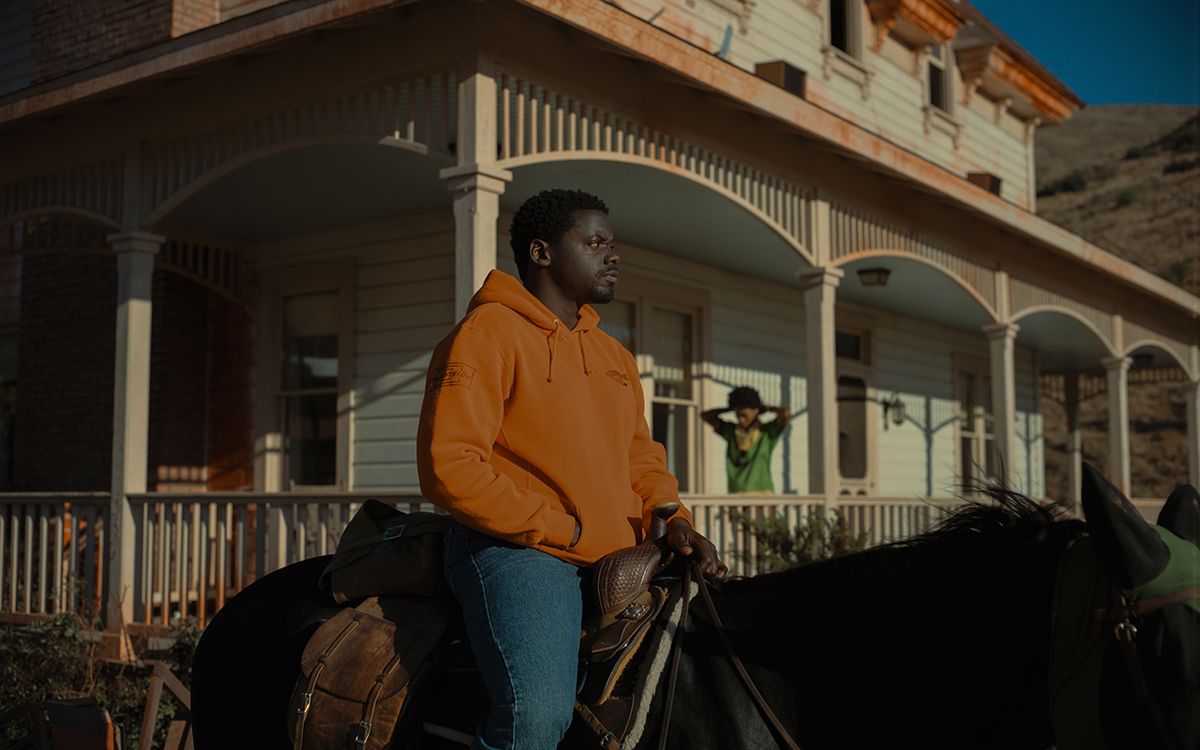
- Article Hero Image Caption: Daniel Kaluuya in <em>Nope</em> (image courtesy of Universal Studios)
At the heart of the film is OJ (Daniel Kaluuya) and Emerald Haywood (Keke Palmer), two estranged siblings who begin to reconnect after a recent family tragedy. While Emerald has been chasing a life of her own, OJ remains dedicated to the Haywood family business: training horses for film productions at their family ranch in the mountains of outback California. This isolated rural setting is the perfect backdrop for strange happenings that begin to haunt their home. The iconography one often associates with Area 51 and Roswell, New Mexico, is a staple of Nope. There’s a kind of comfort in the film’s ambience, one that dangles you between the safety of your viewing-space and the eerie happenings onscreen. The howling wind, the wide-open ranges shrouded in darkness, the chilling suspicion that something is out there among the stars, watching us, lingers throughout the film. Peele concocts familiar sounds, visuals, and ideas from pop-culture to form this specific mood. There’s even a clever sound-design that subtly incorporates the iconic high-pitched, Theremin tune often associated with alien encounter films from the 1950s.
From the slow, sinister uncovering of what is hiding in the desert ranges, the film smoothly transforms into a thrilling adventure. The camerawork is grandiose in scope, the music rousing, the performances all strong. Given Peele’s background in comedy (most notably his sketch series Key & Peele), he also gives his characters a certain amount of wit and levity. Sometimes it works, as in Kaluuya’s dry, down-to-earth performance as OJ. Other times it doesn’t, as with a certain minor character whose singular, distractingly cartoonish quirk is that he is obsessed with his camera at the expense of everything else.
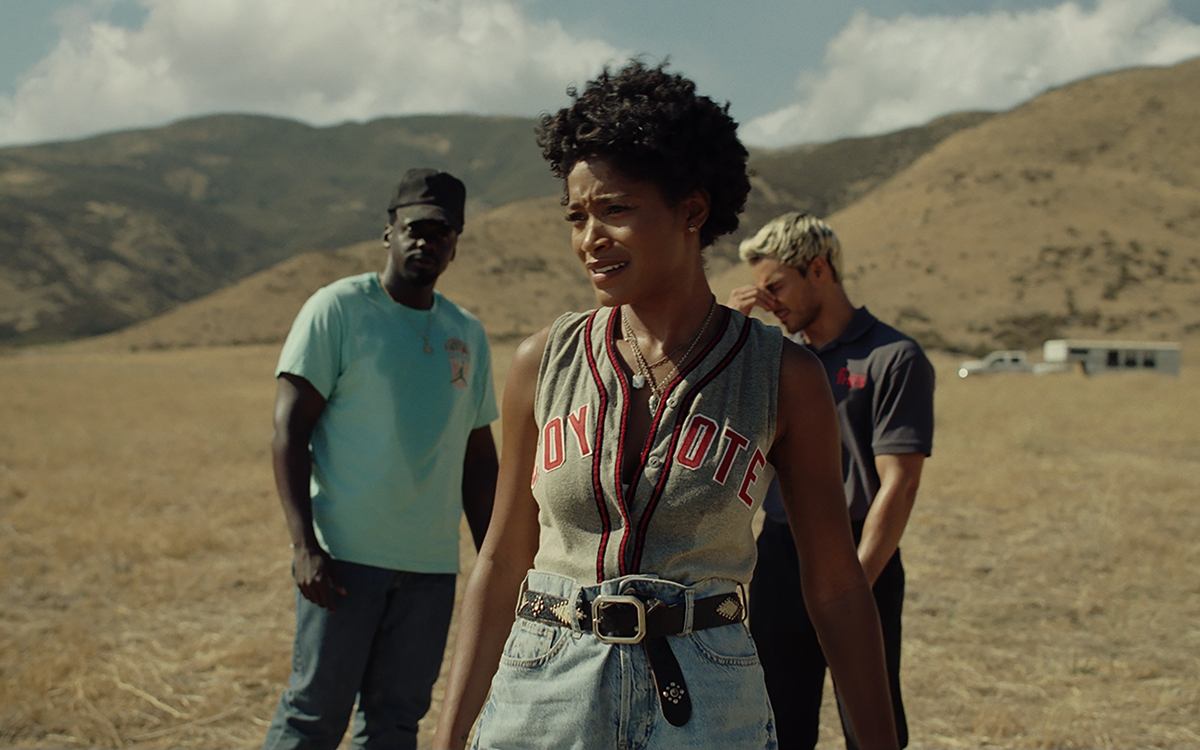 Daniel Kaluuya, Keke Palmer, and Brandon Perea in Nope (image courtesy of Universal Studios)
Familiar though the folkloric UFO motifs and Spielbergian influences are, Peele adapts them in surprising new ways. This is what separates Nope from Top Gun: Maverick and the seemingly endless factory-line of nostalgia-driven projects produced nowadays. Nope doesn’t rely on brand recognition or a collection of sequels, prequels, and reboots. It is an original story with a litany of fresh ideas, including thematic ones. As in Peele’s previous films, Nope is noteworthy for its allegorical depth. Peele leaves you with much to think about during and after the film. While this is a welcome feature of his work, he may be juggling a little too much on this occasion.
In various interviews, Peele has revealed that he wanted Nope to be a commentary on our dangerous inability to look away from spectacle, but also on the exploitation of animals and people in the entertainment industry, as well as the erasure of African Americans from Western cinema and history, while still being a Spielbergian science-fiction, horror, adventure, western film. This list is hardly exhaustive. The amount of tiny details, references, and clever symbolism is impressive. Peele’s ambition to say so much is admirable, and a lot of what he does say is frighteningly true. However, rather than weaving his themes together in a naturally cohesive manner, the film’s final act instead muddles them with conflicting results.
The antagonistic force haunting the ranch seemingly represents the vicious, indifferent machine that is the entertainment industry. Its unique design even mimics that of a camera. Other times, though, it assumes the position of a pitiful victim of said industry; akin to the horses which OJ is desperate to save throughout the story. This mixture of allegories ultimately undermines the film’s final conflict and the effectiveness of the characters’ motivation. The story proposes that such a force should be destroyed (in a celebratory fashion, no doubt), yet when the antagonist has also been portrayed as a victim that needs saving the impact becomes unintentionally confused. What should be taken as literal or allegorical seems inconsistent and unable to cope with the sheer number of thematic ideas Peele toys with.
Despite these tangled themes though, Nope succeeds most where it counts – as spectacle. Peele employs his vast budget to create a film so striking in its atmosphere and excitement that he more than proves the absolute, magnetic power that visual entertainment can hold over us. Sometimes that truth is an unsettling one, but for Nope itself, it’s merely the sign of a talented filmmaker.
Nope (Universal Pictures), 135 minutes, is in cinemas now.