


- Free Article: No
- Contents Category: Music
- Review Article: Yes
- Article Title: Bo Skovhus and Brahms’ German Requiem
- Article Subtitle: SSO serves up a Viennese feast
- Online Only: No
- Custom Highlight Text:
Over the years, the demise of the solo art song recital has often been predicted, yet the format lives on, sometimes reflecting new approaches and variations on tried and tested practices, but generally remaining within the parameters of a singer and pianist in evening wear on an empty stage. It evolved from informal house concerts in Europe in the late eighteenth century, probably reaching its ‘standard’ setting in the mid to late nineteenth century in the German-speaking lands in a form known as the Liederabend (song evening) ...
- Article Hero Image (920px wide):
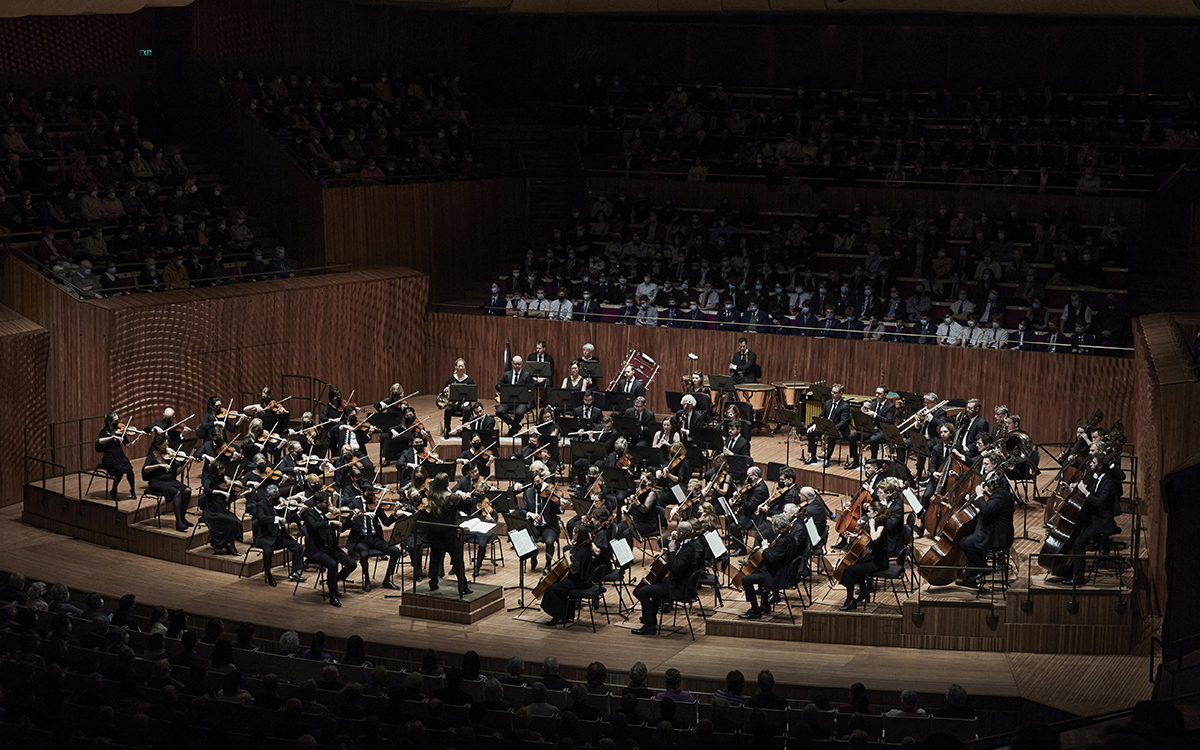
- Article Hero Image Caption: Simone Young and the Sydney Symphony on the Concert Hall stage (credit: Pierre Toussaint)
Of the art song specialists who emerged during the nineteenth century, German baritone Julius Stockhausen (1826–1906) is probably the most significant, credited with developing the concept of the Liederabend dedicated to the exclusive performance of art songs. He gave the first public performance of Schubert’s Die schöne Müllerin. Frequently accompanied at the piano by Brahms, they performed Schumann’s Dichterliebe and Frauen Liebe und Leben, together, and Brahms composed his song cycle Die schöne Magelone for him. Stockhausen also sang the baritone solo in the first performance of Brahms’s German Requiem in Bremen in 1868. He made his living primarily as a recitalist and concert singer, not opera. But it was famous singers of the late nineteenth and early twentieth centuries such as Jenny Lind (1820–87), Nellie Melba (1861–1931) and Enrico Caruso (1873–1921) who filled the concert halls, usually with a mixed bag of repertoire consisting of opera arias, a few art songs, and popular ballads. They were not particularly outstanding recitalists in the strict sense of the term, but audiences flocked to hear them. Certainly today, one cannot make a living as a singer specialising in song recitals, as was the case in the past.
There have been many attempts to enliven this format. A recent, brilliant example was British tenor Allan Clayton and pianist Kate Golla’s performance of Schubert’s Winterreise accompanied by Fred Williams’s paintings, which served as a visual background for Lindy Hume’s minimalist staging. Schubert’s great cycle has been a popular choice for a variety of presentations. Sydney Festival audiences will also remember the version sung by Matthias Goerne with visual effects by William Kentridge.
Happily, ‘traditional’ recital programs of groups of songs by different composers, sometimes linked thematically, still occur. This is due in some part to its ubiquity in the training of young singers in conservatoria throughout the world. Yet at its best, the song recital can convey much of the intensity and subjectivity of the dramatic monologue. While a loose narrative can sometimes be imposed on song collections, far more important is the inner subjective narrative of changing states of mind. The interest lies primarily in exploring isolated and often rapidly evolving emotional situations, making great demands on singer and pianist.
Simone Young, taking up her position as chief conductor of the Sydney Symphony Orchestra, was scheduled as the accompanist for the first song recital in the newly revamped Sydney Opera House Concert Hall. As she explained to the audience at the outset, she had to withdraw because of an injury sustained in Europe, one that did not hinder her conducting but that made playing Schubert too difficult.
Celebrated Danish baritone, Bo Skovhus’s choice of program in the Opera House Concert Hall at first glance seemed idiosyncratic. The six Haydn English settings chosen to open the concert, though not rarities, rarely feature in what might be described as ‘serious’ recitals. These are skilful and charming works, mostly settings by eighteenth-century Scottish poet Anne Hunter, but they do not probe the emotional depths of the later German Lied repertoire. However, like Mozart’s songs of roughly the same period, they look forward a decade or two to Beethoven and then, above all, to Schubert, where this repertoire comes fully into its own.
Skovhus sang the Haydn with elegance and agility, never tempted to overload them with a weight and significance they do not possess. The meat of the recital was eight late Schubert songs with texts by Ludwig Rellstab. Together with settings of Heinrich Heine and Johann Gabriel Seidl, they were given the collective title Schwanengesang (‘swan song’) by the publisher (not Schubert) in 1828. Skovhus has twice recorded these songs, and his understanding of the essence of this music was apparent. There was some beautiful legato singing, caressing the famous Ständchen, but allied to operatic power when needed in a song such as the thunderously dramatic Aufenthalt. One longed to hear the full cycle.
Skovhus’s voice is at the peak of its powers; a resonant and focused instrument, his singing reveals a performer with extensive experience in a wide variety of repertoire. He is a baritone in the celebrated Germanic tradition of Dietrich Fischer-Dieskau and Hermann Prey; not a voluptuous, ‘Italianate’ sound, but with the requisite power when needed, allied to excellent projection and clarity of diction.
Skovhus reminds one of the outstanding Swedish baritone Håkan Hagegård, a great favourite in Sydney in years gone by. He is as intelligent and expressive as his admired American contemporary Thomas Hampson – fine opera singers both, who engage with much new opera as well as the standard repertoire, but also outstanding and frequent recitalists. Jumping in at short notice, Andrea Lam demonstrated what a superb pianist she is, technically and interpretatively at ease with this repertoire. Occasionally, one would have liked a little more expressivity and visual engagement with the singer, but Lam has a great future as a vocal recital pianist.
Two bon bons to finish were songs by a highly successful Austrian operetta and film composer, Robert Stolz (1880–1975). These songs are suffused with a nostalgically romantic and rose-tinted view of belle époque Vienna. With a fine sense of drama, Simone Young walked out with Skovhus to play these final two songs, claiming that ‘One doesn’t have to play what’s on the page!’ Young showed her mastery and enjoyment of the operetta idiom, and these songs were a delightful conclusion to the recital. However, not quite … there were several encores, with the piano duties shared by Young and Lam who played the final song in Danish, Jeg elsker dig (‘I love you’), by Grieg. But the absolute final word was left to Young and Skovhus with Rudolf Sieczyński’s (1879–1952) emotionally laden Viennese homage, Wien, du Stadt meiner Träume (‘Vienna, city of my dreams’), which had a highly contented audience humming along.
Of much interest were the acoustics of the revamped Concert Hall. With some caveats, they are certainly an improvement, but they remain somewhat less than ideal for solo vocal recitals, not particularly flattering the voice in comparison with some of the larger European concert halls, not to mention an even far larger venue such as Carnegie Hall in New York. Diction remains a problem; even Skovhus’s outstanding clarity and projection of text were not enhanced by the acoustic, which may require some fine tuning for future similar performances.
The Viennese focus of the recital linked it well with Brahms’s Ein deutsches Requiem, which is indelibly woven into the fabric of that city. Brahms ‘tried out’ the first three movements of the work in 1867, but it was something of a disaster due to infelicitous performance conditions, spurring a critic to term it ‘a requiem for the decorum of Viennese concert rooms’. This was perhaps a reflection of Catholic Vienna’s resistance to the Protestantism suffusing the work, not least in its echoes of the great choral works of J.S. Bach.
It was the death of his mother that spurred Brahms to start working seriously on the Requiem in 1865. Brahms ignored the traditional Latin Mass and selected passages from the Bible: the work addresses the living rather than the dead. Luther’s Bible, which, like the King James Version and the English language, is woven into the German vernacular, provided the texts. In the end, it was this work that finally put Brahms on the map, alerting the Viennese public to his growing stature.
The Saturday afternoon performance fulfilled the highest expectations. Young marshalled the large forces with authority and a deep understanding of Brahms’s idiom. Creating a rich, warm sound, the Philharmonia Choir produced a wide range of dynamics in this demanding music, with the sopranos particularly impressive in their ethereal upper register. In this work, one became aware of the improved acoustics of the hall as the orchestral clarity and instrumental definition was impressive, the music having more immediate ‘presence’ than before.
Skovhus was joined by Emma Matthews as soprano soloist who delivered a beautiful rendition of her brief solo, Ihr habt nun Traurigkeit (‘You are sorrowful now’), the voice warm and radiant with a gleaming upper register. Skovhus drew on his operatic experience for the powerful baritone exhortations, as well as some finely judged and projected soft singing.
Both concerts were well attended, reflecting the double benefit of Simone Young taking up her appointment to lead the SSO and the Concert Hall’s reopening after the lengthy refurbishment. Both events portend exciting times for Sydney audiences.
Bo Skovhus performed his recital with Andrea Lam on 5 August 2022 at the Sydney Opera House’s Concert Hall. The Sydney Symphony Orchestra performed Brahms’s Ein deutsches Requiem at the same location from 5 to 7 August. Performance attended: 6 August.