


- Free Article: No
- Contents Category: Theatre
- Review Article: Yes
- Article Title: Come Rain or Come Shine
- Article Subtitle: Kazuo Ishiguro on stage
- Online Only: No
- Custom Highlight Text:
English Nobel Laureate Kazuo Ishiguro has had several works translated into film – notably The Remains of the Day (1993) and Never Let Me Go (2010) – but Melbourne Theatre Company’s Come Rain or Come Shine is the first stage musical based on his work. One of five short stories on the theme of music and nightfall that make up the collection Nocturnes (2009), it’s an odd little tale of friendship and failure that careens from the gently elegiac to the outright farcical, like F. Scott Fitzgerald via Michael Frayn.
- Article Hero Image (920px wide):
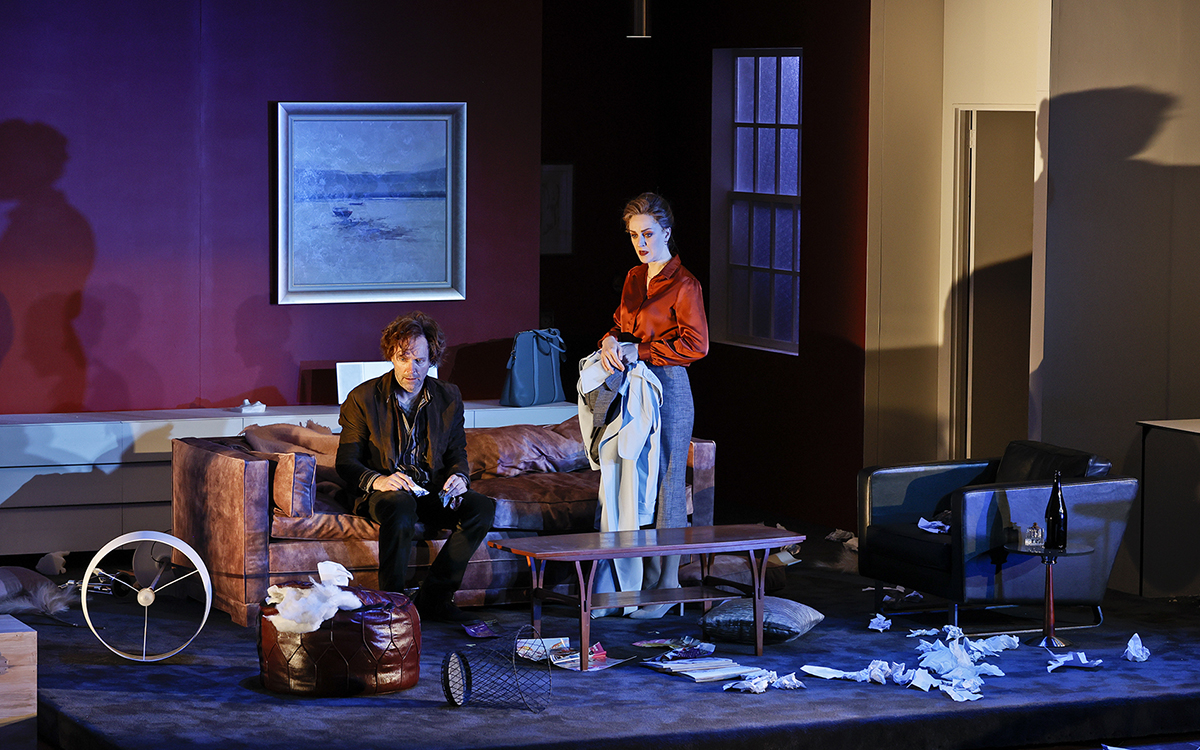
- Article Hero Image Caption: Angus Grant as Ray and Gillian Cosgriff as Emily in <em>Come Rain or Come Shine</em> (photo by Jeff Busby)
Ray (Angus Grant) and Emily (Gillian Cosgriff) bond at university over their shared love of the Great American Songbook, losing themselves in amiable arguments about the merits of Ray Charles over Sarah Vaughan. Their mutual friend Charlie (Chris Ryan) is a crass but charming ignoramus when it comes to music, so it surprises Ray when Emily falls for him and they marry. Years later, Ray comes to stay at the couple’s slick inner-city London pad and quickly realises they are in marital strife; feelings of inadequacy haunt Charlie, and Emily has become something of a caustic corporate shark. Both of them denigrate Ray’s life choices, his lack of ambition, and slovenly appearance. They are less dear old friends and more toxic churls, but Ray accepts their criticism good-naturedly.
When Charlie announces that he is leaving for Frankfurt, he asks a favour of Ray: simply hang out with Emily and be your usual pathetic self. Emily will ‘get some perspective’, realise Charlie is actually doing quite well in life, and the marriage will return to normal. But when Ray discovers an entry in Emily’s diary calling him the ‘Prince of Whiners’, he reacts with anger, screwing up the pages. Worried this will alert Emily to his prying, he enlists Charlie’s help – via increasingly desperate phone calls at airports – to cover up the indiscretion. This in turn leads to a series of ludicrous plots involving a neighborhood dog, a red leather ottoman, and a boiled boot.
Book writer Carolyn Burns approaches the material with a commendable but ultimately counter-productive fidelity; the elements that rankle in the original are just as irritating in the adaptation. Ishiguro’s pacing tends to plod languorously or it lurches desperately into action, and Burns exacerbates this convulsion by including a long prologue set in the past. While this section contains some touching moments, it stalls the narrative and probably would have worked better in flashback. Once the story shifts into the present, Burns has to rely heavily on exposition to establish the new paradigm, so much so that the central farce doesn’t really make an impact until we are past the midway point.
There is something haphazard and arbitrary about that farce – the most artificial of genres, farce requires a precise dramatic structure if it is to achieve the effect of a logically escalating chaos – which makes the comedy feel contrived and unconvincing. Characters don’t have to necessarily adhere to psychological verisimilitude in farce, but their motivations shouldn’t be baffling; here, they behave in increasingly incomprehensible ways, and the result is merely tiresome. Every now and again, delight peeks through the fog like starlight, but for the most part the going is tough.
Tim Finn collaborated with Burns and director Simon Phillips on Ladies in Black (2016). While his compositions for that show were sometimes a little thin, they nevertheless felt assured and well integrated. Here, in a story that revolves so comprehensively around the finest jazz standards of the twentieth century, Finn’s music feels unresolved and substandard. His melodies are hesitant, and his rhymes consistently imperfect, and when he does reach for imitation, it feels more like pastiche than homage. His finest songs – Ray’s best man speech, for example, is a beautifully judged, halting expression of unrequited love – have no precedence in Ishiguro’s story, which makes you wonder what he could do with an entirely original idea.
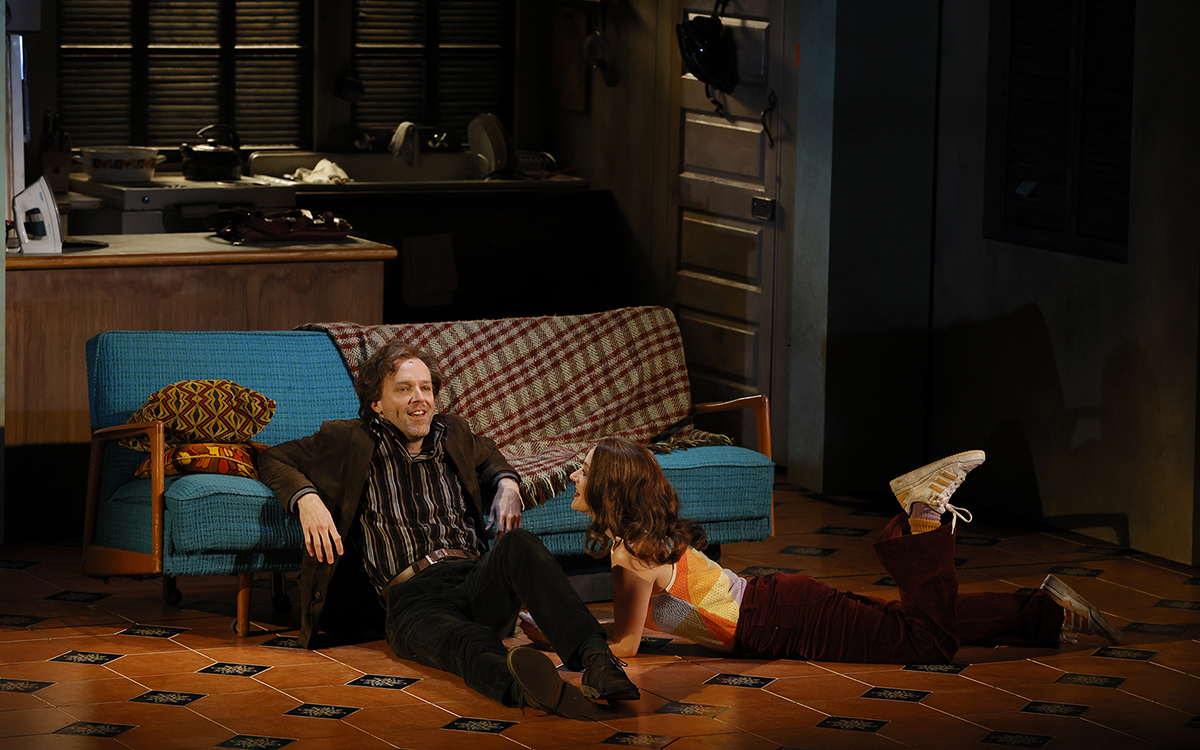 Angus Grant as Ray and Gillian Cosgriff as Emily in Come Rain or Come Shine (photo by Jeff Busby)
The cast are valiant in defeat. Cosgriff tries to fill in the gaping holes in her character’s design, bringing a winning enthusiasm to her younger self and a weary kind of equilibrium to her final scenes, but she can’t make any sense of the inexplicable nastiness of the middle sections when Emily berates Ray mercilessly. Ryan is effective enough as a particular type of caddish narcissist, but his glorious tenor is under-utilised and his natural charm only goes so far. And Grant is lovely in the role with the most nuance, shaggy and sincere, hopelessly in love but loyal to an ideal of friendship that precludes acrimony. It’s just a shame the script has him doing the stupidest things for the most inconceivable of reasons.
Phillips directs with a breezy lightness of touch, but Dale Ferguson’s rigidly modular set and Sophie Woodward’s slightly satirical costumes simply underline the central implausibility of the material. Props and sets slide in and out with monotonous regularity, which emphasises the contrivance and inflexibility of the narrative design. The small band, under the musical direction of Jack Earle, is terrific, supple and evocative; their presence is glimpsed rather romantically through the slats of an apartment upstairs. Come Rain or Come Shine isn’t completely without charm, and the central theme of expectation and exasperation in love and friendship comes through in glimpses, but it never seems to know what kind of beast it wants to be. There is a kind of fealty to the source in that, for better or worse. Happy together, unhappy together.
Come Rain or Come Shine (MTC) is being performed at the Sumner Theatre in Melbourne from 20 June to 23 July 2022. Performance attended: 24 June.
This review is generously supported by the Copyright Agency’s Cultural Fund.
CORRECTION: In an earlier version of this review, Isaac Hayward was incorrectly identified as the musical director. It is, in fact, Jack Earle.