


- Free Article: No
- Contents Category: Film
- Review Article: Yes
- Article Title: Maixabel
- Article Subtitle: The human faces of ETA’s violent legacy
- Online Only: No
- Custom Highlight Text:
You are camping with friends, drinking beer and swimming, celebrating your nineteenth birthday. A car pulls up in the forest. Your aunt emerges, and as she walks towards you she calls out, palms pressed as if in prayer. In Spanish filmmaker Icíar Bollaín’s gripping Maixabel (2021), it is enough for a relative to say your name to know that the worst has happened: your world has ended, your father has finally been slaughtered.
- Article Hero Image (920px wide):
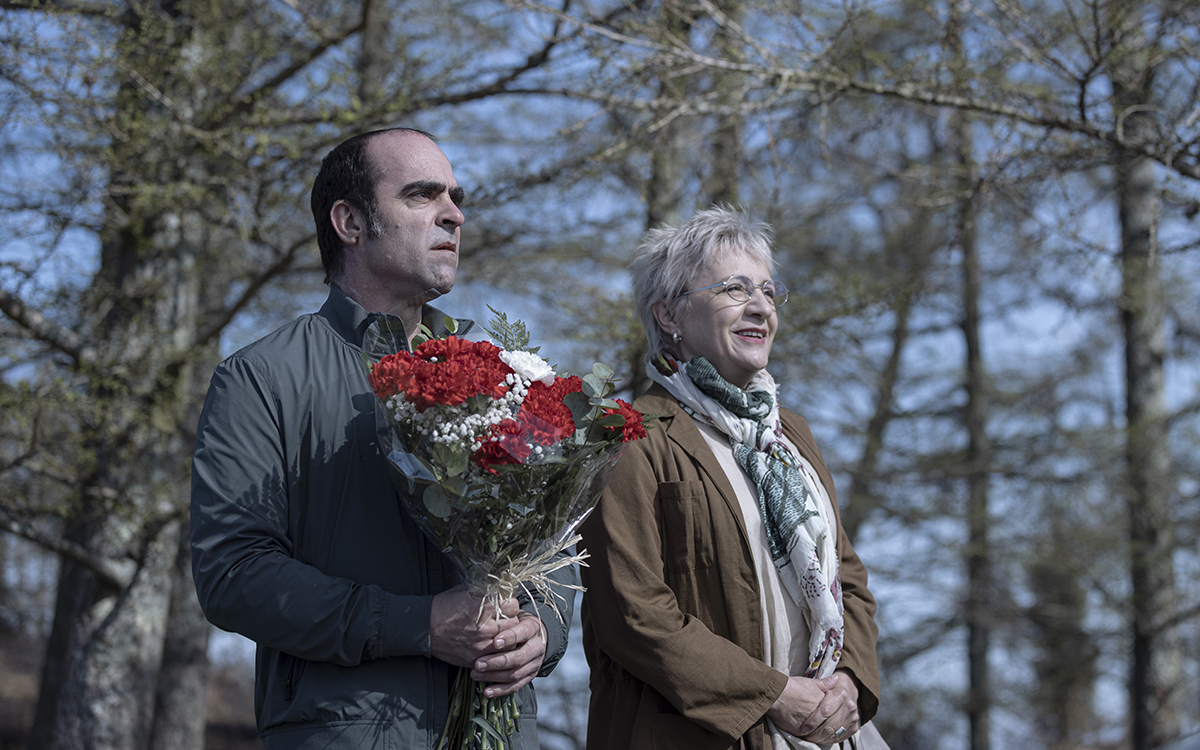
- Article Hero Image Caption: Luis Tosar as Ibon Etxezarreta and Blanca Portillo as Maixabel Lasa in <em>Maixabel</em> (image courtesy of Palace Films)
- Alt Tag (Article Hero Image): Luis Tosar as Ibon Etxezarreta and Blanca Portillo as Maixabel Lasa in <em>Maixabel</em> (image courtesy of Palace Films)
Maixabel – a highlight of the Spanish Film Festival – opens with the brisk and brutal daylight killing of Juan María Jáuregui, a real-life retired politician who in July 2000 was murdered by ETA separatists. Although ETA originally formed in resistance to Spanish dictator Francisco Franco’s repression of Basque culture and language, the group continued to murder and maim well after the dictatorship’s end in 1975. By 2011, when ETA finally called a ceasefire, more than 850 had been killed in the name of an independent Basque country. Officially, ETA’s kidnappings, shootings, and car bombs targeted the Spanish state. In reality, many of ETA’s victims were the Basque people it allegedly defended: local businessmen who refused extortion; politicians like Jáuregui who condemned terrorism of all kinds.
In Spain, the 2011 ceasefire has unleashed immense interest in exploring ETA’s violence and legacy. Amid a glut of books, television, and film, however, Bollaín’s contribution is a standout. Few offer as nuanced and compelling an insight into the crater this violence left in ordinary lives, without resorting to stereotypes or trauma-porn. In Maixabel, Bollaín makes a clear decision not to indulge in the spectacle of violence that feeds terror. Initial scenes are powerful but economical; the way the film moves through the murder, funeral, and judge’s verdict leaves the viewer with a faint sense of shock that hints at the victims’ own upheaval. What Maixabel does linger on is the aftermath of violence and in particular the questions of closure and justice that agonise those ETA leaves behind, such as Jáuregui’s widow, Maixabel Lasa, played with warm intensity and intelligence by Spanish screen veteran Blanca Portillo.
Years after the murder, Maixabel agrees to take part in an innovative but controversial program called the Vía Nanclares, which pairs ETA prisoners with the group’s victims. Her daughter María (María Cerezuela) cannot bear to participate. Cerezuela’s performance captures how live the trauma still is for María – and so many victims – as she yoyos between grounded pragmatism and a hysterical but not unfounded fear for her mother’s safety.
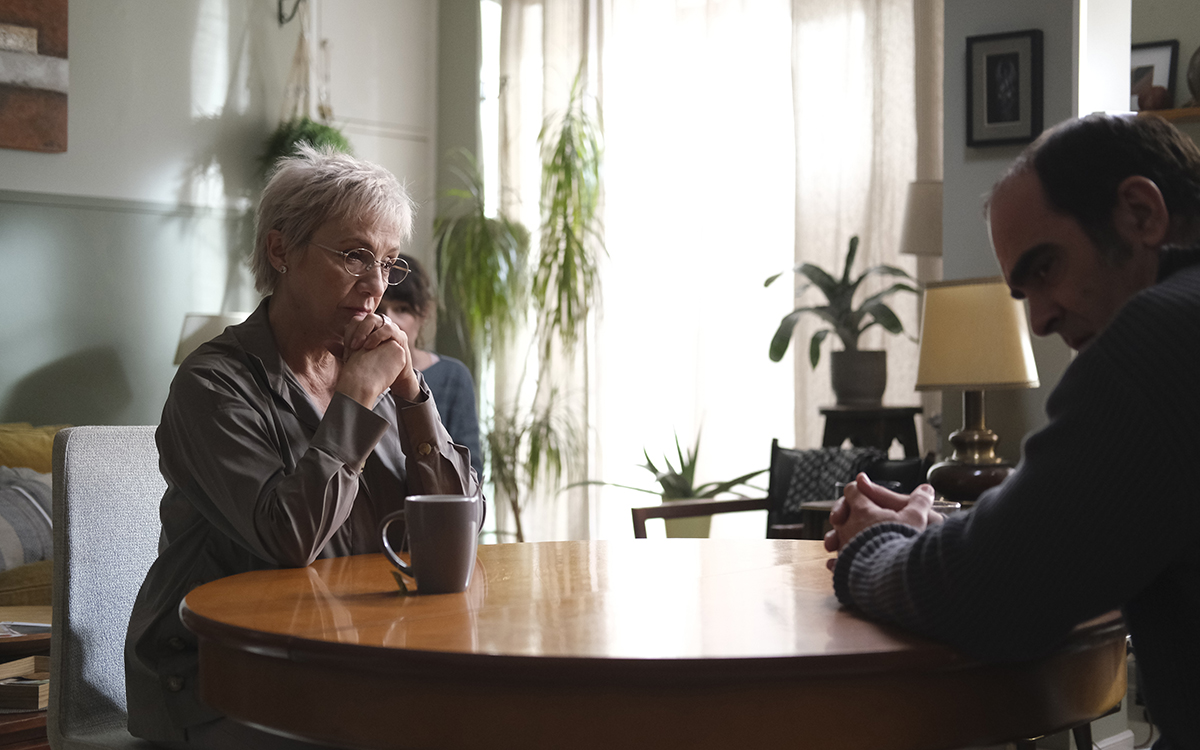 Luis Tosar as Ibon Etxezarreta and Blanca Portillo as Maixabel Lasa in Maixabel (image courtesy of Palace Films)
Nanclares is about more than asking forgiveness. In a peeling concrete prison room, the program’s mediator Esther (Tamara Canosa) reminds reformed etarras (members of ETA) that they are uniquely positioned to provide answers to distraught victims’ questions. When two of Jáuregui’s killers volunteer – Luis Carrasco (Urko Olazabal) and Ibon Etxezarreta (Luis Tosar) – she insists that they must be willing to answer any and every question – you cannot ask a victim into the room and then refuse to talk. Silence has disfigured Basque culture for decades, and fear of speaking out has stunted public discourse. Unlike judicial or journalistic investigations, however, Nanclares offers a private path to healing that relies on individuals committing to dialogue.
This gets to the tangled knot of individual and collective responsibility at the film’s moral heart. The kinds of nationalism, tribalism, and ideology that tore Spanish society apart during the brutal civil war and dictatorship required the individual to submit – body, mind, and spirit – to the collective. Many etarras, though repentant, are initially outraged by Esther’s suggestion that they should personally ask forgiveness for a crime authored by a faceless collective. Tosar manages to explore Ibon’s moral reckoning as he first resists and then yields to this process of healing, without equating his suffering and Maixabel’s. This is a fine line to walk in Spain, as excavating historical atrocities from the civil war, dictatorship, and ETA attacks is still fraught with the pain of survivors and divergent political interests.
Tosar’s rough, gruff portrayal strips back the myth and glamour that ETA relies on to recruit martyrs for the cause, showing instead how ETA chews up and spits out its foot soldiers. His surprise as he learns more about his victim’s own left-wing and anti-fascist activism exposes the ignorance necessary to ETA’s myth. By eliminating nuance and cutting off individuals from their culture and community, ETA creates etarras dumb and numb enough to kill their neighbours.
At several points in the film, characters say ‘it’s over’ or conversely ‘it will never be over’. By opening with Jáuregui’s killing, the film emphasises that it is both a violent climax – the culmination of his loved ones’ worst fears – and only the beginning, a new wound in an apparently endless cycle. The desperate question courses through the film: how can this possibly end?
The crime that haunts Maixabel and Ibon also unites them in a story that, as Maixabel remarks, ‘only ends when one of them dies’. In the loneliness of their daily lives – the ex-etarra in prison and the widow, surrounded by community but robbed of her life partner – their point of connection proves utterly compelling. Bollaín’s unrelenting close-ups on their encounter illuminate the human pain, awkwardness, and fear as Maixabel and Ibon embark on the impossible: attempting to articulate the senselessness of slaughter. They talk. There are no grand gestures. In a process that remains almost unbearable for both sides, we glimpse a peace that is possible but never inevitable.
Maixabel (115 minutes) is screening at the Spanish Film Festival (Palace).