


- Free Article: No
- Contents Category: Film
- Review Article: Yes
- Article Title: The Northman
- Article Subtitle: Vikings and vengeance
- Online Only: No
- Custom Highlight Text:
If you were to pluck a tenth-century Norse Viking from their firelit longhouse and drop them into the twenty-first century so that they could create a film accurate about their life and culture, you would probably end up with something not far off from Robert Eggers’ The Northman, and not just because of the film’s graphic violence, fanatical religious ceremonies, and historically faithful aesthetics. The Northman also successfully depicts the way in which Northerners may well have perceived and spiritually understood the world around them.
- Article Hero Image (920px wide):
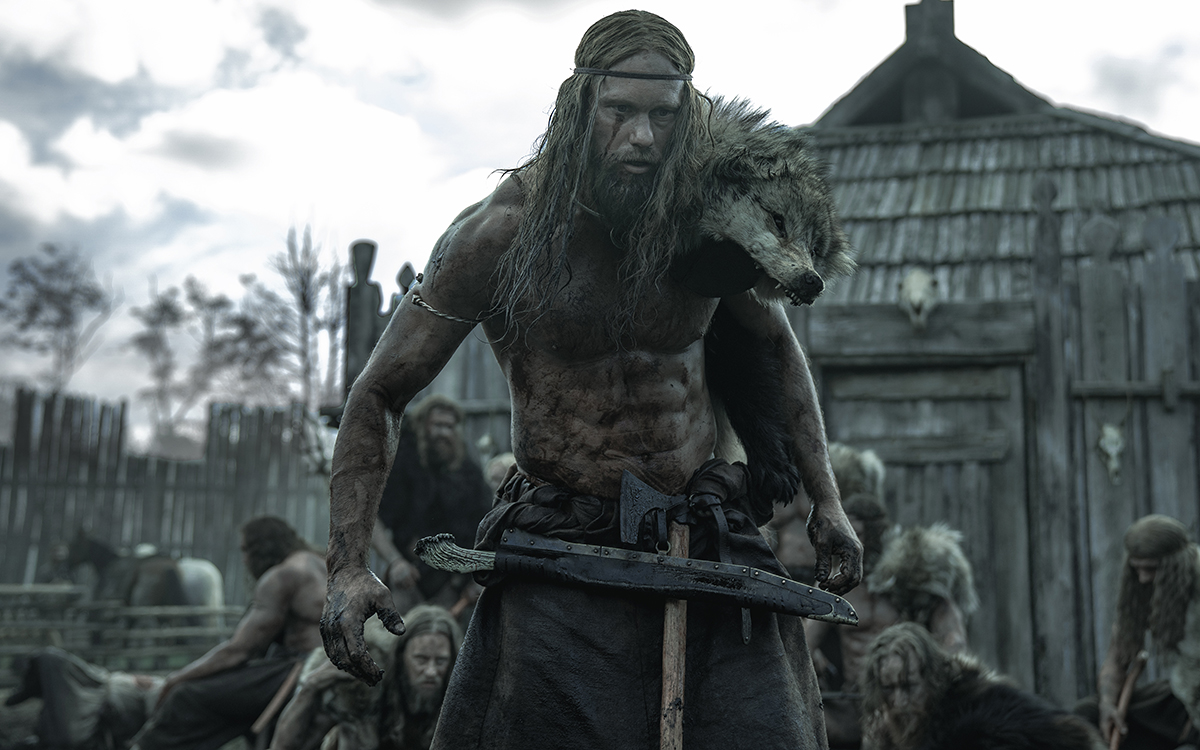
- Article Hero Image Caption: Alexander Skarsgård stars as Amleth in <em>The Northman</em> (photo credit: Aidan Monaghan / © 2022 Focus Features, LLC)
- Alt Tag (Article Hero Image): Alexander Skarsgård stars as Amleth in <em>The Northman</em> (photo credit: Aidan Monaghan / © 2022 Focus Features, LLC)
While the thirty-eight-year-old American director can never make such a portrait completely true to life, since his début horror feature, The Witch (2015), Eggers has shown that there is no such thing as too much research. Whether it be writing all of his dialogue in Early Modern English for The Witch, using a tight 1.19:1 aspect ratio for his ghostly period piece The Lighthouse (2019), or co-writing The Northman with acclaimed Icelandic author Sjón, Eggers is never short on historical accuracy.
The same attention to detail also applies to the incorporation of Norse mythology. Just as The Witch was a candid seventeenth-century New England folktale brought to screen, The Northman is an epic saga of old presented with a hefty degree of sincerity. Here, the gods, monsters, and curses spoken of by their delphic seers are real. Whether it is a supernatural influence over animals, humans, or the stormy skies above, the mystic workings of the gods weave their way into the story and allow us to understand, connect with, and believe in the film’s protagonist, Amleth (Alexander Skarsgård).
Here, ‘Amleth’ may ring a bell. The Scandinavian name (and story) is an anagram and narrative inspiration for none other than Shakespeare’s Hamlet. Hundreds of years before the lauded play, Amleth was one of the subjects of Danish historian Saxo Grammaticus’s famous Gesta Danorum books. These Latin historical retellings of Danish and Scandinavian history up to the twelfth century are the oldest surviving records of the timeless story of a son avenging his father. Such a tale has seen numerous interpretations and deviations over the years, and The Northman is the latest, following Amleth as he coldly fights to ‘avenge his father, save his mother, and kill his uncle, Fjölnir’.
Despite our familiarity with the story, Eggers injects enough life, passion, and spectacle into the film to succeed in creating a worthwhile addition. Characteristic moments like Amleth’s father, Aurvandil (Ethan Hawke), being struck down by his brother Fjölnir (Claes Bang) and Amleth’s fierce acts of vengeance years down the track are intensified by Eggers’ impressive camerawork, which confidently presents its action in elongated single takes as the camera glides over walls, passes burning buildings, and buries itself amid chaotic battles. In addition, there are memorable, almost psychedelic images of godly visions entering the minds of our characters or of Valkyries riding down from the sky to carry the fallen back to Valhalla.
Between these transcendental displays and the vast, hilly landscapes of Iceland, Eggers spiritually and visually places us into tenth-century northern Europe. Then there is Robin Carolan and Sebastian Gainsborough’s musical score, which is heavy and suitably chant-like in its rhythm. The dialogue is brisk and poetically sharp, despite the occasional line that is perhaps overly expository.
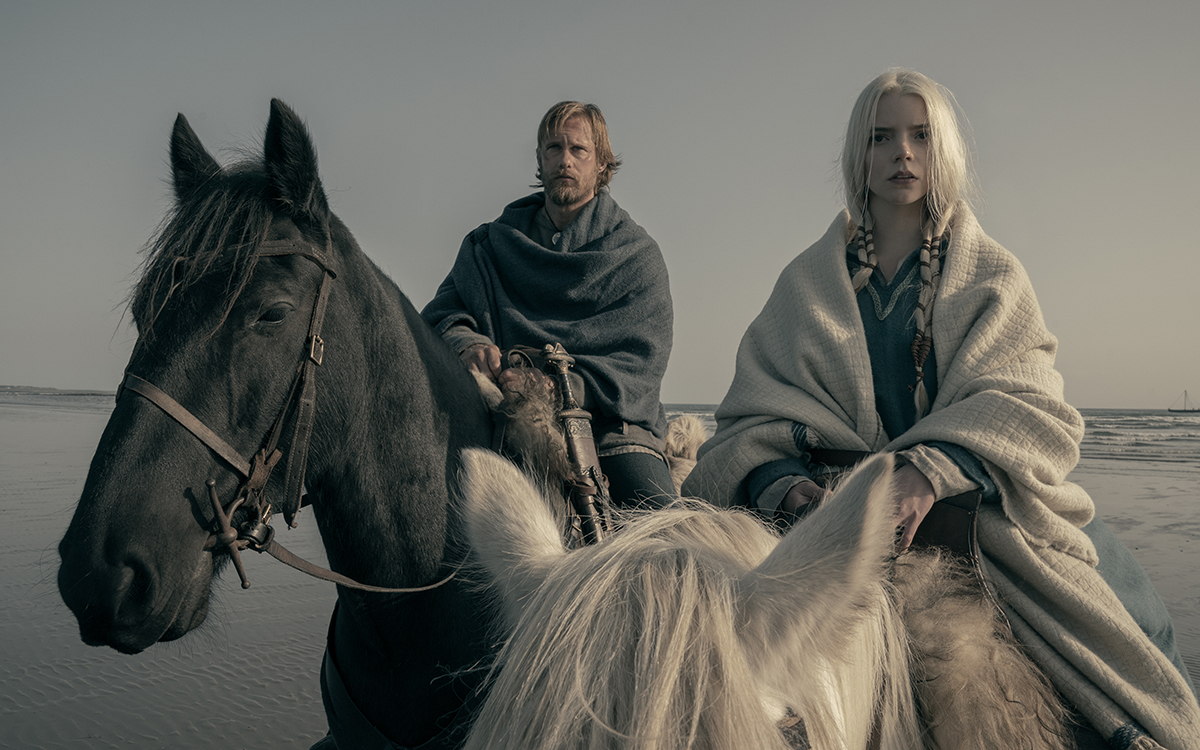 Alexander Skarsgård stars as Amleth and Anya Taylor-Joy as Olga in The Northman (photo credit: Aidan Monaghan / © 2021 Focus Features, LLC)
Yet, the experience wouldn’t be nearly as impactful without the performances from the all-star cast. Skarsgård commits entirely to conveying the Vikings’ primal savagery in battle, as well as to capturing the warrior’s exhaustion afterwards. Here, an honest depiction of the fear and fatigue that come during and after life-threatening scenarios is rare and refreshing. Through Skarsgård’s intense performance we experience the many nuances of Amleth’s emotions. Equally noteworthy are the performances from Nicole Kidman (Queen Gudrún, Amleth’s mother) and Anya Taylor-Joy (Olga, his sorceress companion). These two characters are given far greater urgency, motivation, and noteworthiness than was the case in Grammaticus’s original writings. Even in Eggers’ early short-film adaptations of the tales of Hansel and Gretel and Cain and Abel, the director transmuted the original story in surprising ways. The Northman is no different, particularly in regard to the story’s central thread of fate.
For a Viking, fate as predetermined by the three Norns was inevitable, just as it is for Amleth to enact revenge against Fjölnir. While the original story’s morality is more black and white concerning Amleth’s vengeful motivation, Eggers’ adaption subtly complicates it. Growing intricacies with Gudrún and a blossoming relationship with Olga influence Amleth’s motivation and development, pulling him between fateful revenge and escaping the bloody affair. Thus, the story plays on our innate desire to control our own fate. We are left clinging to the bittersweet hope that Amleth will free himself from this vengeful burden. Eggers successfully makes this yearning seem all the more equivocal when the world is so strictly adherent to Norse history and mythology. We are left to ponder who is truly in control of their fate, and if it even matters, right up to the final moments of the film. From this arises The Northman’s greatest idea: even if all that is prophesied comes true and the gods are genuinely in control, does that really matter if Amleth, in his own heart, truly believes in what he is doing?
The Northman (Universal Pictures), 137 minutes, is in cinemas now.